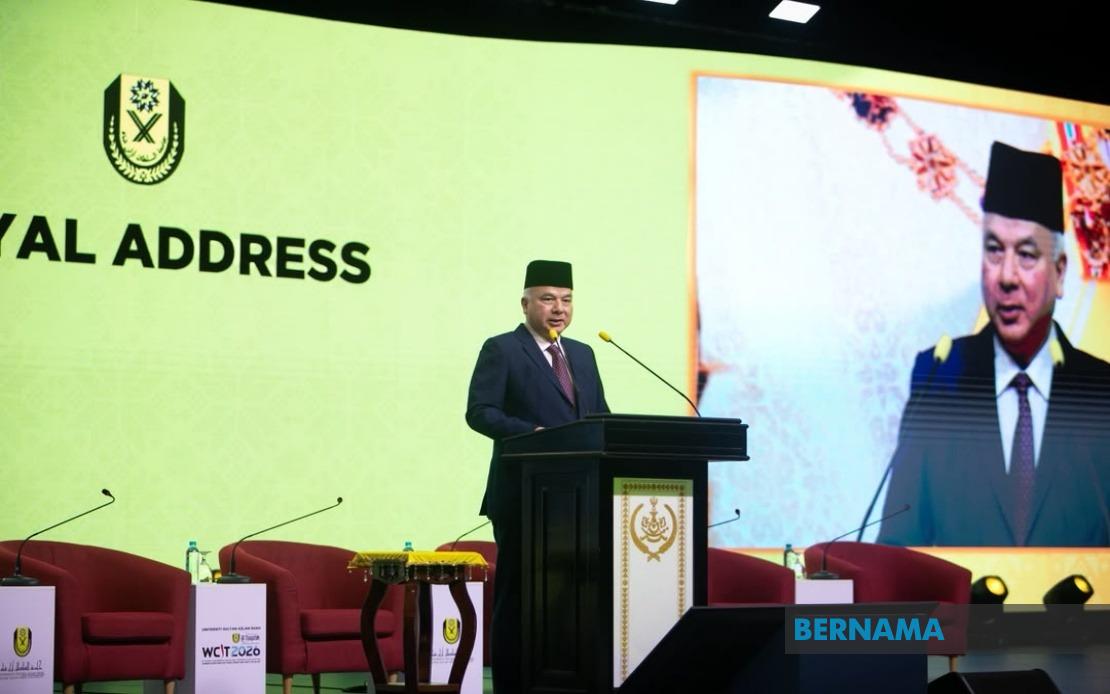
The Sultan of Perak, Sultan Nazrin Shah, has articulated a vision of national security that prioritises the bonds holding society together over conventional defence mechanisms. Delivering the keynote address at the 8th World Conference on Islamic Thought and Civilisation in Ipoh on July 21, he argued that while traditional security concerns—border protection, cybersecurity, and countering extremism—remain necessary, they pale in comparison to the enduring strength provided by a socially cohesive nation.
His framing represents a marked departure from security paradigms that emphasise hardware and hardware-adjacent responses to threats. Sultan Nazrin positioned social cohesion as something more fundamental: a foundation upon which all other security measures depend. Without it, he suggested, even the most robust security apparatus functions as mere window dressing, providing a false sense of safety while underlying fractures widen.
For Malaysia specifically, the Sultan identified a particular vulnerability: the weaponisation of religious identity for political advantage. He cautioned against allowing faith to become a vehicle for division, pointing to a troubling global pattern in which religious sentiment is manipulated to serve narrow factional interests. This concern carries particular weight in the Malaysian context, where communal identity intersects with electoral politics and where historical episodes of inter-communal tension remain within living memory.
The Sultan's emphasis on inclusion reflected directly in his definition of what true national belonging requires. Citizens must perceive themselves as having a genuine, substantive stake in their country's trajectory. This sense of ownership cannot be manufactured through proclamation or enforced through administrative decree. Rather, it emerges when people recognise themselves in the nation's institutions—its legal frameworks, economic structures, educational systems, and leadership composition. The absence of such recognition creates a deficit that no security establishment can remedy.
He drew a crucial distinction between two types of unity: that imposed through coercion, which remains inherently fragile and vulnerable to rupture, and that built upon shared belonging, which possesses genuine resilience. This distinction carries implications for how Malaysia approaches its multicommunal reality. A nation that privileges control over authentic inclusion may achieve short-term stability but creates structural vulnerabilities that accumulate over time.
The Sultan's broader argument linked national integrity directly to security, arguing they cannot be separated. A state may repel external adversaries while simultaneously hollowing itself from within through corruption and systemic injustice. Such a nation has not truly secured itself; it has merely deferred an inevitable reckoning. This formulation suggests that internal cohesion serves as a prerequisite rather than a secondary consideration in national defence strategy.
Addressing the human development dimension, Sultan Nazrin advocated for educational investment that transcends conventional boundaries. He called for simultaneous strengthening of sciences and mathematics alongside humanities and arts, and for elevating technical and vocational education to parity with academic pathways. This integrated approach reflects recognition that contemporary challenges—automation, climate disruption, economic transformation—demand workforce versatility and cognitive flexibility beyond what narrow specialisation can provide.
He identified a critical mismatch between educational models shaped by industrial-era requirements and the competencies demanded by an artificial intelligence-saturated future. Rote memorisation and standardised testing, which functioned adequately when economic value lay partly in information retention and recall, have become increasingly anachronistic. In an environment where information access is instantaneous and nearly costless, the human competitive advantage lies elsewhere: in critical analysis, ethical reasoning, creative problem-solving, and adaptive capacity—precisely the domains where artificial intelligence encounters fundamental limitations.
The Sultan argued that properly conceived Islamic education, grounded in both revealed knowledge and rational inquiry, has always cultivated such capacities. This positioning reconnects educational philosophy with intellectual tradition, suggesting that contemporary reform need not represent a departure from established principles but rather a return to original intentions. The argument carries significance for Southeast Asian nations seeking to modernise educational systems while maintaining cultural and religious authenticity.
His remarks, delivered before Deputy Prime Minister Datuk Seri Fadillah Yusof, Perak Menteri Besar Datuk Seri Saarani Mohamad, and Higher Education Minister Datuk Seri Dr Zambry Abd Kadir, articulated principles relevant to Malaysia's ongoing policy debates. The emphasis on human capital investment challenges policymakers to measure educational success not merely through examination scores but through the cultivation of qualities that enable citizens to navigate unprecedented complexity.
The Sultan's framing offers a counterweight to security discourse that emphasises surveillance, control, and military capacity. By locating the foundation of genuine security in inclusive governance, equitable opportunity, and authentic belonging, he has articulated a vision that aligns with social cohesion as both means and end. For Malaysia navigating demographic diversity, political contestation, and technological transformation, the argument suggests that security ultimately derives from citizens who feel genuinely invested in their nation's institutions and trajectory—a form of security that no amount of apparatus alone can provide.

