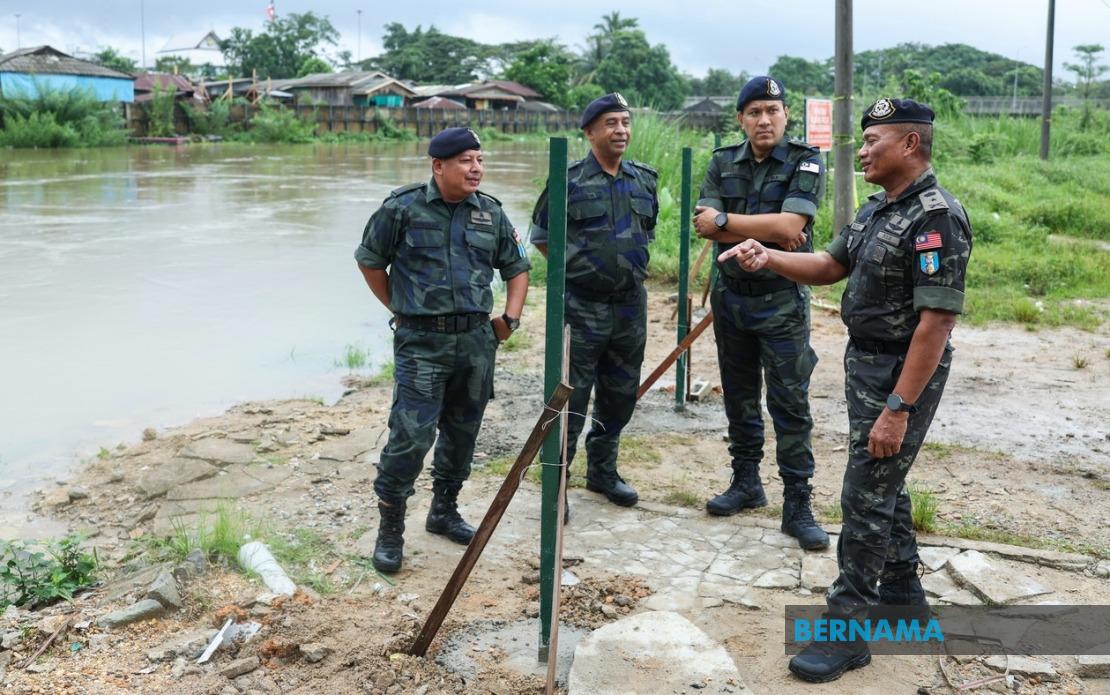
The General Operations Force has exposed an evolving smuggling operation that demonstrates how criminal networks are adapting their methods to circumvent strengthened border security measures across Malaysia. During Operasi Taring Wawasan Kelantan, authorities arrested 13 Myanmar nationals in the Pasir Mas district of Kelantan after discovering that smuggling syndicates have fundamentally altered how they transport undocumented migrants into the country. Rather than concentrating people into larger transport vehicles, which present obvious security risks and draw official attention, the networks now deploy dispersed movements across multiple trips and staggered drop-off points throughout forested areas.
The operation commenced in the early hours of June 28 when GOF's 8th Battalion, acting on intelligence information, detected suspicious activity near Kampung Banggol Kemian in Pasir Mas. A Proton Exora vehicle aroused their suspicions, and as security personnel moved to intercept it, the driver abandoned the vehicle and fled into nearby woodland, successfully evading capture. Authorities conducting a systematic search of the Proton Exora recovered four Myanmar men who had no documentation authorising their presence in Malaysia. The vehicle seizure marked only the beginning of the operation, as continued searches through the surrounding forest over the subsequent hour led to the discovery and apprehension of a further nine Myanmar nationals spread throughout the area.
What emerges from the arrested individuals' accounts is a deliberate strategic shift in smuggling methodology. According to Southeast Brigade GOF commander SAC Ahmad Radzi Hussain, the migrants had been transported from Thailand across the Golok River by two unknown facilitators who deliberately dropped them off at different locations within the forest. This deliberate dispersal strategy directly addresses law enforcement's ability to conduct mass arrests and deters security patrols from discovering large concentrations of undocumented foreigners in single locations. By fragmenting the transport operation into multiple smaller movements, smuggling networks substantially reduce the detection probability, as security checkpoints and border patrols are designed partly around identifying vehicles carrying suspiciously large numbers of passengers lacking proper documentation.
The arrested individuals, ranging in age from twenty to thirty-seven years, openly disclosed their intended destination as the Kuala Lumpur metropolitan area, where they anticipated obtaining employment opportunities. This revelation underscores a broader regional challenge: the persistent demand for undocumented foreign labour within Malaysia's industrial, construction, and domestic service sectors continues to sustain sophisticated smuggling operations. The economic incentive structures that drive both labour market demand and migrant supply ensure continued pressure on border security systems, particularly across the Golok River, which remains a critical vulnerability point for irregular population movement from Thailand into Kelantan.
The law enforcement response in this instance benefited from coordination between multiple agencies, particularly the GOF's 8th Battalion working collaboratively with the Criminal Investigation Division of the Pasir Mas district police headquarters. This inter-agency cooperation proved essential for comprehensive apprehension of scattered individuals and subsequent investigation and prosecution pathways. All thirteen arrested individuals were transferred to police custody for processing under Section 6(1)(c) of the Immigration Act 1959/63, which addresses illegal entry and harboring of undocumented foreigners. Beyond the human trafficking dimension, authorities also seized the Proton Exora estimated at approximately RM30,000, denying smuggling syndicates access to transportation assets critical for operational continuation.
The tactical evolution revealed through this operation reflects broader trends within Southeast Asian smuggling networks, which continuously adapt methodologies in response to security force adjustments and technological improvements in border monitoring. Intelligence-gathering capabilities that identified the suspicious vehicle movement demonstrated that law enforcement agencies retain situational awareness, yet the driver's successful escape illustrates that criminal networks maintain operational resilience and escape route familiarity. The sophistication evident in the deliberate dispersal strategy suggests these operations involve experienced facilitators with detailed geographical knowledge and established procedures refined through multiple previous operations across the Thailand-Malaysia border corridor.
For Malaysia, this incident encapsulates the perpetual tension between security imperatives and humanitarian considerations regarding undocumented migrants. While immigration law enforcement remains necessary to maintain border integrity and facilitate systematic population management, the underlying drivers of irregular migration—economic disparities between Thailand and Malaysia, conflict-related displacement from Myanmar, and labour market demand—persist regardless of enforcement intensity. The migrants apprehended in Pasir Mas were themselves vulnerable individuals exploited by smuggling networks, yet their processing through criminal immigration legislation emphasizes the state's security-first approach to irregular migration management.
The Golok River crossing point remains particularly vulnerable due to its geographical characteristics, limited surveillance resources relative to crossing frequency, and established smuggling infrastructure developed over decades. Communities adjacent to the crossing points often hold knowledge of trafficking patterns and routes, yet limited incentive structures exist for voluntary information provision to authorities, particularly where undocumented migrants have established economic relationships within these localities. The successful operation in Pasir Mas therefore represents one intervention point within a much larger ongoing movement of undocumented populations across multiple crossing locations throughout the peninsula and Sabah.
Moving forward, the revelation of this tactical adjustment suggests law enforcement agencies require sustained investment in rural border area surveillance, particularly within dense forest regions where migrants are deposited. The cost-effectiveness of dispersed small-group transport tactics means security forces may expect continued encounters with scattered individuals rather than larger discovery events. Border security strategy must therefore emphasize distributed mobile patrols capable of rapid response to intelligence information, community engagement programs that encourage reporting of suspicious activities, and intelligence networks capable of identifying smuggling operations before physical border crossing occurs. The GOF's Operasi Taring Wawasan Kelantan demonstrates capacity for such operations, yet scaling similar efforts across all vulnerable border sectors requires sustained resource allocation and prioritization within national security frameworks.

