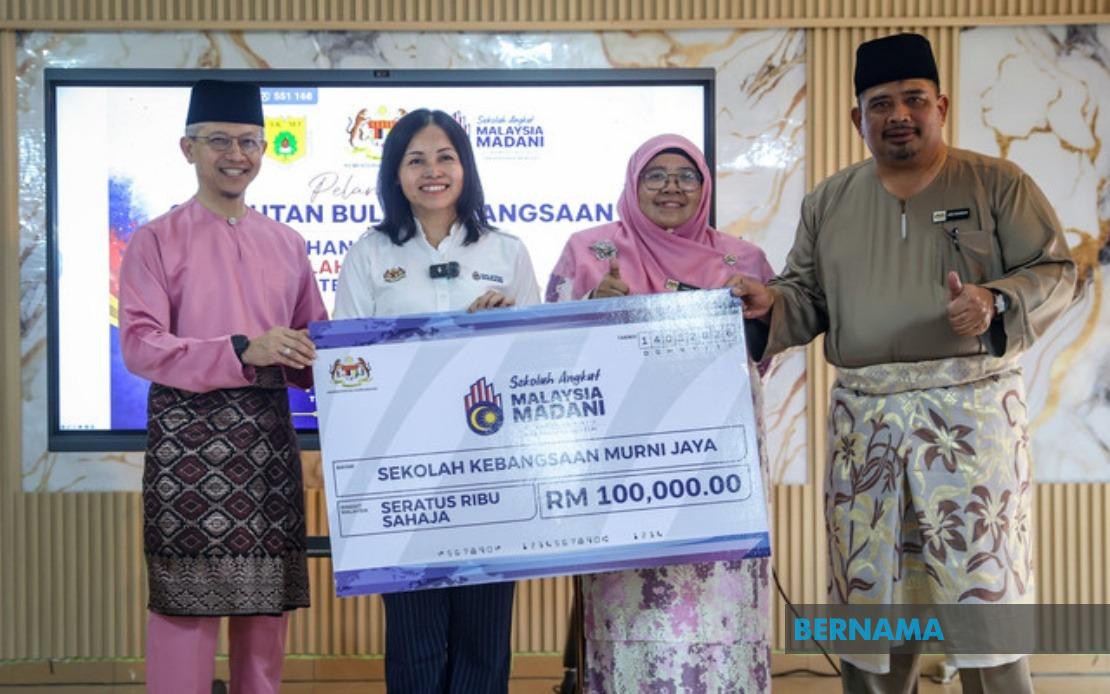
SK Murni Jaya in the Layang-Layang area of Kulai has been selected as a MADANI Adopted School under the Ministry of Communications, securing RM100,000 in funding designated for comprehensive facility improvements. The financial allocation, announced during the ministry's 2026 funding distribution ceremony held at the school, represents a significant investment in modernising educational infrastructure and learning resources for the student body. Deputy Communications Minister Teo Nie Ching presided over the handover, underscoring the government's commitment to elevating standards across Malaysian primary schools through targeted capital grants and equipment provisions.
The funding allocation addresses multiple infrastructure and technology needs identified at the school. Four new signboards will enhance the institution's visual identity and wayfinding for visitors and parents. Two Smartboards, destined for the school hall and resource centre, will facilitate interactive teaching methodologies and multimedia-enhanced learning experiences. Complementing these digital additions, the school will benefit from comprehensive lighting system upgrades and aesthetic improvements to the assembly hall, creating a more conducive environment for whole-school gatherings and events. A modern public address system will replace existing audio infrastructure, ensuring clear communication across the campus during announcements and emergency procedures.
Climate control and technology provision form additional critical components of the upgrade package. Two air-conditioning units will be installed to improve comfort levels within key learning spaces, particularly important in Malaysia's tropical climate where classroom temperature can significantly affect student concentration and academic performance. The technology component includes ten iPads specifically allocated for the computer laboratory, expanding digital literacy opportunities and providing hands-on experience with contemporary devices. A Robot Sumo set has been included to support STEM (Science, Technology, Engineering, and Mathematics) and TVET (Technical and Vocational Education and Training) curricula, enabling students to engage with robotics and automation concepts increasingly relevant to future employment pathways.
Teo Nie Ching outlined the implementation timeline during the ceremony, noting that facility upgrades at SK Murni Jaya should reach completion by October of this year. This accelerated schedule reflects ministerial priorities in rapid infrastructure deployment while maintaining quality standards. For other schools participating in the MADANI Adopted School programme that have received comparable funding allocations, the deadline for full project implementation extends to the end of the calendar year, aligning with broader Ministry of Finance guidelines governing capital expenditure cycles and project completion requirements across federal institutions.
Beyond the primary RM100,000 allocation, supplementary funding of RM20,000 has been earmarked specifically for the school canteen facilities. This additional grant will finance the procurement of nineteen tables and chairs, indicating ministerial recognition that student welfare encompasses not merely academic infrastructure but also the dining and social spaces where students spend considerable daily time. Improved canteen furnishings contribute to enhanced meal experiences and create more comfortable gathering environments during break periods, supporting both physical nutrition and social development.
The MADANI Adopted School initiative reflects broader government strategy to systematically upgrade educational facilities nationwide, particularly benefiting schools in suburban and semi-urban communities like Kulai. By designating specific schools for focused investment, the programme ensures that infrastructure improvements reach institutions serving diverse student populations across different socioeconomic backgrounds. SK Murni Jaya's selection underscores the Communications Ministry's role in the wider ecosystem of educational development, extending beyond its traditional portfolio into infrastructure modernisation.
For Malaysian educators and school administrators, the MADANI programme signals expanding opportunities for facility enhancements through dedicated ministry funding channels. Schools seeking to modernise ageing infrastructure or introduce contemporary learning technologies can reference the SK Murni Jaya allocation as a benchmark, understanding the types and quantum of investments available. The inclusion of STEM and TVET equipment reflects national educational policy prioritising technical competencies and preparing students for evolving job markets requiring technological proficiency.
The timing of this funding announcement arrives amid broader national discussions regarding educational equity and resource distribution across Malaysia's school system. Urban institutions historically enjoy advantages in accessing funding and private donations, while schools in smaller towns often struggle with infrastructure deficits. Grant programmes like the MADANI initiative attempt to narrow these disparities, though questions persist regarding equitable allocation across all states and school categories. Kulai's selection suggests continued federal investment focus on Johor's educational development, reflecting demographic and political considerations alongside pedagogical assessment.
Implementation of such facility upgrades carries practical implications extending beyond immediate physical improvements. Introduction of Smartboards and iPads necessitates concurrent teacher training programmes to maximise utilisation and pedagogical effectiveness. Schools must develop curriculum integration strategies ensuring that new technologies enhance rather than merely supplement existing teaching approaches. The Robot Sumo equipment requires educators equipped to guide student learning in robotics concepts, potentially necessitating external training or expertise sourcing. These implementation complexities underscore that infrastructure grants succeed only when accompanied by comprehensive capacity-building support.

