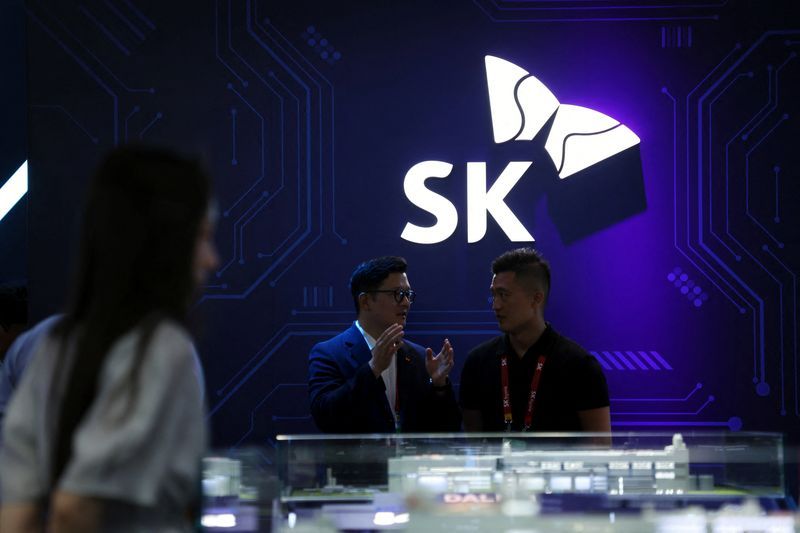
South Korea's SK Hynix announced plans on Wednesday to raise as much as 45.45 trillion won—approximately $29.43 billion—through the listing of American Depositary Receipts, positioning itself to capture growing demand for memory chips critical to artificial intelligence systems. The company intends to issue 17.79 million new shares backing the ADR listing, scheduled for July 10 on the Nasdaq exchange, in a move designed to broaden its investor base while securing capital for an aggressive expansion drive.
The fundraising amount may adjust following the bookbuilding phase, when underwriters gauge demand from institutional investors. However, the indicative target already positions this offering as potentially the largest ADR placement in history, surpassing the $21.8 billion that Chinese e-commerce powerhouse Alibaba raised during its 2014 New York Stock Exchange debut. SK Hynix's emphasis on this superlative reflects the company's confidence in investor appetite for exposure to semiconductor supply chains increasingly vital to the global artificial intelligence ecosystem.
Capital raised through the offering will be deployed strategically across three major infrastructure projects. The company plans to construct a chip manufacturing facility in Yongin, establish an advanced packaging fabrication plant in Cheongju, and procure cutting-edge chipmaking equipment including Extreme Ultraviolet scanners—technology essential for producing the next-generation memory components demanded by artificial intelligence applications. These investments underscore SK Hynix's determination to maintain and expand its technological edge amid fierce international competition.
The listing structure reflects sophisticated financial engineering designed to accommodate investor preferences across different markets. Each ADR will be equivalent to one-tenth of a common share, a configuration selected by the company's financial advisors to optimize trading mechanics and accessibility for varied investor classes. A consortium of four global investment banks—BofA Securities, Citigroup Global Markets, Goldman Sachs, and JP Morgan Securities—are managing the offering, signalling the transaction's significance within global financial markets.
SK Hynix's emergence as a dominant supplier of high-bandwidth memory chips used in artificial intelligence systems has positioned the company at the epicenter of a technology revolution reshaping global commerce. Major customers including graphics processor maker Nvidia and Alphabet subsidiary Google depend heavily on SK Hynix's memory solutions to power their increasingly sophisticated artificial intelligence infrastructure. This dependency has transformed the South Korean manufacturer into a critical node within the global technology supply chain.
The company's ascendancy within its home economy reflects this strategic positioning. SK Hynix surpassed Samsung Electronics to become South Korea's most valuable company on Monday—a historic milestone underscoring the semiconductor sector's economic importance and the particular significance of artificial intelligence-related manufacturing. This ranking shift demonstrates how rapidly competitive dynamics can shift within technology-dependent industries when capital allocation and product development strategies align with transformative technological trends.
For Malaysian and Southeast Asian readers, SK Hynix's expansion carries significant implications. The region's technology sectors depend on reliable supply chains for advanced semiconductors, and SK Hynix's capital-intensive investments in production capacity should improve supply stability for artificial intelligence applications across the region. Additionally, the listing may influence how other regional technology companies consider accessing global capital markets to fund their own expansion ambitions.
The timing of this listing reflects broader market recognition that artificial intelligence represents a sustained, multi-year investment opportunity rather than a cyclical trend. By securing substantial capital now, SK Hynix positions itself to capitalize on anticipated demand expansion as artificial intelligence adoption accelerates across enterprise, consumer, and government sectors globally. Competitors may feel pressure to pursue similar capital-raising strategies to avoid falling behind in the race for production capacity.
SK Hynix's strategic positioning also demonstrates how geopolitical considerations shape semiconductor industry dynamics. The company's success in attracting global capital investment underscores South Korea's established reputation as a reliable, technologically sophisticated manufacturing hub. However, this also reflects broader concerns about supply chain concentration and the strategic importance of semiconductors in international relations—themes that resonate throughout Asia as governments and corporations reassess their technology dependencies.
The successful execution of this listing would validate investor confidence in SK Hynix's management strategy and technological capabilities. Market reception during the bookbuilding phase will provide valuable signals about how global investors view the company's competitive position, expansion plans, and ability to sustain profitability amid rapid industry transformation. These signals extend beyond SK Hynix alone, potentially influencing how other semiconductor manufacturers and technology companies approach capital markets over the coming months.
Looking ahead, SK Hynix's successful capital raise would enable aggressive capacity expansion precisely when industry observers anticipate an extended period of elevated demand for memory chips serving artificial intelligence applications. The company's investments in manufacturing facilities and advanced equipment position it to convert capital into productive assets capable of generating returns across a multi-year horizon, assuming artificial intelligence adoption trajectories meet or exceed current market expectations.