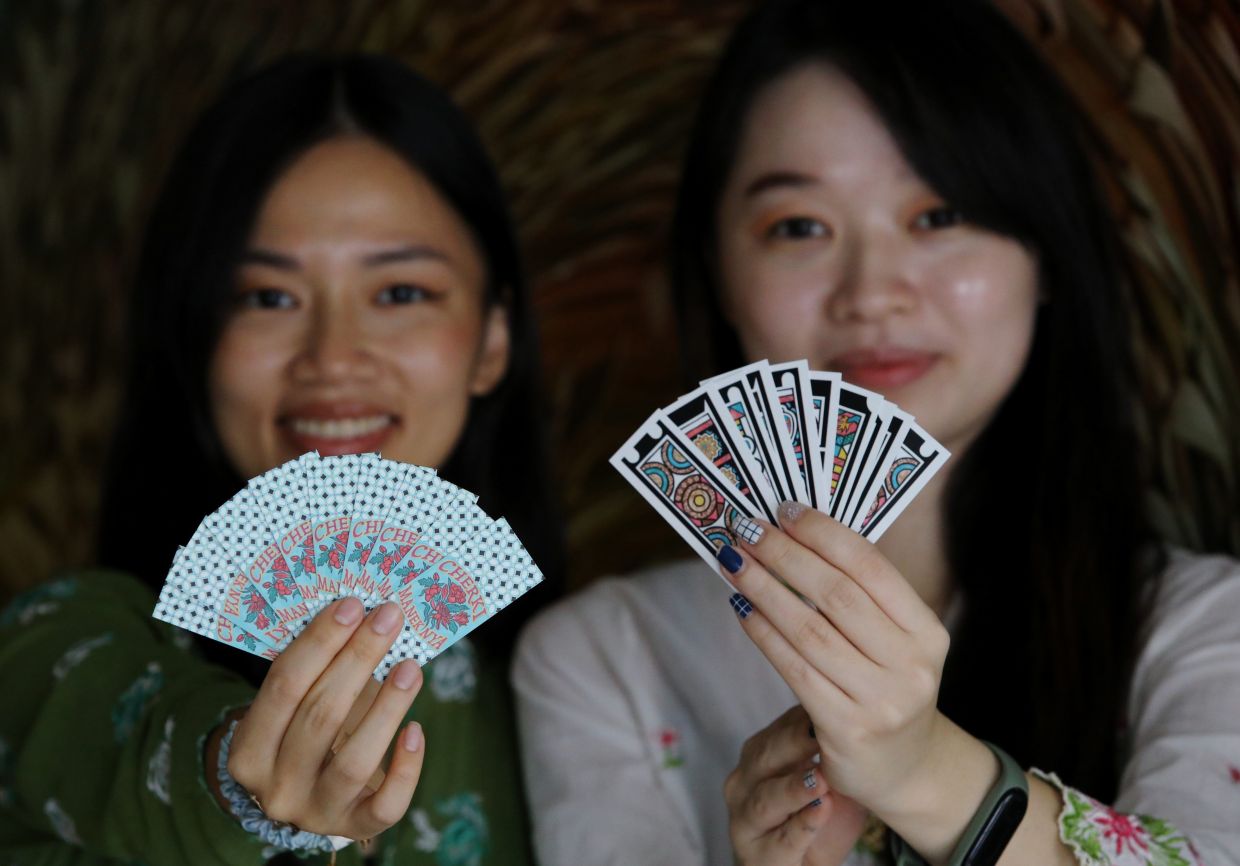
Two Peranakan sisters are undertaking a cultural revival project that extends beyond the celebrated icons of their heritage. While beaded slippers, baju kebaya and Nyonya laksa remain synonymous with Peranakan identity, Lee Swee Lin, 32, and Lee Swee May, 31, are championing an equally important but largely forgotten tradition: the card game Cherki. Working from their Kuala Lumpur-based beaded footwear business, the pair have reimagined this centuries-old game by introducing vibrant colours and contemporary design elements while honouring its traditional motifs and structural integrity.
Cherki, also known as Ceki, Chi Kee or Koa in various regional contexts, represents a unique intersection of Chinese game mechanics and Peranakan cultural expression. Historically played across Singapore, Malaysia, Indonesia and Thailand, the game employs two decks of 60 cards featuring 30 distinct patterns. The traditional format divides these into three suits—coins, strings and myriads—with values ranging from one to nine, supplemented by three special cards. Card games themselves trace their origins to Tang Dynasty China around the 9th century, where historical records document a "leaf game" that would eventually traverse global trading networks and reach Europe by the 14th century. The Peranakan adaptation of these cards became so deeply embedded in cultural practice that they adopted the Malay term "daun ceki," literally meaning leaf-card, as their own nomenclature.
Despite this rich lineage, Cherki faces an uncertain future as fewer young Peranakans learn or play the game. The sisters attribute this erosion partly to their own experience: both grew up in their paternal grandmother Deo Yeok Kim's household in Melaka, absorbing Peranakan traditions through daily observation and participation. Only upon her recent passing did they fully recognise how substantially she had shaped their understanding of their heritage—from culinary knowledge and language to the intricate beading techniques they now practice commercially. This realisation prompted them to consider what cultural knowledge might be lost when intergenerational transmission falters, particularly as lifestyles modernise and migration disperses families away from ancestral strongholds in Melaka and Penang.
The disconnection afflicting younger Peranakans reflects broader patterns documented in academic research. A 2022 comparative study examining cultural material practices among Baba Nyonya communities highlighted how younger descendants increasingly encounter globalised influences through digital entertainment, social media and popular culture, reducing engagement with traditional practices. Lee Yuen Thien, a 36-year-old deputy president of Persatuan Peranakan Baba Nyonya Malaysia, corroborates this observation, noting that career pressures and modern commitments have diminished the cultural space younger members occupy. With the association comprising 3,000 members and estimates suggesting only 10,000 to 15,000 Peranakans nationwide, the urgency of preservation efforts becomes apparent.
The redesigned Cherki deck directly addresses these challenges by making the game visually contemporary while preserving its cultural substance. During 2024, Swee May and Swee Lin collaborated with a small design team, employing digital tools including Procreate and Adobe Illustrator to introduce colours and illustrative patterns. Their adaptation retains Cherki's fundamental structure but modifies the deck from 60 cards (30 patterns repeated twice) to an expanded 120-card format (30 patterns repeated four times), potentially extending gameplay complexity and appeal. The special cards evolved from the traditional white flower, red flower and old thousand to butterfly, dragon and phoenix—symbolic creatures deeply rooted in Peranakan aesthetics and cosmology.
Each numbered card incorporates distinct Peranakan cultural symbols with considerable intentionality. The kantan, a fragrant flower central to Nyonya cuisine, appears alongside the chupu, porcelain storage jars reflecting traditional Peranakan hospitality practices. The kerongsang, ornamental brooches historically used to fasten kebaya fastenings, shares space with gelang, the bracelets worn by Nyonya women in formal settings. These symbols function not merely as decorative elements but as cultural anchors, embedding heritage narratives into gameplay itself. A player handling these cards encounters their ancestry through material practice rather than passive learning, potentially triggering curiosity about the objects and traditions they represent.
The strategic design philosophy underlying this adaptation merits examination. Rather than museumifying Cherki as a historical curiosity, the sisters deliberately positioned it as contemporary entertainment. Swee May articulated this approach explicitly: the goal was creating a game appealing enough to pull out for leisure among today's social circles, not a heritage artefact confined to academic study. By infusing the cards with colour and modern illustration techniques, they negotiated between accessibility and authenticity, ensuring younger players could engage without experiencing cultural alienation. This represents a pragmatic understanding that heritage preservation often requires evolution—cultures that calcify become irrelevant, whereas those adapting remain living traditions.
Tan Sri, manager of the Baba & Nyonya Heritage Museum Melaka, reinforces this perspective, advocating for cultural evolution coupled with deliberate awareness-building. He contends that migration, shifting lifestyles and intermarriage have fundamentally reshaped Peranakan communities, particularly among those geographically removed from traditional strongholds. Under these circumstances, passive transmission through family observation—the model that once sustained cultural continuity—no longer functions uniformly. Intentional education and engagement become necessary supplements, which the Lee sisters' project provides through a medium simultaneously entertaining and culturally educational.
The redesigned Cherki deck arrives at a moment of pronounced demographic transformation within Southeast Asia's Peranakan communities. Younger members face competing demands from globalised education systems, international career opportunities and digital entertainment ecosystems. Within this context, heritage preservation requires not simply nostalgia or accusation of cultural abandonment, but rather innovative reintroduction making traditional practices attractive to contemporary sensibilities. The Lee sisters' Cherki represents one such intervention, though its success will ultimately depend on whether it successfully translates into sustained adoption among young Peranakans. If gameplay generates sufficient engagement, the cards could function as a gateway introducing players to broader cultural exploration.
Looking forward, the Cherki project carries implications extending beyond the Peranakan community specifically. Southeast Asian heritage broadly faces similar pressures from urbanisation, migration and cultural globalisation. The Philippines, Thailand, Vietnam and Indonesia each contend with the erosion of traditional games, crafts and social practices among younger populations. The Lee sisters' approach—thoughtfully modernising rather than abandoning tradition—offers a replicable model for cultural stewardship elsewhere in the region. Whether other heritage practitioners adopt comparable strategies may partly determine whether Southeast Asia's diverse cultural traditions survive the twenty-first century as living practices or become confined to museum exhibitions and academic archives.

