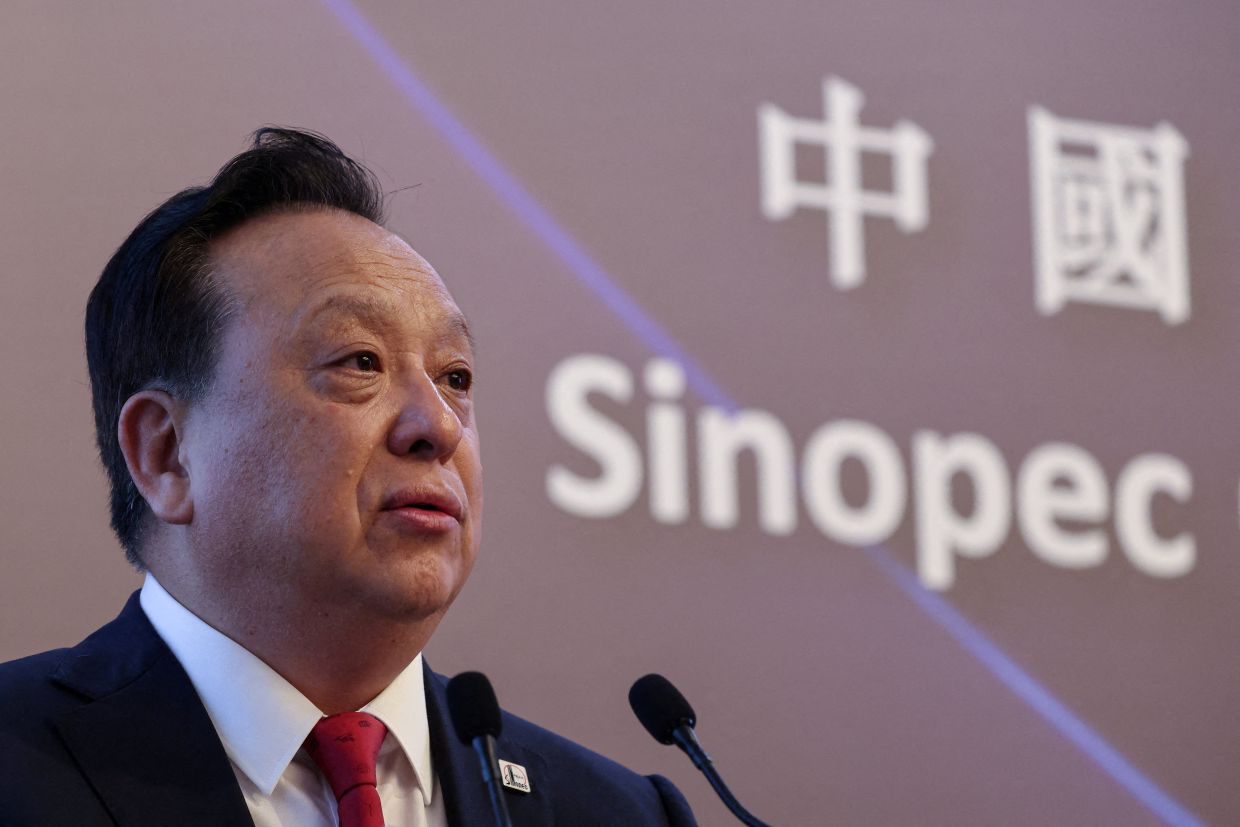
Hou Qijun has embarked on a sweeping institutional overhaul of Sinopec, the planet's largest oil refiner, confronting a company struggling with eroding fuel consumption, excess production capacity across its chemicals segment, and a deteriorating business environment that would leave most executives content to manage decline toward retirement. Since assuming the role of Sinopec chairman just over a year ago, Hou has fundamentally restructured the sprawling state enterprise into four semi-autonomous profit centres focused on distinct business verticals: integrated oil, gas and new energy operations; refining and chemical production; financial services and strategic ventures; and a combined unit managing global commodity trading alongside the company's extensive domestic marketing networks for petroleum products, natural gas, and chemical goods.
Hou's candid assessment of Sinopec's predicament, articulated in remarkably direct language for a Chinese state-sector executive writing in a government publication in July, cut to the heart of the challenge confronting petrochemical giants across Asia. "The biggest hurdles for such a self-revolutionary transformation lie not on technology, resources or markets, but the system and institutional inertia," he wrote in the State-owned Assets Supervision and Administration Commission magazine, an organ of Beijing's powerful state oversight body. He went on to diagnose what he termed the "big company syndrome"—a reference to the bureaucratic sclerosis and sluggish market responsiveness that often afflicts sprawling industrial conglomerates as they accumulate scale and complexity. For Southeast Asian energy markets watching China's energy transition unfold, this admission signals the urgency with which Beijing's largest energy firms are attempting to adapt to fundamental shifts in global demand patterns.
The strategic context animating Hou's reform agenda has grown increasingly acute. Sinopec's domestic fuel sales have contracted to 2017 levels, marking a painful compression in the refiner's core business at a moment when the company faces intensifying headwinds in defending its home market share. The 60-year-old Hou, who would normally be contemplating the comfortable sinecure typical of senior Chinese state executives retiring around age 63, has instead thrown himself into a mission to salvage a company fighting what observers describe as an existential struggle. An executive representing a Chinese institutional shareholder in Sinopec characterized Hou as a rare exception among his peers—a leader close to retirement age who retains the ambition and temperament to drive meaningful institutional change rather than simply presiding over managed decline.
Despite formidable headwinds, Sinopec reported a 19 percent surge in net profit during the first half of 2026, a result that masks underlying structural difficulties. The company remains heavily exposed to oil supply disruptions stemming from the Iran war and faces politically-imposed constraints in its ability to transmit elevated crude costs to consumers through higher pump prices. The company moved approximately 3.6 million barrels daily of gasoline and diesel products during the previous year, predominantly for domestic consumption—a volume that increasingly represents a liability as electric vehicle adoption progressively erodes the addressable market for traditional transport fuels.
Hou articulated this existential challenge with striking clarity at the company's earnings presentation in Hong Kong, posing a rhetorical question that captures the fundamental business model disruption confronting traditional energy majors across Asia: "Gasoline was made for cars, yet half of new cars no longer need fuel ... Under these circumstances, how can producing more gasoline and diesel continue to generate revenue?" His framing reflects the accelerating vehicle electrification visible throughout China and increasingly across Southeast Asian markets, where battery electric vehicles and plug-in hybrids are rapidly displacing conventional internal combustion engine models. To sustain profitability, Hou contends, Sinopec must transition toward production of higher-value chemical feedstocks and specialty materials—a strategic pivot that requires both capital reallocation and technological innovation across the company's operating portfolio.
The capital allocation framework underpinning this transformation is substantial. Sinopec intends to channel approximately 20 percent of its annual capital expenditure—representing more than 30 billion yuan or roughly $4.46 billion annually—into new energy development and advanced materials production across the 2026-2030 period. Through 2030, the company targets completion of over 30 distinct projects spanning reserve augmentation, unconventional shale oil development, sustainable aviation fuel production, and refining cost optimization. This portfolio represents an effort to systematically "convert technology into productivity," in Hou's formulation, though he has simultaneously emphasized the imperative of rapid implementation and accelerated project execution timelines.
The company's pivot toward higher-margin petrochemical products confronts formidable competitive obstacles within China's energy landscape. Sinopec faces intensifying rivalry from locally-backed chemical producers such as Wanhua Chemical, which enjoys substantial government support, and from nimble private enterprises including Satellite Chemical. The sector simultaneously grapples with structural overcapacity in ethylene production—a critical building block for plastic and synthetic fiber manufacturing—creating margin compression across the petrochemical value chain. For Malaysian and Southeast Asian chemical manufacturers and traders, this competitive intensification represents a significant development, as Chinese producers increasingly compete for regional sales and potentially seek to shift overcapacity burdens onto export markets.
A particularly consequential dimension of Hou's strategic initiative involves unconventional shale oil development at the Jiyang trough, positioned within Sinopec's flagship Shengli oilfield complex where conventional reserves face rapid depletion. Hou has personally positioned himself as the project's commanding officer, signaling the strategic importance assigned to this development. His professional trajectory as a geologist who built his career at Daqing oilfield and subsequently served as general manager of Asia's largest producer, China National Petroleum Corporation, before transitioning to Sinopec in June 2025, provides substantial technical grounding for overseeing such technically demanding projects. The Shandong-born executive previously demonstrated restructuring capabilities by orchestrating the consolidation of pipeline assets from China's three oil majors into PipeChina, which he operated from 2019 through 2021.
Observers describing Hou's leadership style emphasize his reputation as a "decisive, quick-in-action" executive capable of extended off-script commentary demonstrating conviction and logical coherence—an unusual communication profile within the typically cautious state enterprise bureaucracy. His demonstrated familiarity with the complete energy value chain, combined with his ability to access government backing for commercially challenging investments in hydrogen production and carbon capture technologies, positions him advantageously to pursue frontier energy initiatives. According to Michal Maiden, director of the China program at Oxford Institute for Energy Studies, Hou possesses the credentials and governmental relationships necessary to capitalize on state support for technology-intensive, presently uneconomic ventures.
Yet fundamental questions shadow Hou's transformation agenda. The critical uncertainty concerns whether Sinopec and its state-owned competitors can effectively compete against non-state actors already establishing footholds in new energy markets—a competitive dynamic substantially different from the protected domestic oil and refining sectors where state enterprises have long enjoyed structural advantages. Chinese private companies and emerging energy startups have demonstrated agility in solar, wind, battery, and hydrogen technologies, operating without the legacy cost structures and organizational inertia that encumber state enterprises. The competitive intensity of this transition, combined with Beijing's policy imperatives around energy security and carbon neutrality, creates an ambiguous operating environment where Hou's restructuring may prove insufficient to guarantee Sinopec's long-term viability absent continued preferential government support.

