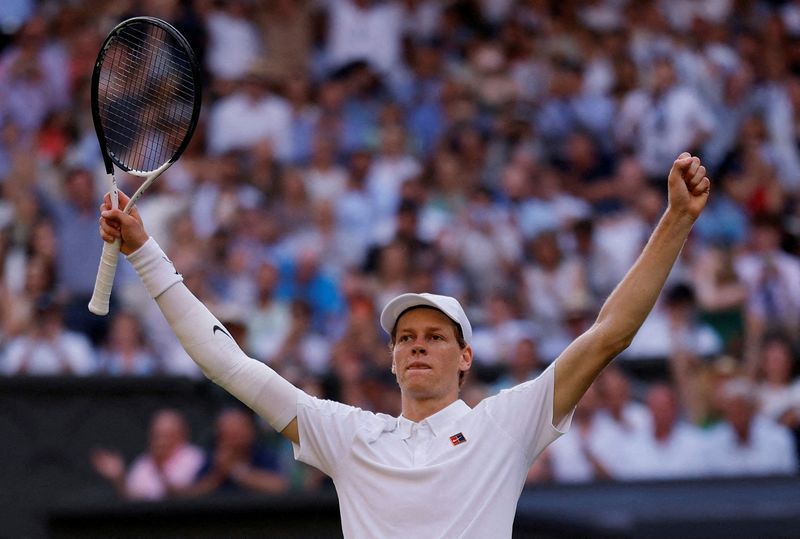
Jannik Sinner's arrival at Wimbledon this week as defending champion comes under considerably different circumstances than when he last held the trophy. The Italian's previously unshakeable dominance has fractured following a stunning second-round collapse at the French Open last month, shattering a 30-match winning streak that stretched back to February and raising fresh questions about whether he possesses the physical and mental resilience required to maintain elite performance across multiple Grand Slams. As the All England Club prepares to host the grass-court season's marquee event beginning Monday, the world number one faces a critical moment to either reassert his supremacy or watch potential challengers seize their moment.
The narrative surrounding Sinner's standing has shifted markedly in recent weeks. His performance on the red clay of Roland Garros exposed vulnerabilities that many observers believed were already addressed through his ascent to the top ranking. Former Grand Slam champion Mats Wilander attributes the collapse to accumulated physical fatigue rather than a fundamental flaw in Sinner's game, noting that the Italian's punishing schedule in the two months preceding Paris left insufficient recovery time. Wilander suggested that Sinner may have actually possessed a superior chance of winning the French Open but squandered it through poor preparation and insufficient energy reserves when it mattered most. The grass courts of Wimbledon, representing tennis's fastest surface, theoretically suit Sinner's attacking style, yet Wilander cautioned against assuming an easy path forward, emphasizing that grass remains inherently unpredictable regardless of a player's baseline prowess.
Sinner's decision to bypass traditional warm-up tournaments before arriving at Wimbledon adds another layer of uncertainty to his title defence. Rest may indeed restore his physical condition, but the absence of competitive match play on grass before facing tournament-level opposition leaves him without the rhythmic preparation that typically precedes his major tournament efforts. This calculated gamble reflects either confidence in his established credentials or concern that additional competition might further compromise his conditioning—observers remain divided on which interpretation proves more accurate.
Despite Sinner's recent stumble, he remains the overwhelming favourite, a position that seems almost certain to persist given that injured rival Carlos Alcaraz cannot compete. The Spanish champion, who claimed Wimbledon in 2023 and 2024, would normally occupy substantial odds consideration; his absence fundamentally reshapes the tournament's contention landscape by removing perhaps the only contemporary player capable of matching Sinner's dominance on faster courts.
Into this vacuum steps Novak Djokovic, whose grass-court credentials represent perhaps the most compelling counter-argument to Sinner's favouritism. The 39-year-old Serbian champion brings eight Wimbledon titles within his grasp, needing just one more victory to match Roger Federer's all-time record at the venue. More significantly for Djokovic's legacy, Wimbledon represents a critical remaining opportunity to secure a standalone 25th Grand Slam championship—a feat that would cement his position atop tennis history's all-time list. Three-times Wimbledon finalist Andy Roddick has articulated precisely why dismissing Djokovic's chances would constitute a serious analytical error, arguing that despite his French Open exit, the veteran remains acutely aware that Wimbledon represents perhaps his final realistic opportunity to accomplish both objectives during his career's twilight phase. Roddick emphasised that Djokovic's proven movement and return-of-serve mastery on grass remain formidable weapons that should not be underestimated based solely on recent results elsewhere.
Alexander Zverev arrives at Wimbledon riding perhaps the most energised wave among the contenders following his first Grand Slam triumph at Roland Garros. The German's long-anticipated breakthrough victory provides considerable psychological momentum heading into grass-court season, a surface where Zverev has consistently demonstrated tactical capabilities without previously translating such prowess into major championship success. Boris Becker, the six-times Grand Slam champion and fellow German, has publicly endorsed Zverev as a genuine favourite for Wimbledon given the combination of Alcaraz's absence and uncertainty surrounding Sinner's condition. Becker highlighted Zverev's substantial serving power as a particularly valuable asset on grass, noting that a reliable first serve typically provides sufficient foundation to reach at minimum the semi-final stage on this surface. While Zverev necessarily faces an adjustment period in adapting his recently triumphant clay-court tactics to grass's fundamentally different demands, Becker's assessment suggests the capability exists within Zverev's skill set to achieve his breakthrough on multiple surfaces.
Beyond the trio of Sinner, Djokovic, and Zverev, the tournament draw presents opportunities for an expanded group of challengers. American prospects Ben Shelton, Taylor Fritz, and Frances Tiafoe each possess the attacking capabilities and serve-based weaponry required to trouble higher-ranked opponents on fast courts. French Open runner-up Flavio Cobolli represents another name ascending the contention hierarchy, suggesting that the draw's competitive depth extends considerably beyond the traditional elite names. This wider distribution of genuine title opportunities reflects both the aforementioned absence of Alcaraz and the temporary vulnerability of Sinner, creating circumstances where several players might plausibly reach championship positioning with a strong fortnight's work.

