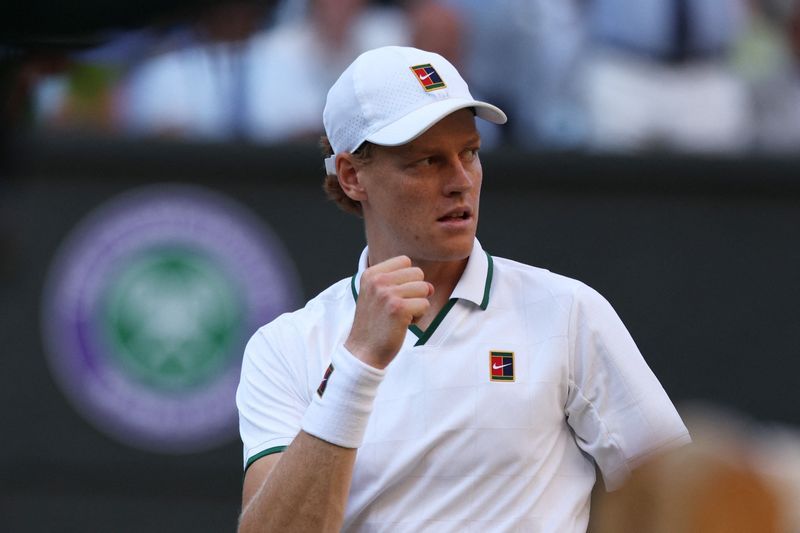
Jannik Sinner has cemented his status as one of professional tennis's most formidable competitors by retaining the Wimbledon title, overcoming Alexander Zverev in a gripping final contested on the All England Club's Centre Court. The Italian champion emerged victorious with a 6-7(7) 7-6(2) 6-3 6-4 scoreline, a result that places him among an exclusive group of players who have successfully defended their Wimbledon honours in the modern era. With this triumph, Sinner has now claimed five Grand Slam titles whilst simultaneously extending his dominance over Zverev to a remarkable ten consecutive victories, a statistical testament to their contrasting form.
Sinner becomes only the tenth man since the sport's professional era began to accomplish the feat of winning Wimbledon in consecutive years, a distinction that underscores both the difficulty of defending major titles and the sustained excellence required at the highest levels of competition. The achievement strengthens the Italian's credentials as a generational talent capable of challenging Carlos Alcaraz's collection of seven major championships, the two players having emerged as the sport's primary torchbearers. At 24 years old, Sinner has already accumulated a resume that would satisfy most careers, yet his trajectory suggests further milestones lie ahead.
The final itself unfolded as a compelling exhibition of modern tennis, with both competitors demonstrating the aggressive ball-striking and physical demands that characterise contemporary play at the grass courts of south-west London. The opening set proved particularly intense, with the two finalists exchanging blows across twelve games on a warm and blustery afternoon. Zverev ultimately claimed the first set through a tiebreak that showcased his capacity for powerful striking, culminating in a forehand winner that prompted visible celebration from the German as he sought to build momentum against his accomplished opponent.
However, Sinner's resilience emerged as the decisive factor as the match progressed into its second and third hours. Whilst Zverev initially demonstrated superior consistency and controlled aggression, the Italian gradually reasserted control through superior tactical awareness and mental fortitude. The second set tiebreak witnessed a reversal of fortunes, with Sinner's animated performance contrasting sharply with Zverev's mounting frustration, eventually forcing the match into a level position at one set apiece after nearly two and a half hours of compelling tennis.
A pivotal moment arrived midway through the third set when Zverev pursued an opportunity to claim his first break point of the contest. The German's attempt to capitalise on a Sinner drop shot resulted in a dramatic slip that left him sprawled on the turf, clutching his right knee whilst the Centre Court crowd reacted with audible concern for his welfare. The injury appeared sufficiently severe to threaten Zverev's continued participation, yet the second seed demonstrated considerable resolve by continuing to compete despite evident discomfort and frustration at the turn of events.
Sinner capitalised ruthlessly on Zverev's reduced mobility in the subsequent game, breaking serve to establish a 5-3 advantage whilst his opponent could only register his frustration by smashing his racket against the court surface. This decisive moment shifted the psychological pendulum decisively in the Italian's favour, and Zverev found himself facing an increasingly improbable path to victory as the third set concluded and he trailed by two sets to one.
The fourth set witnessed further erosion of Zverev's challenge as Sinner broke again to secure a 4-3 lead, capitalising on a temporary dip in the German's play. The Italian maintained his composure during an entertaining final phase of the contest, ultimately completing victory through sheer force of will rather than overwhelming dominance. Upon clinching the title, Sinner collapsed to the grass in celebration, an expression of relief and joy that reflected both the intensity of the battle and the significance of successfully defending a major championship.
Zverev's defeat represents his fourth Grand Slam final loss, a statistic that will undoubtedly weigh upon a player of his considerable ability who has frequently threatened major breakthrough moments without managing to convert them into titles. The German nevertheless conducted himself with considerable grace in defeat, acknowledging Sinner's superiority whilst recognising the honour of competing on Centre Court during the championship weekend. His humorous observation that he had lost to Sinner "nine times in a row"—an undercount of the actual ten-match losing streak—suggested an ability to maintain perspective despite the disappointment of falling short at tennis's highest level.
For Malaysian and Southeast Asian tennis enthusiasts, Sinner's continued ascent provides compelling evidence that the sport remains characterised by genuine competition between emerging talents rather than domination by any single player. Whilst Alcaraz currently holds the edge in major championship count, Sinner's trajectory and current form suggest the rivalry between the two will define the next phase of professional tennis. The Italian's success also demonstrates that consistency at the highest level—particularly the capacity to win consecutive majors—remains achievable in an era when many predicted greater parity across the field of top competitors.
Sinner's post-match remarks demonstrated the emotional significance of his achievement, as he reflected upon the privilege of competing before the All England Club's appreciative audience and acknowledged the uncertainty inherent in achieving multiple major victories. His comment that "there's no better place, honestly, to play tennis" encapsulated the unique atmosphere and prestige associated with Wimbledon, a sentiment that resonates across the sport and explains why successive victories at the grass court major represent such a cherished accomplishment. The Italian's display of emotion and gratitude underscored that even at the sport's highest levels, major championship victories retain their capacity to inspire profound satisfaction.
The final itself will be remembered as a test of character as much as technical skill, with Sinner's ability to maintain focus and intensity during challenging moments—particularly when Zverev threatened a comeback in the middle sets—proving decisive. The German's injury, though genuinely unfortunate, cannot diminish Sinner's achievement, as the Italian had already assumed control of the match's trajectory and was systematically dismantling his opponent's game plan through superior court positioning and tactical execution. As the professional tennis circuit moves forward, Sinner's continued dominance and expanding record of major championships suggest that observers of the sport should anticipate further outstanding achievements from the Italian in the coming seasons.

