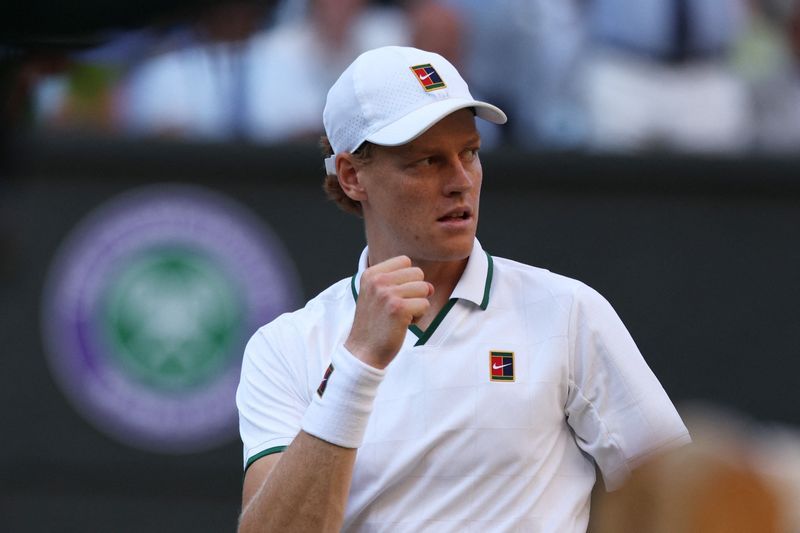
Jannik Sinner has solidified his position as one of tennis's dominant forces by successfully defending his Wimbledon title, overcoming determined German challenger Alexander Zverev in a gruelling Sunday final at the All England Club. The Italian's 6-7(7) 7-6(2) 6-3 6-4 victory adds a fifth Grand Slam crown to his resume and places him among a select group of just ten men who have managed to retain the prestigious grass-court championship in the professional era.
Zverev arrived at the final riding an extraordinary wave of momentum following his maiden Grand Slam triumph at Roland Garros mere weeks earlier, making him a formidable opponent. The 29-year-old German mounted a sustained assault against Sinner throughout the match, particularly in an opening set that tested the Italian's resolve across an intense 65-minute opener dominated by heavy-hitting baseline exchanges. Zverev's impressive service game held firm throughout the early stages, with only one break point materialising in the opening dozen games as both players traded blows in conditions that favoured aggressive striking.
The crucial turning point in the first set came during the tiebreak, where margins of error shrunk to negligible levels. Zverev's forehand, historically a vulnerability in high-pressure moments during his career, proved extraordinarily stable and helped him secure the opening set. When he finally converted a set point with a commanding forehand winner, he simultaneously snapped Sinner's remarkable streak of winning 14 consecutive sets against him. The significance of this breakthrough extended beyond the mere scoreline; it demonstrated that Zverev possessed the tactical wherewithal and emotional fortitude to compete at the highest level against the world's top-ranked player.
Entering the second set, frustration visibly crept into Sinner's demeanour as Zverev's dominant serving continued to repel breakpoint opportunities. Yet the Italian's experience and adaptability would prove decisive. Sinner elevated his intensity dramatically in the second-set tiebreak, orchestrating a decisive shift in momentum that levelled the match and set the stage for an absorbing final two sets. The momentum swings throughout the contest underscored how evenly matched these competitors truly were, with neither player establishing lasting ascendancy despite their respective rankings.
The pivotal moment materialised during the third set at a critical juncture roughly two hours and forty minutes into proceedings. With Zverev holding his first break point of the entire match at 3-3, an innocuous moment transformed the match's trajectory entirely. As Sinner executed a delicate drop shot, Zverev raced backwards attempting a directional shift but slipped awkwardly behind the baseline, hitting the turf heavily. Though the German insisted he remained uninjured, the visible impact of the tumble appeared to shake his composure and physical confidence. Sinner promptly held serve and then achieved his first service break precisely as Zverev was visibly moving with diminished mobility, the frustration evident as the German hurled his racket onto the turf.
The injury incident fundamentally altered the contest's complexion. While Zverev demonstrated admirable resilience and recovered his poise to some extent during the fourth set, Sinner's aggressive intent had fully awakened by this stage. The Italian secured another crucial break for 4-3 in the final set, his confidence visibly building with each passing game. Sinner's movement became increasingly dominant, and his serving grew nearly untouchable, having surrendered zero service games throughout both the semi-final and final matches—a remarkable testament to his consistency under pressure.
The concluding games provided some of the tournament's finest tennis, with two exceptionally lengthy and fiercely contested rallies bookending Sinner's service games as he closed out the match after three hours and forty-six minutes. The quality of play across these final moments showcased why both competitors have established themselves among tennis's elite athletes, with groundstroke exchanges combining power, precision, and tactical sophistication.
At 24, Sinner has already rewritten Italian tennis history. He became the first Italian to capture a Wimbledon singles title when winning last year and now becomes only the second Italian man ever to successfully defend a major championship. His consistency across different surfaces and tournament formats—despite a recent second-round French Open exit and a close call against Miomir Kecmanovic in the first round at Wimbledon—demonstrates the mental resilience separating champions from contenders. The Italian's poise on Centre Court, particularly his decision to check on his injured opponent mid-match rather than capitalise on obvious vulnerability, reflected sportsmanship amid competitive intensity.
For Malaysian and Southeast Asian audiences, Sinner's dominance holds particular resonance as Asian tennis continues developing its professional infrastructure. The 24-year-old represents a new generation of global players unburdened by established hierarchies, similar to how Asian players have disrupted other traditionally European-dominated sports. His rapid ascent to the world's top ranking within five years of professional experience offers a blueprint for the region's emerging talents regarding what focused dedication and sound coaching can achieve.
Zverev's performance, whilst ultimately unsuccessful, should not be overshadowed by the result. At his fourth Grand Slam final defeat, the German finally captured his breakthrough major at Roland Garros barely four weeks earlier, and Wimbledon represented his maiden grass-court final appearance at such an elevated stage. Having now reached multiple major finals, Zverev has demonstrated that further Grand Slam titles appear inevitable, particularly given his elevated confidence levels following his French Open success. His immediate goal of becoming the first German man to win Wimbledon since Michael Stich's 1991 triumph remains achievable within the remaining years of his prime competitive window.
Sinner's victory extends his unbeaten record against Zverev to ten consecutive encounters, a statistical dominance that paradoxically undersells the German's competitive quality given how closely contested this particular final proved. The Italian's capacity to elevate his performance when championship moments demand it—refusing to drop his serve across two rounds and weathering an opponent who arrived with justified confidence—separates truly elite competitors from the broader pack of talented professionals. As Sinner collects the Challenge Cup with its distinctive pineapple-shaped finial and reflects upon his achievement, his transition from promising youngster to established multi-major champion appears complete, with future Wimbledon titles seeming an inevitable consequence of his current trajectory and competitive maturity.

