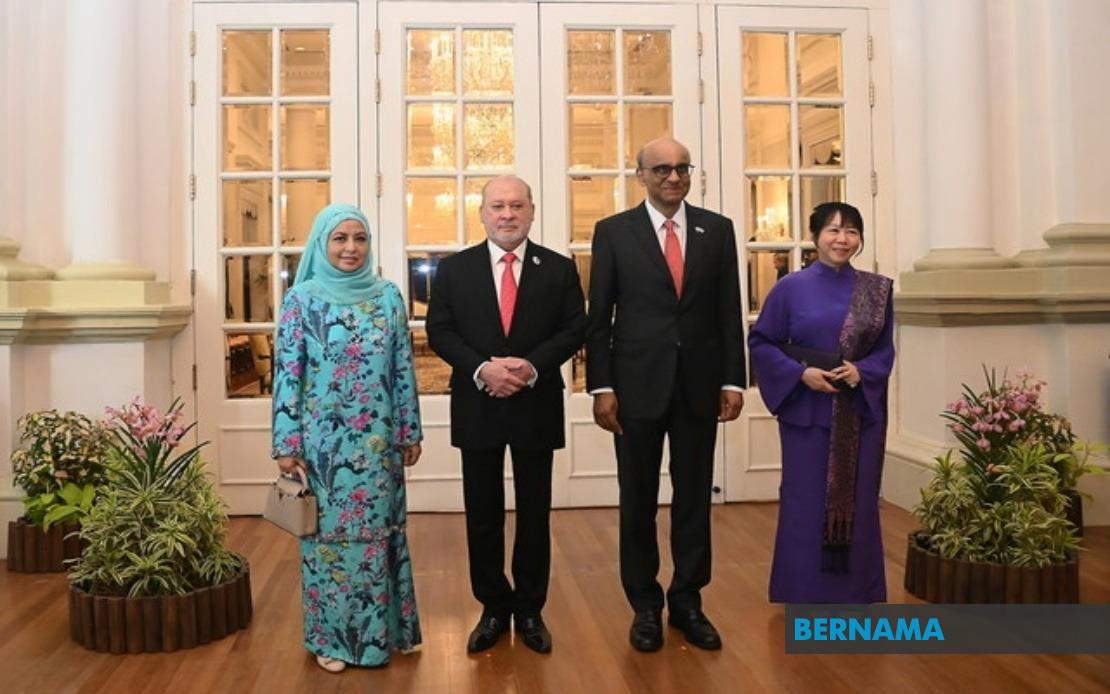
Singapore President Tharman Shanmugaratnam has characterised the relationship between Singapore and Malaysia as one anchored in centuries of shared history and mutual trust, signalling that future cooperation must transcend transactional commercial interests. In an exclusive interview ahead of his three-day state visit to Malaysia from July 13, 2026—undertaken at the invitation of His Majesty Sultan Ibrahim, King of Malaysia—Tharman articulated a vision of bilateral partnership rooted in cultural continuity and institutional discipline in managing disagreements.
The two nations, Tharman stressed, possess economic integration of remarkable depth, evidenced by the Johor-Singapore Causeway serving as the world's busiest land border crossing. Yet beneath this quantifiable reality lies a constellation of cultural and familial connections that have evolved organically across generations. Tharman pointed to recent multilateral cultural recognition efforts, notably the joint UNESCO inscription of the kebaya alongside Brunei, Indonesia, and Thailand, as well as ongoing collaborative initiatives to secure international recognition for Chingay, the vibrant street procession that embodies their shared multicultural traditions. Such symbolic achievements matter because they crystallise intangible heritage for coming generations, ensuring that contemporary links between Singapore and Malaysia remain visibly tethered to their intertwined past rather than floating untethered on ephemeral economic advantage.
Central to Tharman's framing is the proposition that neighbouring states inevitably experience friction over specific issues, yet mature relationships distinguish themselves by their capacity to compartmentalise disagreements without allowing them to corrode the broader architecture of cooperation. He acknowledged that Singapore and Malaysia have historically contended with sensitive and complex bilateral matters, a reality he framed as natural consequence of territorial proximity and historical entanglement. What distinguishes the two countries, in his analysis, is their successive governments' consistent refusal to permit these disputes to dominate the agenda, instead choosing to engage them through calm deliberation, mutual respect, and adherence to international law. This approach, he suggested, cultivates reserves of trust and familiarity among leaders, officials, and ordinary citizens—reserves that become indispensable during periods of global instability.
The articulation of this philosophy carries particular resonance for Southeast Asia at a moment of intensifying geopolitical turbulence. Regional stability, Tharman contended, does not depend on the absence of disputes but rather on institutional discipline in managing them responsibly. Singapore and Malaysia's demonstrated capacity to navigate disagreements through dialogue and mutual understanding, he implied, offers a model instructive for ASEAN and the wider region. Their willingness to prioritise rules-based order and respect for sovereignty, even when contentious questions arise, reinforces the case for maintaining institutional mechanisms that privilege restraint and dialogue over unilateral assertion.
Looking forward, Tharman identified several domains where deepened integration could yield tangible benefits for both populations. The Johor-Singapore Special Economic Zone represents his exemplar of win-win cooperation, combining each nation's distinct comparative advantages to generate mutual prosperity. Similarly, the Rapid Transit System Link promises to facilitate daily movements for the hundreds of thousands of Malaysians and Singaporeans traversing land checkpoints, reducing friction in people-to-people contact and softening the psychological boundaries that national borders impose. These infrastructure and economic initiatives matter not merely as ends in themselves but as vectors through which ordinary citizens experience the practical benefits of neighbourly cooperation.
Climate transition and renewable energy cooperation emerged as particularly significant in Tharman's assessment, reflecting the shared vulnerabilities tropical nations confront in managing climate change. Both Singapore and Malaysia have announced ambitious sustainability and energy transition targets. Collaboration in renewable energy markets and carbon credit mechanisms, Tharman suggested, represents an opportunity to transform complementary policy commitments into concrete investments and technological cooperation. Such sectoral integration reduces the likelihood that environmental pressures will generate zero-sum competition for resources while simultaneously advancing each nation's decarbonisation objectives.
Tharman accorded substantial analytical weight to ASEAN's digital economy frameworks, particularly the Digital Economy Framework Agreement recently concluded and scheduled for signature at the 49th ASEAN Summit in Manila in November 2026. Current projections suggest ASEAN's digital economy could reach approximately US$1 trillion by 2030 on its existing trajectory. However, studies indicate a high-quality DEFA implementation could potentially double this to US$2 trillion, representing transformative value creation across the region. Singapore and Malaysia, as digital economy leaders, possess particular responsibility in shepherding ASEAN toward institutional arrangements that permit this value capture while protecting smaller and less technologically advanced economies from asymmetric competitive pressures.
A recurring theme throughout Tharman's remarks concerned the critical importance of deliberately cultivating people-to-people connections across the border, particularly among younger generations. He observed that what came naturally to earlier cohorts—regular personal, professional, and cultural exchange—can no longer be taken as automatic but instead requires proactive facilitation. Tharman advocated expansion of bilateral exchange programmes, joint internships, youth leadership forums, and collaborative community projects as mechanisms through which friendships and mutual comprehension could deepen and broaden. This emphasis reflects an implicit concern that without deliberate institutional investment in cross-border human connection, generational turnover risks attenuating the accumulated goodwill and familiarity that have historically underpinned bilateral stability.
As founding ASEAN members, Tharman emphasised that Singapore and Malaysia share institutional stakes in strengthening ASEAN's centrality, unity, and relevance amid global fragmentation. He lauded Malaysia's ASEAN Chairmanship in 2025, undertaken under Prime Minister Datuk Seri Anwar Ibrahim's leadership, as exemplifying the organisation's persistent capacity to navigate complex geopolitical and geoeconomic environments. Significant achievements under Malaysia's stewardship included Timor-Leste's accession as ASEAN's 11th member, upgrading of the ASEAN Trade in Goods Agreement, and substantial conclusion of the Digital Economy Framework Agreement. These outcomes, Tharman suggested, demonstrated ASEAN's continued convening power and relevance even as global great-power competition intensifies. Singapore and Malaysia could build upon this momentum by jointly maintaining pressure for open and rules-based international order, deepening intra-ASEAN integration, and expanding the grouping's external partnerships as Singapore approaches its 2027 Chairmanship.
The broader strategic context animating Tharman's remarks concerns the fracturing of the multilateral trading system and escalating great-power competition, dynamics that necessarily compel regional actors toward closer integration with immediate neighbours. Neither Singapore nor Malaysia can maintain prosperity through individual action; both nations instead depend upon deepened value chains, supply chain resilience, and coordinated responses to shared challenges. The question before both governments, implicit in Tharman's framing, concerns whether bilateral and regional institutions can be sufficiently strengthened and modernised to permit the institutional coordination that twenty-first century economic and security challenges demand.
Tharman's characterisation of the Malaysia-Singapore relationship as one requiring hearts to shake hands—a formulation emphasising emotional and existential connection beyond contractual obligation—speaks to a conviction that neighbourly relations demand cultivation of affect and mutual recognition alongside institutional cooperation. The state visit itself functions as performative assertion of this philosophy, a ritualistic reaffirmation of commitment undertaken at the highest diplomatic level. Yet the substantive content of Tharman's remarks suggests that maintenance of bilateral goodwill requires constant institutional work: deliberate people-to-people programmes, proactive cultural recognition, infrastructure investment in cross-border mobility, and disciplined political commitment to managing disagreements through dialogue rather than escalation. For two nations whose prosperity and stability remain fundamentally interdependent, such deliberate cultivation of relationship represents not luxury but essential requirement for navigating an increasingly turbulent regional and global environment.

