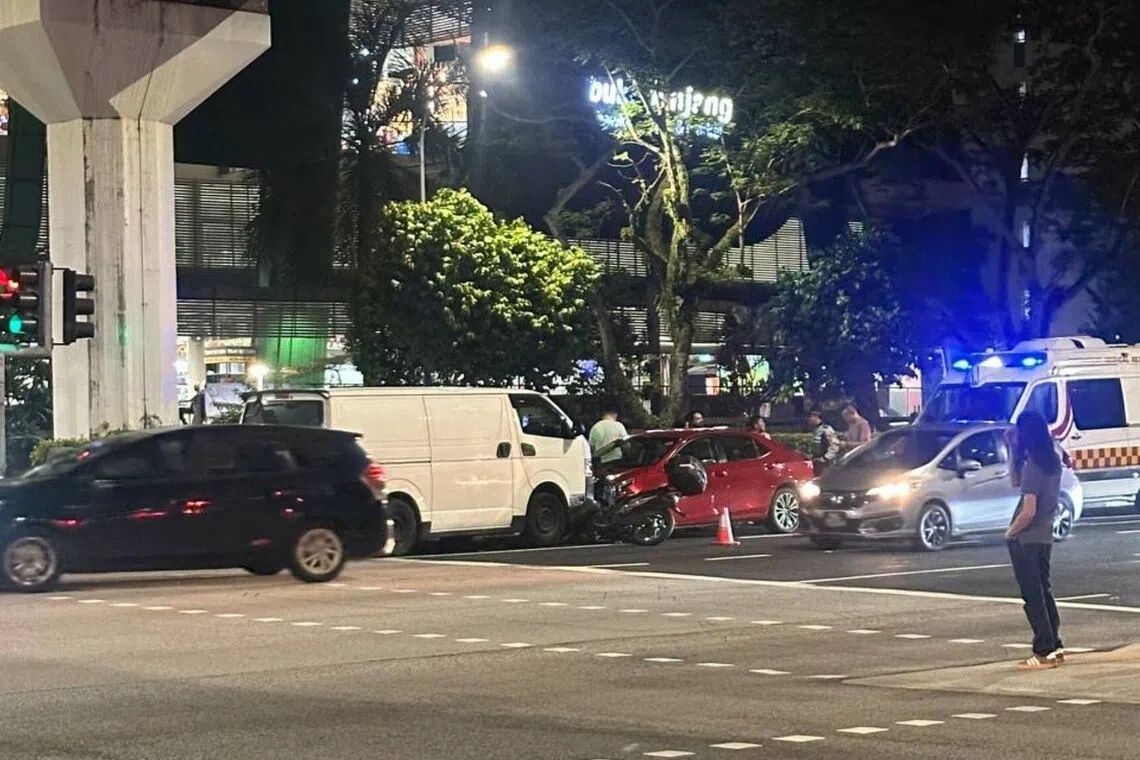
A 27-year-old man operating a commercial van has been taken into police custody following a serious traffic incident in Singapore's Bukit Panjang neighbourhood that left several vehicles damaged and at least two people injured. The multi-vehicle collision occurred on Bukit Panjang Road near its junction with Bukit Panjang Ring Road at approximately 9pm on Friday, August 14, according to statements from law enforcement and emergency services responding to the scene.
The incident involved four separate vehicles: the van in question, a motorcycle, and two passenger cars. Initial observations from eyewitness footage suggest the van was travelling in the wrong direction along the roadway at the moment of impact, colliding head-on with a red sedan while a motorcycle became trapped between the two larger vehicles. A black sedan was also struck in the sequence of collisions, sustaining damage in the parking area metres behind the primary point of contact. The chain-reaction nature of the accident underscores the severity of the initial impact and the danger posed to other road users in the vicinity.
Police investigations focused immediately on the van driver as the primary focus, with officers suspecting that impairment from controlled substances played a contributory role in the accident. The circumstances of the collision—particularly the vehicle travelling against traffic flow—raised immediate red flags for investigating officers who were dispatched to secure the scene. This suspicion led to a comprehensive search of the vehicle, which yielded evidence that would substantiate their initial concerns about the driver's state of consciousness and sobriety at the time of the incident.
Among the items recovered during the police search of the van were two electronic vaporising devices and three replacement cartridge pods typically used with such equipment. While such devices are increasingly prevalent in society, their presence in a vehicle involved in a serious accident sparked official concern regarding their contents and potential contribution to the driver's impaired state. The seizure of these items reflects law enforcement's broadened approach to detecting drug use beyond traditional narcotics, recognising that vaporising technology can be used to consume various prohibited substances.
The Health Sciences Authority, Singapore's regulatory agency overseeing drug and substance testing, has taken possession of the vaporising equipment for detailed chemical analysis. This referral process is crucial for establishing whether the devices contained controlled substances and whether residual traces could indicate recent consumption by the driver. The laboratory analysis may take several weeks to complete, but the results could form a critical component of the prosecution's case and help establish causation between substance use and the accident.
Medical responses at the scene indicated that two individuals sustained minor injuries from the collision. Despite the intervention of the Singapore Civil Defence Force, who attended to provide emergency care and vehicle extrication if necessary, both injured parties declined transportation to a hospital facility. Their refusal of medical attention suggests the injuries, whilst requiring assessment, were not deemed serious enough by the affected parties to warrant immediate hospitalisation. However, this does not diminish the potential for delayed injury manifestation or the severity that could have resulted from a more direct impact.
The arrest of the 27-year-old driver on suspicion of driving under the influence of drugs represents the most serious charge emerging from the incident, though additional traffic violations are likely to follow upon finalisation of investigations. Driving whilst impaired by drugs carries substantial penalties under Singapore's strict road safety regulations, including potential jail sentences, substantial fines, and automatic driving licence suspension. The mandatory testing regime following such arrests ensures that any substance detected can be quantified and traced to a specific timeframe.
This incident reflects a broader concern across Southeast Asia regarding drug-impaired driving, which remains significantly underdetected compared to alcohol-related impairment despite posing equally severe public safety risks. The visibility of this case through social media documentation and mainstream press coverage serves as a reminder of the escalating problem, particularly given the proliferation of synthetic drugs and novel consumption methods that traditional roadside testing may not immediately identify. Malaysian authorities and regional transport safety bodies monitor such incidents closely as they provide insight into emerging trends and enforcement approaches.
The investigation remains ongoing, with police statements indicating that additional forensic analysis and witness interviews will inform the eventual charging decision. The footage circulated through social media accounts such as sgfollowsall provides visual corroboration of the accident sequence and may assist in establishing liability and causation. As the case progresses through Singapore's judicial system, it will likely generate discussion regarding drug testing protocols, vaporising device regulation, and the adequacy of current roadside detection methods for identifying impaired drivers using modern consumption technologies.

