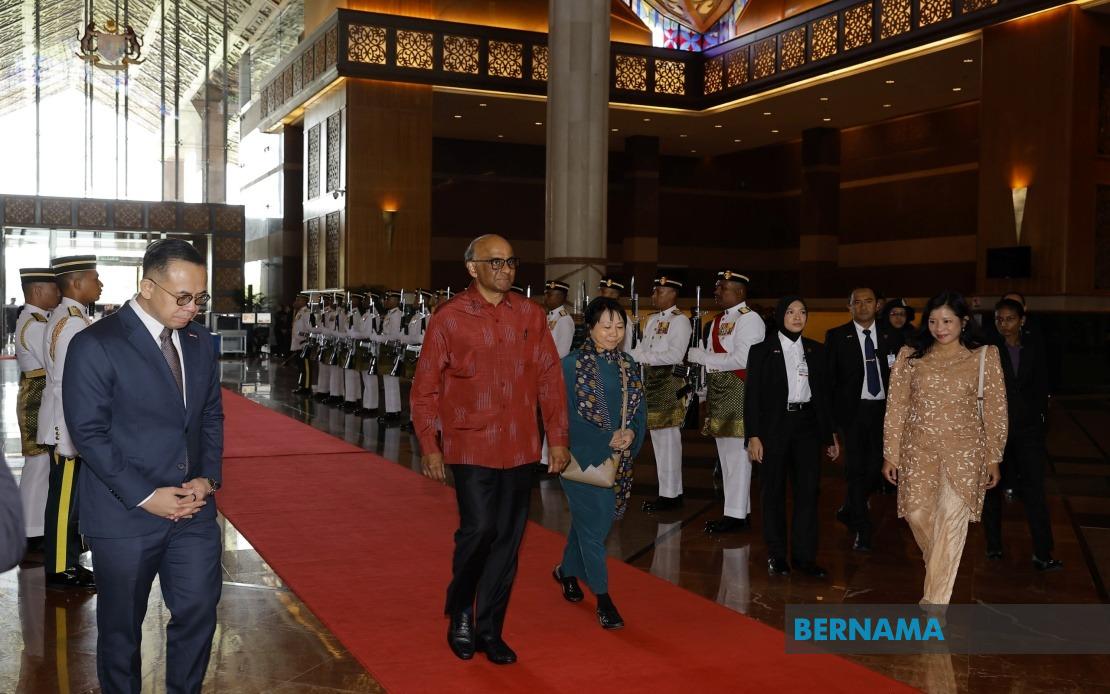
Singapore President Tharman Shanmugaratnam concluded his three-day state visit to Malaysia on Monday, departing from Kuala Lumpur International Airport at 2.20 pm aboard a commercial flight to Singapore, accompanied by his wife Jane Ittogi and a delegation. The departure was marked by formal protocol, with a static Guard of Honour comprising two officers and 26 personnel from the First Battalion of the Royal Ranger Regiment presented at the airport's Bunga Raya Complex. Minister of Entrepreneur and Cooperatives Development Steven Sim attended the farewell ceremony, underscoring the official nature of the occasion.
The visit, which commenced on Sunday at the invitation of His Majesty Sultan Ibrahim, King of Malaysia, held particular significance as Tharman's inaugural state visit to the country since his inauguration as Singapore's ninth President on September 14, 2023. The timing and formality of the trip reflected the mutual commitment between the two neighbours to strengthen and maintain their deeply rooted diplomatic relationship. Such high-level visits serve as crucial mechanisms through which Southeast Asian neighbours reinforce their shared interests and address bilateral matters of importance.
Monday's itinerary included the formal state welcoming ceremony at Istana Negara, where Tharman was received with full ceremonial honours befitting a visiting head of state. This was followed by a private audience with Sultan Ibrahim, allowing both leaders to engage in substantive discussions regarding matters of mutual concern. The breadth of Malaysian representation at subsequent meetings demonstrated the cross-governmental importance placed on strengthening Singapore relations across multiple portfolios and policy areas.
Prime Minister Datuk Seri Anwar Ibrahim extended a courtesy call to the visiting Singapore President, signalling the priority the Malaysian government places on this bilateral relationship at the highest political level. The meeting was attended by Foreign Minister Datuk Seri Mohamad Hasan, Investment, Trade and Industry Minister Datuk Seri Johari Abdul Ghani, and Sim, indicating that discussions likely touched on trade, investment, and broader economic cooperation between the two nations. Such multifaceted representation allows for comprehensive dialogue covering the full spectrum of bilateral engagement.
The visit also included protocol meetings with state-level leadership, reflecting the federal nature of Malaysian governance. On the previous day, the Sultan of Selangor, Sultan Sharafuddin Idris Shah, granted an audience to President Tharman at Istana Alam Shah, extending courtesies that demonstrate how state-level rulers participate in Malaysia's diplomatic framework. These engagements are particularly meaningful given Malaysia's constitutional structure, where Yang di-Pertuan Agong and the state sultans play formal diplomatic roles.
This state visit fundamentally served as reciprocal acknowledgment of Sultan Ibrahim's official trip to Singapore on May 6 and 7, 2024, maintaining the customary diplomatic balance essential to bilateral relations. Such reciprocal visits between heads of state are conventional diplomatic practice, ensuring that neither nation's leader receives visits without returning them in kind. For Singapore and Malaysia, these exchanges carry added weight given their geographical proximity, shared maritime interests, and interconnected economic systems that make their relationship one of the most operationally complex in Southeast Asia.
The visit underscores the enduring closeness and longstanding ties binding the two countries, despite occasional tensions that periodically surface in their relationship. Beyond the ceremonial aspects, such high-level exchanges provide platforms for resolving outstanding issues, negotiating new agreements, and aligning positions on regional matters. For Malaysia and Singapore, areas of ongoing cooperation span trade, transportation, water agreements, aviation, and increasingly, efforts to manage maritime boundaries and environmental concerns.
For Malaysian readers, the successful conclusion of this state visit carries implications for bilateral economic relations, particularly given the presence of Investment, Trade and Industry officials during Tharman's meetings with Malaysian leadership. Enhanced bilateral relations often translate into improved investment flows, facilitated business dealings, and expanded trade opportunities for Malaysian enterprises operating in Singapore or doing business with Singaporean counterparts. The explicit attention to these portfolios suggests active discussions regarding trade facilitation and investment promotion.
Singapore's strategic importance to Malaysia extends beyond bilateral relations to regional dynamics. As a key Southeast Asian financial hub and gateway to global markets, Singapore's relationship with Malaysia influences broader ASEAN cohesion and effectiveness. Tharman's visit, through its demonstration of cordial state-to-state relations, contributes to the stability and predictability that characterizes the region's diplomatic environment. This is particularly significant given ongoing regional challenges including South China Sea disputes, economic integration initiatives, and climate cooperation efforts where Malaysia and Singapore often coordinate positions.
The formal nature of Tharman's visit, complete with full state honours and multi-level engagement across Malaysian government agencies, reflects how both nations continue to treat their bilateral relationship as a priority despite their differences. In the broader context of Southeast Asian geopolitics, where larger powers vie for influence and smaller nations navigate complex strategic choices, the maintenance of strong bonds between neighbouring countries provides stability and reinforces ASEAN's principle of non-interference and peaceful resolution of differences.

