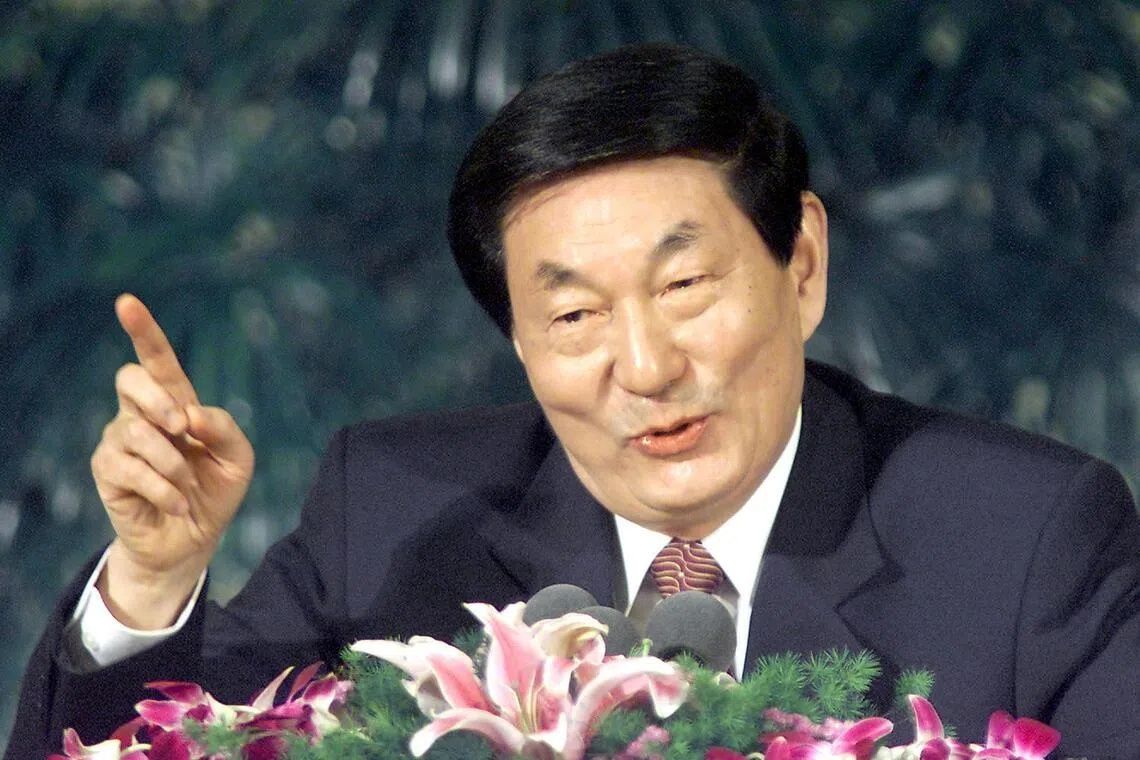
Singapore's Prime Minister Lawrence Wong has conveyed his condolences to Chinese Premier Li Qiang following the passing of Zhu Rongji, one of China's most influential economic architects of the reform era. Zhu died in Beijing on Wednesday, August 12, just two months before what would have been his 98th birthday, according to Chinese state news agency Xinhua. Through a formal letter dated August 13, PM Wong acknowledged the former premier's extraordinary legacy in reshaping China's economy and positioning the nation as a major player on the global stage.
In his tribute, PM Wong highlighted Zhu's instrumental role in advancing China's economic reform programme and orchestrating the country's accession to the World Trade Organization in 2001—a watershed moment that integrated China into the global trading system and fundamentally altered economic dynamics across Asia. The Singapore leader characterised Zhu as possessing remarkable strategic foresight and determination, qualities that proved essential during a critical period of China's development. This recognition reflects Singapore's appreciation for leaders whose vision extends beyond their own borders to shape regional prosperity.
PM Wong elevated Zhu's status in Singapore's diplomatic consciousness by describing him as "an old friend of Singapore," a designation that underscores the depth of bilateral relationships cultivated over decades. The former Chinese leader maintained personal connections with Singapore's senior statesmen, meeting on numerous occasions with former prime ministers Lee Kuan Yew and Goh Chok Tong. These high-level engagements established channels of communication and mutual understanding that transcended formal diplomacy, allowing for candid discussion of regional challenges and opportunities during a transformative period in Asia's history.
A particularly significant marker of Zhu's influence came in 1999 when he became the first Chinese leader to deliver the Singapore Lecture, the prestigious annual public forum organised by the ISEAS – Yusof Ishak Institute. This platform, which brings together prominent world leaders and scholars to address global and regional affairs, became an opportunity for Zhu to articulate his vision for China's economic trajectory and its implications for the wider Asia-Pacific region. His presence and participation in this intellectual forum signalled China's growing confidence and willingness to engage in substantive dialogue about its development model and regional role.
In his Singapore Lecture, Zhu articulated a strategic perspective that linked China's domestic economic growth directly to broader Asian prosperity. He proposed establishing a free trade area between the Association of Southeast Asian Nations (Asean) and China, a concept that reflected his understanding that economic integration could deepen ties across the region and create mutual benefits. This proposition was prescient, preceding by several years the formal launch of the China-Asean Free Trade Area, which would eventually become one of the world's largest regional trading blocs. For Singapore and other Southeast Asian nations, Zhu's advocacy for closer economic cooperation validated regional interests in engaging constructively with a rising China.
The realisation of Zhu's regional vision has become evident in subsequent decades. Today, China stands as a cornerstone economic partner for Singapore and throughout Southeast Asia, with trade volumes and investment flows that would have seemed remarkable in 1999. PM Wong explicitly acknowledged this validation, noting that Zhu's strategic foresight regarding the mutually beneficial nature of China's economic development has been substantially borne out. This retrospective assessment demonstrates how regional leaders in Singapore recognised and valued far-sighted economic thinking, even when the full implications might not have been immediately apparent.
Beyond grand regional vision, Zhu's practical contributions to Singapore-China relations were equally significant. He served as an early and enthusiastic supporter of the China-Singapore Suzhou Industrial Park, the flagship government-to-government development project that became a template for subsequent bilateral cooperation. This park exemplified how two nations with different systems could collaborate on concrete economic ventures that generated tangible benefits for both sides. The project also demonstrated Zhu's willingness to move beyond rhetoric to implement policies that embedded Singapore's interests within China's development strategy.
During his tenure as Shanghai mayor, Zhu actively fostered exchanges and mutual learning between Singapore officials and their Shanghai counterparts. These bureaucratic interactions, while perhaps less visible than high-level state visits, proved invaluable in building institutional understanding and establishing practical working relationships. By encouraging Shanghai officials to learn from Singapore's experience in economic management, urban planning, and governance, Zhu was positioning Chinese leaders to absorb lessons from a successful Asian city-state and adapt them to Chinese contexts. This openness to learning from neighbouring societies reflected an intellectual humility that characterised Zhu's approach to modernisation.
PM Wong characterised these accumulated efforts—from institutional partnerships to official exchanges—as laying the essential groundwork for the extensive and multifaceted relationship that Singapore and China maintain today. The friendship between two nations, he implied, rests not on momentary diplomatic gestures but on sustained engagement at multiple levels. Zhu's contribution to this foundation, spanning roles as Shanghai mayor, premier, and elder statesman, demonstrates how individual leaders can shape bilateral trajectories through consistent engagement and forward-thinking policies.
The significance of Zhu's passing extends beyond Singapore's bilateral relationship with China. Throughout Southeast Asia, policymakers and analysts regard him as a pivotal figure whose economic policies and regional outlook fundamentally shaped the post-1990s Asian landscape. His vision of a prosperous China contributing to rather than destabilising regional growth influenced how the region approached engagement with Beijing during a period of rapid power transitions. For Malaysian observers and policymakers, Zhu's legacy underscores the importance of economic interdependence and the potential for constructive great power relationships rooted in mutual benefit.
PM Wong's final assessment—that Zhu will be remembered for his distinguished contributions to both China's development and Singapore-China relations—encapsulates how regional leaders evaluate historical figures. The measure of statesmanship extends beyond domestic achievement to encompass the quality of relationships cultivated with neighbours and partners. In this regard, Zhu Rongji's record represents a model of pragmatic, economically-grounded diplomacy that prioritised concrete cooperation over ideological posturing, a lesson that remains relevant for Southeast Asian nations navigating relationships with major powers in an increasingly complex regional environment.

