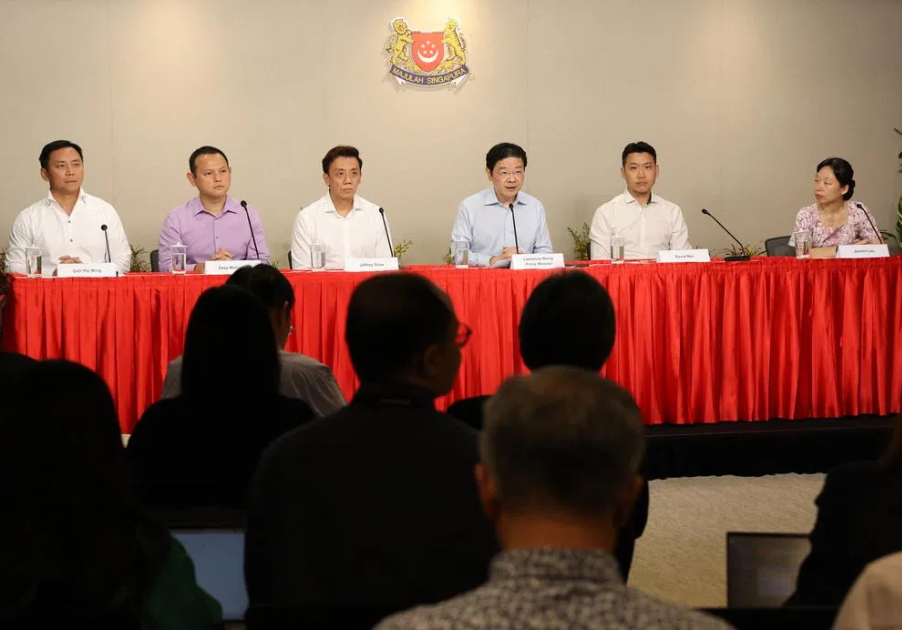
Prime Minister Lawrence Wong has unveiled a restructured Singapore Cabinet designed to blend the stability of experienced leadership with the advancement of a younger generation of politicians. The reshuffle, announced on July 22, reflects the government's deliberate strategy to build a pipeline of future leaders while navigating immediate national challenges through the expertise of senior office-holders. The announcement comes shortly after two Cabinet-level resignations in 2026, prompting Wong to recalibrate the ministerial line-up to ensure continuity and strength in governance.
The most significant promotions in this round of changes involve two politicians first elected to Parliament in the 2025 general election. Jeffrey Siow and David Neo have been elevated from acting ministerial roles to full minister status, marking a rapid ascension for first-term parliamentarians. Siow, who has been Acting Transport Minister since May 2025, will continue in that portfolio as a full minister, while Neo, serving as Acting Minister for Culture, Community and Youth, will similarly retain his position with enhanced authority. Both appointments signal Wong's confidence in their administrative capabilities and capacity to manage complex policy domains independently.
Beyond these two promotions, several other restructurings reshape the distribution of Cabinet responsibilities. Sim Ann, another first-term politician, has been appointed Second Minister for Foreign Affairs and Home Affairs, a dual responsibility that underscores the government's trust in her ability to manage sensitive national security and international relations matters. Jasmin Lau, similarly a first-term member, takes the helm of the Manpower Ministry as acting minister, displacing the incumbent Tan See Leng, who transitions to become Minister for Trade and Industry with a specific focus on Energy and Industry portfolios.
The reshuffle also represents the reintegration of a key labour movement figure into formal Cabinet structures. Ng Chee Meng, the labour chief, returns to the Cabinet as Minister in the Prime Minister's Office after a period away from ministerial responsibilities. Simultaneously, K. Shanmugam receives elevation to Senior Minister status, joining Lee Hsien Loong as one of two most experienced members of the Cabinet. Wong explained that as Singapore navigates its generational leadership transition, the counsel and mentorship of such veteran politicians becomes increasingly valuable for guiding newer office-holders.
Two additional politicians round out the ministerial promotions: Foo Cexiang and Shawn Loh, both backbench MPs in their first parliamentary term and former senior civil servants, will assume positions as ministers of state. Their transition from the backbenches to junior ministerial roles exemplifies the administration's commitment to identifying and developing talent from within the parliamentary ranks, rather than relying solely on the existing ministerial cohort.
Wong articulated the strategic logic underlying these changes during his address at the National Press Centre. He emphasised that Singapore's governance model requires simultaneous investment in both stability and renewal, necessitating the retention of experienced hands while progressively transferring substantive authority to a new cadre of leaders. The new appointees have, according to Wong, demonstrated their capability and earned the confidence of both Cabinet colleagues and the civil service professionals who work under them during their probationary acting roles.
The Cabinet reshuffle occurs against a backdrop of two significant political departures in 2026. Acting Minister-in-Charge of Muslim Affairs Faishal Ibrahim resigned on July 20 following what Wong termed a "lapse of judgment" in managing his personal interactions, in addition to his role as Senior Minister of State for Home Affairs. Earlier, on June 1, senior minister of state Koh Poh Koon stepped down citing family reasons. These departures necessitated accelerated deliberation about ministerial allocation and prompted Wong to consider both planned succession strategies and unexpected vacancies requiring immediate attention.
Wong acknowledged that while Cabinet composition undergoes annual review as standard practice, the unanticipated resignations added urgency to the reshuffle timeline. He framed these disruptions not as setbacks but as imperatives to strengthen the government's succession pipeline beyond the ministerial level itself. Wong noted that robust leadership renewal requires cultivation of talent across multiple levels—not merely identifying candidates for ministerial elevation but simultaneously nurturing strong backbench politicians who can eventually progress through the system.
A notable structural decision involved Wong's deliberate choice not to appoint a second deputy prime minister alongside the existing Gan Kim Yong. Instead, Wong defended the current arrangement as providing sufficient senior leadership capacity through the Cabinet's three coordinating ministers: Shanmugam (National Security), Chan Chun Sing, and Ong Ye Kung, each overseeing different governmental domains. Wong suggested this structure remains appropriate to current circumstances while remaining subject to evolution as leadership renewal progresses further.
Regarding his continued tenure as Finance Minister since 2021, Wong characterised his search for a successor as "a work in progress." He articulated a philosophy emphasising that political leaders develop at varying paces, with some demonstrating readiness for expanded responsibilities earlier than others. His role, Wong explained, involves assessing each politician's development trajectory and assigning responsibilities commensurate with demonstrated competence and readiness. This gradual approach to responsibility allocation, Wong argued, reflects Singapore's distinctive model of leadership renewal, which emphasises continuity rather than abrupt generational shifts.
The July 27 implementation date marks the beginning of these transitions, though Wong indicated some changes would take effect later. The reshuffle represents the latest iteration of Singapore's deliberate, methodical approach to governmental renewal—simultaneously honoring the accumulated expertise of senior leaders while creating structural space for tested newcomers to assume greater authority. For Malaysian observers, this approach contrasts with various models adopted across Southeast Asia, offering a case study in how single-party dominant systems manage intergenerational political transitions through institutionalised succession planning rather than intra-party contestation or electoral uncertainty.

