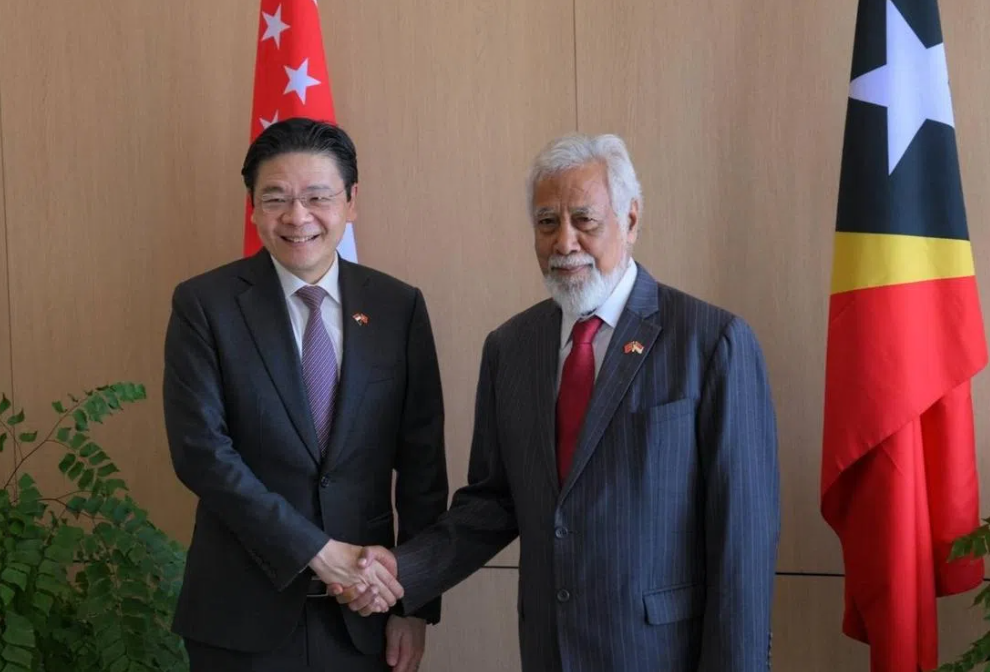
Prime Minister Lawrence Wong has concluded a historic two-day visit to Timor-Leste by cementing Singapore's commitment to deepen ties with the region's newest Asean member, positioning the city-state as a key economic and institutional partner for the nation's ongoing development. The visit culminated in the signing of a bilateral cooperation framework on July 3, witnessed by both premiers at the Government Palace in Dili, establishing structured channels for regular dialogue on economic, political and strategic matters that will reshape the relationship between the two small island nations.
The formal agreement creates a mechanism whereby foreign ministries from each country will conduct regular consultations extending beyond bilateral trade issues to encompass wider regional and international developments. This institutional architecture provides Singapore with enhanced influence in Timor-Leste's policy formation at a critical juncture when the nation is still consolidating its independence and integrating into regional bodies. For Timor-Leste, the arrangement offers access to Singapore's institutional expertise and diplomatic networks at a time when it remains vulnerable to external pressures and internal institutional fragmentation.
Economically, Singapore has already positioned itself as one of the largest foreign investors in Timor-Leste, with companies exploring opportunities across diverse sectors including wholesale trade and renewable energy development. PM Wong highlighted that these capital flows demonstrate growing confidence in Timor-Leste's economic prospects, yet the real breakthrough comes through labour market opening. From the second half of 2027, Singapore will designate Timor-Leste as a non-traditional labour source, permitting construction and marine shipyard companies to recruit Timorese workers on work permits, a significant development for both nations. This move addresses Singapore's persistent labour shortage while creating employment pathways for Timorese citizens, though it also raises questions about wage standards and worker protections in these sectors.
The labour initiative reflects practical recognition that both countries remain constrained by geography and scale, themes that PM Wong emphasised throughout the visit. His assertion that national destiny transcends size, achievable through partnership and determination, resonated particularly given Timor-Leste's precarious position as a young state navigating great-power rivalries in the Indo-Pacific. PM Gusmao reciprocated by describing Singapore as a trusted partner that had championed Timorese membership in Asean, acknowledging the substantial diplomatic effort required to bring Timor-Leste from independence in 2002 to regional integration in 2025.
Healthcare cooperation represents another pillar of the expanding relationship, with the National University Hospital and Timor-Leste's health ministry preparing to sign a five-year framework agreement later in July focusing on workforce development and institutional capacity-building. The collaboration targets emergency care, prehospital services, paediatrics, obstetrics and gynaecology, and other priority areas identified by Timor-Leste's health authorities. This arrangement addresses a critical vulnerability in Timor-Leste's nascent health system, which struggles with limited technical expertise and inadequate infrastructure, problems inherited from decades of occupation and compounded by poverty and geographic isolation.
Educational support forms the third major cooperation strand, with Singapore directing resources toward training Timorese school leaders and education administrators through engagement with the national teacher training institute. This initiative operates at the soft-power level, shaping institutional cultures and professional networks that will influence educational policy and practice for years ahead. By embedding Timorese educators in Singapore's training systems, Singapore cultivates a cohort of leaders with direct exposure to the city-state's meritocratic governance model and development philosophy, thereby extending influence beyond traditional aid relationships.
Timor-Leste's recent accession to Asean as the eleventh member state in October 2025 created both opportunities and pressures that explain Singapore's accelerated engagement. The nation faces immediate expectations to participate constructively in regional forums and mechanisms, yet lacks the institutional capacity developed by longer-established members. Singapore's expanded Stars package addresses this directly, providing targeted training for Timorese officials on Asean procedures and protocols. More significantly, Singapore has committed to hosting attachments for Timorese officials on its own chairmanship teams when it assumes the Asean rotating presidency in 2027, offering practical exposure to the mechanics of regional leadership.
Looking ahead to Timor-Leste's scheduled Asean chairmanship in 2029, Singapore recognises the stakes inherent in the transition. A poorly executed chair could damage Timor-Leste's credibility and regional standing, outcomes that would weaken Asean cohesion and create openings for external actors to exploit divisions. By investing in capacity-building now, Singapore positions itself as essential to Timor-Leste's success, creating reciprocal obligations and dependencies that favour the city-state's interests in shaping regional outcomes. The workshops on chairmanship duties being organised for Dili officials constitute preventive diplomacy, reducing risks of diplomatic missteps that could undermine the broader regional architecture.
The conferment of the Order of Timor-Leste (Grand Collar) upon PM Wong by President Jose Ramos-Horta formalised Singapore's contribution to nation-building, yet Wong's acceptance speech redirected credit toward individual Singaporeans who had served in training and capacity-building roles. This rhetorical move subtly reinforced Singapore's soft-power message: the relationship operates through people-to-people engagement and technical knowledge transfer rather than grand strategic imposition. Such framing proves particularly valuable in Timor-Leste, where memories of foreign domination remain visceral and nationalist sentiment runs high.
For Malaysian observers and policymakers, Singapore's Timor-Leste strategy offers instructive lessons about managing relationships with smaller, newer Asean members during their consolidation phases. The approach combines economic investment, labour mobility arrangements, institutional capacity-building, and strategic mentorship within a formal governance framework, creating multiple reinforcing bonds that entrench influence across multiple domains. Malaysia, as a larger regional player with its own development experiences, might consider whether similar multi-dimensional engagement strategies could strengthen ties with less-developed neighbours while positioning Malaysia as a preferred development partner and knowledge source within Southeast Asia.

