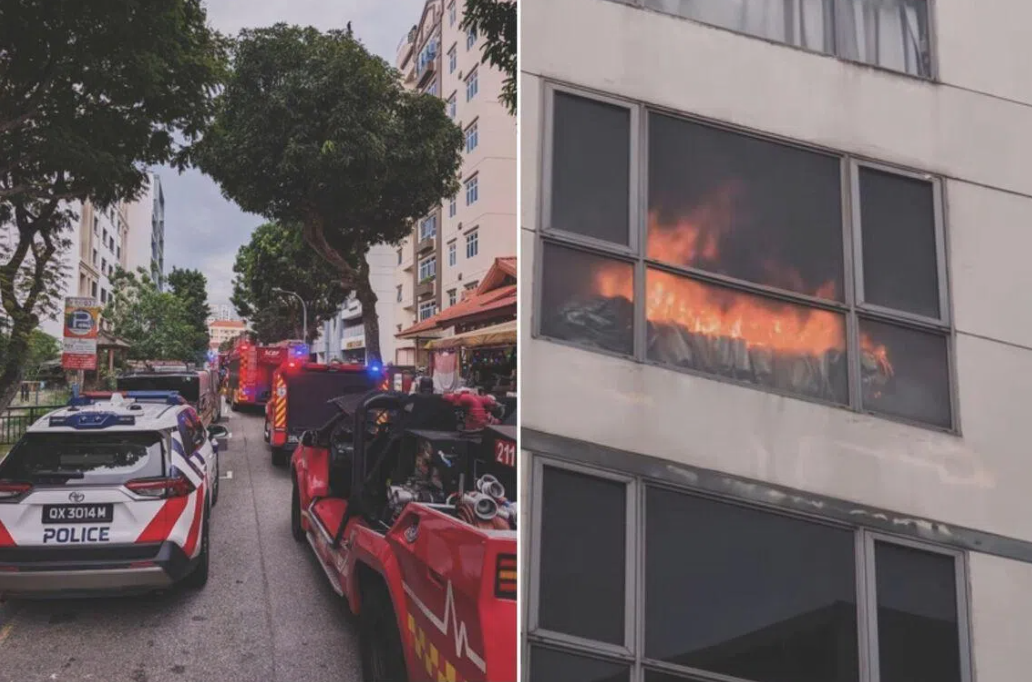
Five residents were forced to leave their homes after a power-assisted bicycle battery ignited while charging unattended in a seventh-floor unit at Casa Aerata condominium in Singapore's Geylang district on Sunday afternoon. The Singapore Civil Defence Force received the alert at 5.35pm and swiftly extinguished the blaze using standard firefighting equipment, preventing the situation from escalating into a major residential incident. No injuries resulted from the fire, though the incident underscores growing concerns about the hazards posed by charging active mobility devices in residential settings without proper supervision.
The fire originated in the living room of the affected unit, where the battery was being charged without anyone present to monitor it. Preliminary investigations by the SCDF determined that the fire was electrical in nature, stemming directly from the power-assisted bicycle's battery system. This finding aligns with a broader pattern of electrical fires linked to active mobility devices across Singapore's residential properties. The SCDF response involved evacuating residents from neighbouring units as a precautionary step, demonstrating the standard safety protocols authorities deploy when fires originate from potentially dangerous power sources in multi-unit residential buildings.
The incident gained further attention when Cai Yinzhou, the Member of Parliament for Bishan-Toa Payoh GRC, arrived at the scene after noticing smoke and hearing emergency sirens in the vicinity. His rapid response included clearing the area directly beneath the burning unit in anticipation of structural damage from the intense heat, a concern that materialised when a window eventually shattered due to thermal stress. His presence and public account of the incident highlighted the real dangers posed by unattended battery charging in densely populated residential areas, where fire spread and evacuation challenges are magnified by proximity to neighbouring units.
The SCDF has intensified public messaging around the safe use and maintenance of active mobility device batteries. Officials specifically cautioned residents against purchasing or installing non-original replacement batteries in power-assisted bicycles and personal mobility devices, as such batteries often lack the safety certifications and quality controls built into manufacturer-approved components. The use of counterfeit or inferior batteries dramatically increases fire risk, as these products frequently lack adequate thermal management systems and protective circuitry that prevent overcharging and short circuits. This warning extends across the entire spectrum of active mobility devices, from e-bikes and e-scooters to motorised personal aids.
Equally critical is the SCDF's guidance against extended or overnight charging of active mobility device batteries, particularly in enclosed residential spaces. Charging for prolonged periods without interruption or supervision creates conditions where thermal runaway—a chain reaction of overheating within the battery—can occur undetected. Once initiated, thermal runaway generates intense heat that can ignite surrounding materials and spread rapidly through a confined space. The risks are compounded in condominium settings, where fires can potentially affect adjacent units through shared ventilation systems, electrical conduits, and structural openings, endangering multiple families simultaneously.
Statistics compiled by the SCDF reveal a complex landscape of active mobility device-related fires across Singapore's residential sector. In the first two months of 2025, active mobility devices were responsible for 34 of the 304 electrical fires reported at residential premises, representing roughly eleven percent of all domestic electrical fire incidents. This proportion underscores that while active mobility device fires remain a minority of residential electrical emergencies, they represent a distinct and growing category of hazard that requires targeted safety interventions. The figures demonstrate that as e-bikes, e-scooters, and similar devices become increasingly common in urban households, fire risk management must evolve in parallel.
A closer examination of the year-on-year data reveals nuanced trends within the active mobility device category itself. Although the overall number of active mobility device fires declined from 67 incidents in 2024 to 49 in 2025, this apparent improvement masks a troubling shift in the composition of these fires. Personal mobility device fires, predominantly e-scooters, increased from 25 to 31 cases during the same period, suggesting that the e-scooter subset is becoming proportionally more hazardous relative to other active mobility devices. This divergence may reflect differences in battery technology, charging practices, or the prevalence of non-original components across different device categories, warranting more granular investigation into which products and usage patterns drive the highest risk.
For Malaysian readers and residents throughout Southeast Asia, the Geylang incident carries significant relevance as e-bikes and e-scooters have surged in popularity across the region's urban centres. Cities including Kuala Lumpur, Bangkok, and Jakarta have experienced rapid growth in last-mile mobility solutions, often accompanied by similar gaps in public awareness about battery safety and charging best practices. The regulatory frameworks governing the sale and use of active mobility devices in Malaysia remain less developed than Singapore's regime, creating potential vulnerabilities where substandard or counterfeit batteries may enter the market with limited oversight. Malaysian apartment dwellers and condominium managers should pay close attention to Singapore's experience and proactively establish charging guidelines before incidents occur in local residential complexes.
The incident also highlights the intersection of consumer choice, regulatory enforcement, and personal responsibility in managing emerging technologies within residential environments. While authorities can issue safety advisories and regulate the sale of batteries, individual users must make deliberate choices about purchasing original components, monitoring charging activities, and following manufacturer guidelines. The fire at Casa Aerata represents a failure at the user level—an unattended charging session—rather than a systemic regulatory gap, yet it resulted in neighbourhood-wide disruption. This pattern suggests that education campaigns must shift from purely informational messaging toward behavioural change, perhaps through community engagement initiatives or incentive structures that reward safe charging practices.
Looking forward, the management of active mobility device batteries in residential settings will likely become an increasingly important issue for building management corporations, municipal authorities, and residents' associations across Southeast Asia. Some jurisdictions have begun exploring dedicated charging stations in common areas, battery swapping systems that reduce overnight charging needs, and stricter regulations on battery composition and safety certification. Singapore's incident demonstrates that reactive measures alone—responding to fires after they occur—are insufficient to protect residential communities. Proactive strategies, including fire-rated storage solutions, automatic charging cutoff systems, and neighbourhood awareness programmes, may offer more sustainable approaches to integrating active mobility devices into residential life without compromising safety.

%22%2F%3E%3C%2Fpattern%3E%3C%2Fdefs%3E%3Crect%20width%3D%22100%25%22%20height%3D%22100%25%22%20fill%3D%22url(%23ph3sqpyg)%22%2F%3E%3Crect%20width%3D%22100%25%22%20height%3D%22100%25%22%20fill%3D%22url(%23ph3sqpyp)%22%2F%3E%3Ctext%20x%3D%2250%25%22%20y%3D%2250%25%22%20text-anchor%3D%22middle%22%20dominant-baseline%3D%22central%22%20fill%3D%22rgba(255%2C255%2C255%2C0.95)%22%20font-family%3D%22Georgia%2C%20'Times%20New%20Roman'%2C%20serif%22%20font-weight%3D%22700%22%20font-size%3D%22320%22%20letter-spacing%3D%22-0.02em%22%3EPM%3C%2Ftext%3E%3C%2Fsvg%3E)
%22%2F%3E%3C%2Fpattern%3E%3C%2Fdefs%3E%3Crect%20width%3D%22100%25%22%20height%3D%22100%25%22%20fill%3D%22url(%23ph3l4smg)%22%2F%3E%3Crect%20width%3D%22100%25%22%20height%3D%22100%25%22%20fill%3D%22url(%23ph3l4smp)%22%2F%3E%3Ctext%20x%3D%2250%25%22%20y%3D%2250%25%22%20text-anchor%3D%22middle%22%20dominant-baseline%3D%22central%22%20fill%3D%22rgba(255%2C255%2C255%2C0.95)%22%20font-family%3D%22Georgia%2C%20'Times%20New%20Roman'%2C%20serif%22%20font-weight%3D%22700%22%20font-size%3D%22194%22%20letter-spacing%3D%22-0.02em%22%3EBersatu%3C%2Ftext%3E%3C%2Fsvg%3E)