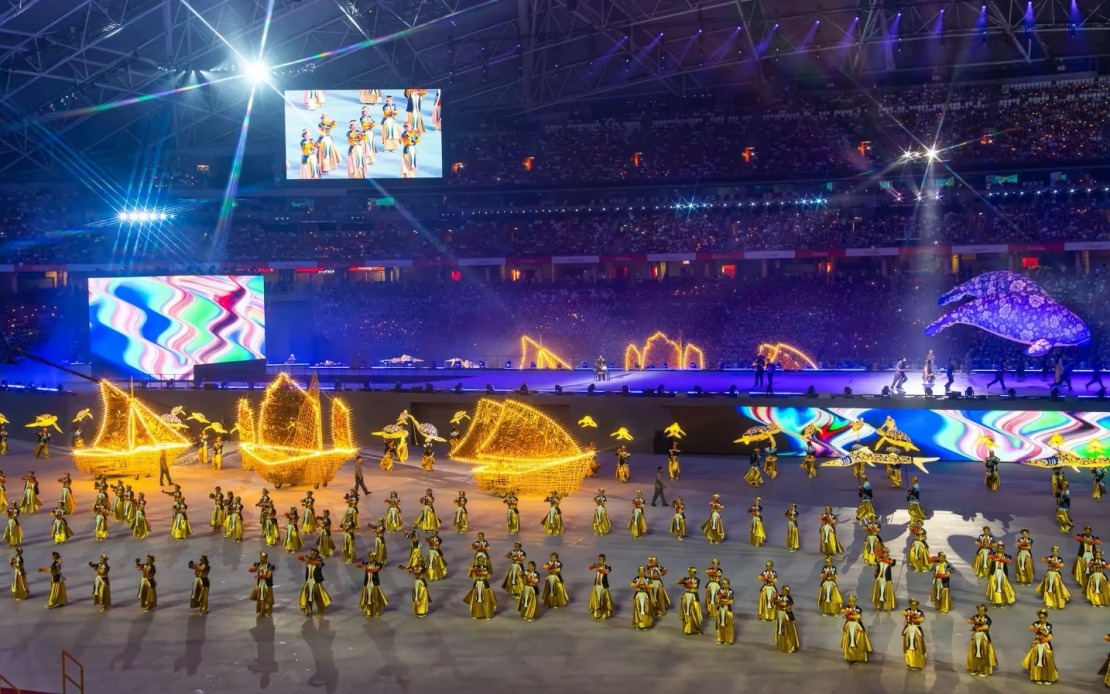
Singapore rang in its 61st National Day on Sunday with a momentous occasion: the return of the National Day Parade to the National Stadium after a gap of ten years. The celebration unfolded under the inspiring banner "Majulah Singapura, Go Beyond!", resonating with the city-state's enduring commitment to progress and excellence. The milestone gathering drew approximately 42,000 members of the public to the iconic venue, many adorned in the national colours of red and white, creating a sea of patriotic sentiment that filled the stadium's expanse.
President Tharman Shanmugaratnam and Prime Minister Lawrence Wong, alongside the full Cabinet and Members of Parliament, presided over the NDP 2026 ceremony, underscoring the significance of the occasion for Singapore's political leadership. Their presence at the event reflected the importance placed on national cohesion and the marking of another year in the republic's journey since independence. The gathering of senior government figures at the National Stadium symbolised the continuity of institutional traditions that have characterised Singapore's development over six decades.
A significant innovation marked this year's festivities: for the first time in Singapore's 61-year history, the Presidential Gun Salute and State Flag Flypast extended beyond the National Stadium itself, moving to Kallang Basin. This spatial expansion of the traditional ceremonial elements represented a deliberate effort to democratise the experience, allowing citizens across the broader precinct to witness the historic ritual. The spectacle featured four 25-pounder Howitzer guns mounted on Mobility 3rd Generation rafts, which sailed across the basin in a striking maritime display that brought the dignified gun salute experience closer to thousands of additional spectators gathered throughout the Kallang area.
The traditional gun salute itself enlisted the participation of 151 military personnel drawn from the 23rd Battalion of the Singapore Artillery and 35th Battalion of Singapore Combat Engineers. This ceremonial element, steeped in protocol and military precision, remained central to the national observance even as the parade's infrastructure underwent transformation. The integration of water-based delivery mechanisms for the artillery pieces demonstrated how Singapore continues to blend historical convention with contemporary logistics and public engagement strategies.
The formal parade and ceremony segment commenced at approximately 6 pm, unfolding under the thematic banner "Go Beyond Self". The procession marshalled 32 distinct contingents encompassing more than 2,000 participants across multiple categories. The Guard of Honour contingents numbered six, drawn from the Singapore Army, Republic of Singapore Navy, Republic of Singapore Air Force, the newly prominent Digital and Intelligence Service, Singapore Police Force, and Singapore Civil Defence Force. These 72 personnel, positioned to escort the Singapore Armed Forces Colours Party, represented the full spectrum of Singapore's security and governance apparatus.
Supporting the core ceremonial elements were ten contingents from uniformed youth organisations, reflecting Singapore's investment in developing younger generations within structured, nationally-oriented frameworks. An additional sixteen supporting contingents rounded out the parade composition, creating a comprehensive cross-section of state institutions and organised civil society. This multifaceted parade structure conveyed not merely the apparatus of the state, but the interlocking layers of national organisation that sustain Singapore's functioning as a developed city-state.
Beyond the formal parade mechanics, the evening featured an elaborate show segment grounded in the overarching theme of "Go Beyond". This entertainment component mobilised an impressive roster of 36 artistes and more than 2,600 performers who crafted a narrative arc celebrating Singaporean achievement and identity. The production blended authentic storytelling rooted in citizens' lived experiences with cutting-edge technological innovation, complemented by a carefully curated musical score designed to evoke emotional resonance and national pride.
Particularly noteworthy among the show's features was its deliberate inclusivity in casting and choreography. The segment featured seven dancers from markedly diverse backgrounds, including performers with disabilities—specifically an autistic dancer and a dancer with Down syndrome. This programming choice articulated a conscious message about societal belonging and contribution. By centering these performers within the spectacle rather than relegating them to marginal roles, the parade organisers visibly demonstrated the principle that all Singaporeans, regardless of neurological differences or physical ability, possess inherent dignity and capacity to participate in shaping the nation's collective future.
The integration of performers with varying abilities into Singapore's most significant national celebration carries particular relevance for Southeast Asian audiences observing disability inclusion practices. Many regional nations continue wrestling with how to meaningfully incorporate persons with disabilities into civic and cultural participation. Singapore's approach—embedding such representation within the nation's highest-profile ceremonial event rather than cordoning it off into separate observances—suggests a different philosophical framework around inclusion and national identity that extends beyond mere tokenism.
From a regional perspective, Singapore's National Day celebrations offer interesting contrasts and comparisons with how other Southeast Asian nations mark independence or founding moments. While Singapore's approach emphasises technological sophistication, inclusive representation, and geographic expansion of ceremonial experience, it reflects the particular circumstances of a developed, densely populated city-state with advanced institutional capacity. For Malaysian observers and other regional audiences, Singapore's evolution of its national day traditions demonstrates how celebrations can be refreshed and reimagined while maintaining connection to historical precedent and national symbolism.
The decision to relocate the parade to the National Stadium after a decade away, combined with the expansion of ceremony into Kallang Basin, suggests deliberate curatorial choices about accessibility and public participation. Rather than concentrating the experience in a single venue accessible primarily to ticketholders and dignitaries, the organisers created multiple vantage points and participation opportunities. This distributed approach to national celebration reflects contemporary thinking about inclusive civic engagement and the democratisation of state pageantry.
Looking forward, Singapore's capacity to continually evolve its national day observance while maintaining ceremonial continuity offers lessons in how established traditions can accommodate innovation. The 61st celebration, with its firsts and expansions, suggests that the republic will continue adapting its annual commemoration to reflect changing demographics, technological possibilities, and societal values. For Southeast Asian policymakers and civic organisers, Singapore's approach demonstrates that venerable traditions need not calcify; rather, they can remain vibrant and relevant through thoughtful adaptation that preserves core meanings while expanding accessibility and contemporary resonance.

