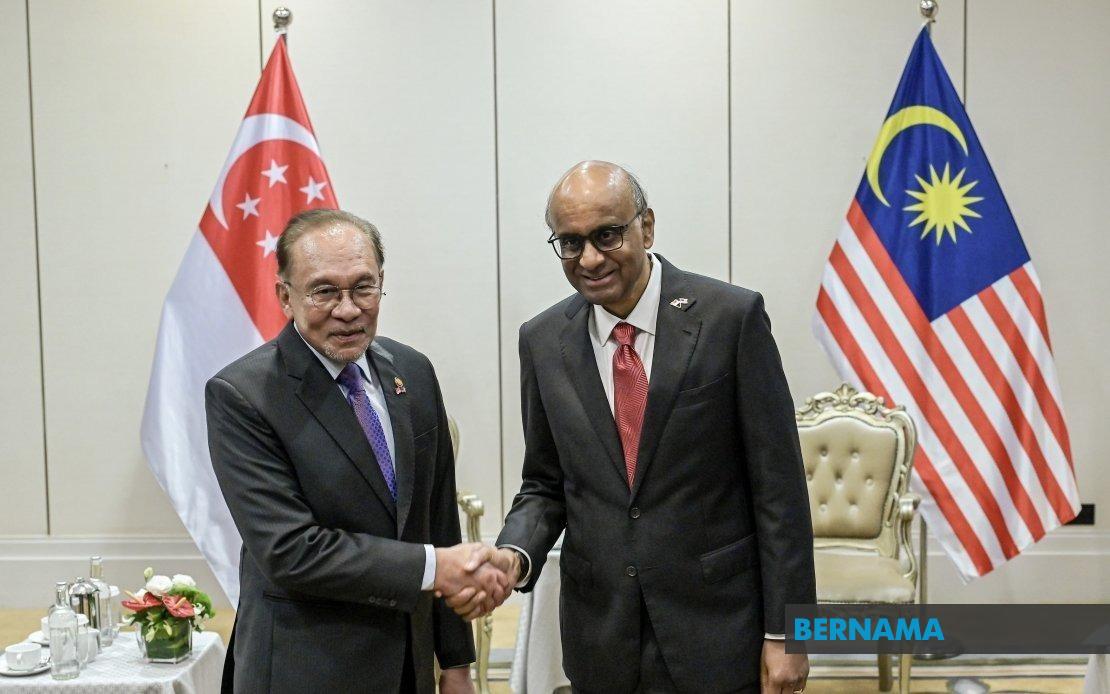
Singapore and Malaysia are moving to strengthen their bilateral relationship across critical economic and security domains, signalling a renewed focus on shared regional challenges. The commitment was articulated during President Tharman Shanmugaratnam's courtesy call on Prime Minister Datuk Seri Anwar Ibrahim on Monday, marking a significant moment in the relationship between the two closest neighbours in Southeast Asia.
President Tharman arrived in Malaysia on July 12 for an inaugural state visit that underscores the diplomatic importance Singapore places on its larger neighbour. The presidential delegation, which included his wife Jane Ittogi Shanmugaratnam, was ceremonially received at Istana Negara by His Majesty Sultan Ibrahim, King of Malaysia, and Her Majesty Raja Zarith Sofiah, Queen of Malaysia. Such high-level protocol reflects the significance both nations attach to maintaining robust bilateral ties at a time of shifting regional dynamics.
Food security and energy resilience have emerged as priority areas for the two governments, according to Singapore's Foreign Ministry. These domains reflect practical concerns facing both island-dependent Singapore and Malaysia, where supply chain vulnerabilities have become increasingly apparent in recent years. The region's exposure to global disruptions means that coordinated approaches to securing reliable sources of essential commodities can yield mutual benefits, particularly given Malaysia's agricultural capacity and energy resources.
Beyond economic matters, the two leaders engaged substantively on regional geopolitical developments that carry implications for both nations. Particular attention was devoted to the evolving situation in West Asia, a region whose instability can reverberate across global trade routes and Southeast Asia's strategic environment. Both President Tharman and Prime Minister Anwar underscored the necessity of maintaining stable international norms and institutions as a bulwark against unpredictability.
The explicit reaffirmation of commitment to international law, particularly the United Nations Convention on the Law of the Sea, reflects shared interests in maintaining an open and rules-based regional order. UNCLOS underpins maritime commerce that flows through Southeast Asian waters, affecting both nations' economies and security. Safeguarding freedom of navigation—a principle both leaders emphasised—remains essential for the region's stability and prosperity, given its position on critical shipping lanes.
During his stay, President Tharman expanded diplomatic engagement beyond the federal level. He met with the Sultan of Selangor, Sultan Sharafuddin Idris Shah, and Selangor Menteri Besar Datuk Seri Amirudin Shari on Tuesday, demonstrating interest in subnational cooperation. This approach recognises that Malaysian federalism means states possess significant administrative autonomy in various sectors, and direct engagement with state leadership can yield practical collaborative outcomes.
State-level discussions centred on vocational and technical education, an area where Singapore's expertise and Malaysia's training ecosystem could complement each other. Both nations face skills gaps in rapidly evolving sectors, and cross-border educational initiatives could help address labour market mismatches. Climate adaptation and flood mitigation featured prominently, reflecting the urgency of addressing environmental challenges that transcend borders. Selangor's experience with flooding and Singapore's technical capabilities in water management make this a natural area for knowledge transfer and joint problem-solving.
The growth of start-up ecosystems emerged as another collaborative frontier. Singapore has positioned itself as Southeast Asia's fintech and innovation hub, while Malaysia possesses a growing entrepreneurial class and younger demographic. Strategic collaboration in this space could facilitate Malaysian entrepreneurs' access to Singapore's capital and networks, while Singapore gains insights into emerging market dynamics. President Tharman's welcome for expanded Singapore-Selangor exchanges suggests willingness to deepen these developmental initiatives.
The visit demonstrates how bilateral relationships between neighbouring nations require constant cultivation at multiple governmental levels. By engaging with both federal and state actors, and addressing both traditional security concerns and contemporary economic challenges, Singapore and Malaysia are constructing a partnership architecture suited to 21st-century regional realities. The emphasis on international law and maritime norms also positions both nations as defenders of a stable rules-based order amid great power competition in the Indo-Pacific.
For Malaysia, deepening ties with Singapore offers pragmatic advantages in technology transfer, financial expertise, and best practices in governance. For Singapore, a stable and prosperous Malaysia underpins its own economic security and regional influence. The breadth of cooperation areas—spanning from food and energy through education to innovation—reflects understanding that modern prosperity is multidimensional and requires coordinated effort across sectors.
The visit occurred against a backdrop of complex regional dynamics, where Southeast Asian nations increasingly navigate relationships between major powers with competing interests. By reaffirming commitments to international law and rules-based order, Singapore and Malaysia offer a counterweight to unilateral approaches and underscore the region's preference for multilateral institutions and predictable norms. Their cooperation agenda, while focused on mutual benefit, also carries implications for broader Southeast Asian stability and coherence.

