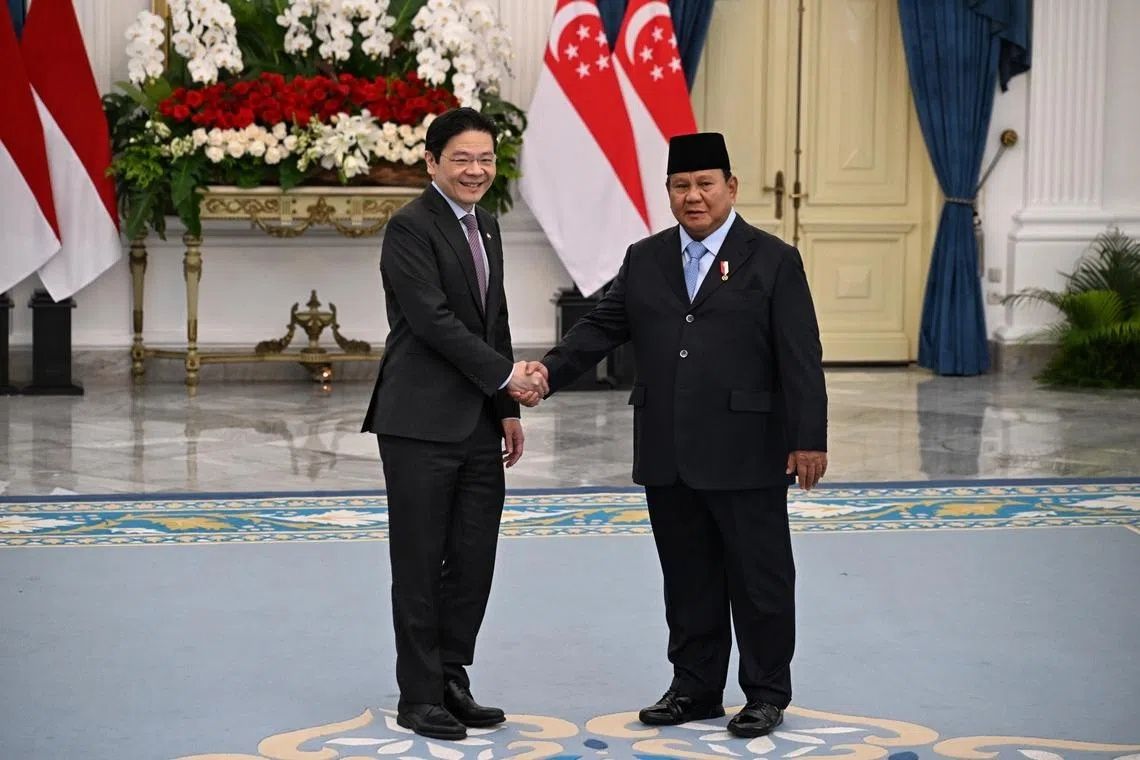
Singapore and Indonesia have jointly committed to maintaining the Strait of Malacca as an open, secure and accessible waterway for all nations, underscoring a deepening strategic partnership that both governments view as fundamental to regional prosperity and geopolitical stability. The pledge emerged from high-level talks between Prime Minister Lawrence Wong and President Prabowo Subianto during their annual Leaders' Retreat on July 6, where maritime security took centre stage alongside discussions on energy transition, digital infrastructure and cross-border economic integration.
The strategic synchronisation between the two Southeast Asian nations carries particular significance given the Strait's role as one of the world's most critical maritime chokepoints. Connecting the Indian Ocean to the South China Sea, this narrow waterway processes an enormous volume of international commerce and energy supplies annually, making its stability essential not just to regional economies but to global trade patterns. President Prabowo emphasised that Indonesia and Singapore, as neighbouring littoral states directly bordering the strait, bear shared responsibility for its security and openness. He stressed the imperative to maintain coordinated vigilance against piracy, pollution and maritime accidents whilst ensuring the corridor remains navigable under international law, particularly the United Nations Convention on the Law of the Sea.
PM Wong connected the maritime security agenda to contemporary global instability, referencing how recent Middle Eastern conflicts have disrupted traditional shipping lanes and energy flows. The closure of the Strait of Hormuz by geopolitical tensions has already demonstrated the severe economic consequences when major sea routes become compromised, underscoring why Singapore and Indonesia must act in concert to prevent similar disruptions in their region. By framing the Strait's accessibility as a non-negotiable principle, both leaders sent a clear message that no single power should be permitted to restrict or weaponise this vital conduit of commerce.
The commitment also reflects Indonesia's diplomatic position as the most influential littoral state within the strait, given its substantial territorial presence along the waterway. By coordinating with Malaysia and Thailand through established maritime forums, Indonesia seeks to establish binding multilateral protocols that transcend individual state interests and enshrine freedom of navigation as an inviolable principle. This regional framework strengthens the position of smaller maritime nations and prevents hegemonic powers from dominating these strategic passages.
Beyond the symbolic reaffirmation of maritime principles, the bilateral retreat revealed how Singapore-Indonesia ties are evolving into a comprehensive strategic partnership spanning new frontiers. The two countries have initiated concrete cooperation on cross-border electricity trade, with Indonesia's sovereign investment fund Danantara taking the lead in coordinating infrastructure development. Singapore-based firms including Keppel Electric, Sembcorp Industries and Singapore Energy Interconnections have signed agreements that establish technical and commercial frameworks for future electricity imports from Indonesia into the city-state.
This electricity corridor initiative holds profound implications for Southeast Asian energy security and climate ambitions. Indonesia possesses vast renewable energy potential through geothermal, hydroelectric and solar resources, whilst Singapore faces physical constraints as a densely populated island nation dependent on energy imports. Cross-border electricity commerce would allow Indonesia to monetise its renewable reserves whilst providing Singapore with cleaner energy alternatives to natural gas, reducing the region's carbon footprint whilst strengthening economic interdependence. PM Wong described the arrangement as a foundational building block for a broader ASEAN Power Grid, a visionary infrastructure project that could eventually integrate power systems across the entire association and create unprecedented energy resilience.
The expanded cooperation also encompasses digital infrastructure and cybersecurity, sectors increasingly critical to economic competitiveness in the post-pandemic era. Both governments acknowledge that digital ecosystems and supply chain vulnerabilities present emerging security challenges requiring coordinated responses. By strengthening collaboration in these domains, Singapore and Indonesia are positioning themselves as regional leaders in critical infrastructure protection whilst creating partnership models for other ASEAN members to emulate.
The supply chain resilience dimension of the bilateral relationship warrants particular attention for Malaysian observers. Regional supply chains have become increasingly fragmented and vulnerable to external shocks, as demonstrated by recent pandemic-induced disruptions. By formalising cooperation mechanisms, Singapore and Indonesia are attempting to create more robust cross-border logistics frameworks that could eventually extend throughout ASEAN, enhancing the bloc's collective resilience and reducing dependency on external supply corridors.
The retreat also served as a powerful demonstration of Singapore's long-term confidence in Indonesia's development trajectory and investment prospects. PM Wong repeatedly affirmed Singapore's commitment to Indonesia's economic growth, emphasising that the city-state's investments extend far beyond financial capital to encompass technology transfer, skill development and industrial ecosystem creation. The expansion of the Kendal Industrial Park in central Java, which reaches full capacity by 2025 and is scheduled to grow by an additional 1,000 hectares, exemplifies this model. Such industrial hubs generate substantial employment, attract regional manufacturing investment and contribute to Indonesia's evolution towards higher-value-added production.
PM Wong's emphasis on Singapore's confidence in Indonesia reflects broader strategic calculations about Southeast Asia's future economic architecture. As Indonesia consolidates its position as the region's economic engine, Singapore recognises that its own prosperity depends substantially on Indonesia's success. By positioning itself as a reliable development partner through infrastructure investment, technological collaboration and market access, Singapore ensures it remains central to Indonesia's transformation narrative rather than relegated to peripheral commercial transactions.
Looking forward, the 60-year diplomatic milestone in 2027 provides both nations with an opportunity to consolidate these expanding partnerships into enduring institutional frameworks. The evolution from trade-focused relations towards strategic infrastructure cooperation and shared security commitments signals a maturation of bilateral ties that transcends traditional economic calculation. For Malaysian readers, this deepening Singapore-Indonesia partnership carries direct implications for regional maritime governance, energy cooperation and economic integration patterns that will shape Southeast Asian dynamics throughout this decade.
The commitment to keep the Strait of Malacca open and free ultimately represents both countries' recognition that their individual prosperity remains inextricably linked to regional stability and rules-based international commerce. By publicly reaffirming these principles and translating them into concrete infrastructure projects and security protocols, Singapore and Indonesia are effectively raising the diplomatic and institutional barriers against any power seeking to exploit maritime chokepoints for geopolitical advantage. This strategic alignment, though framed in cooperative language, constitutes a quiet but significant assertion of Southeast Asian agency in managing one of the world's most critical strategic commons.

