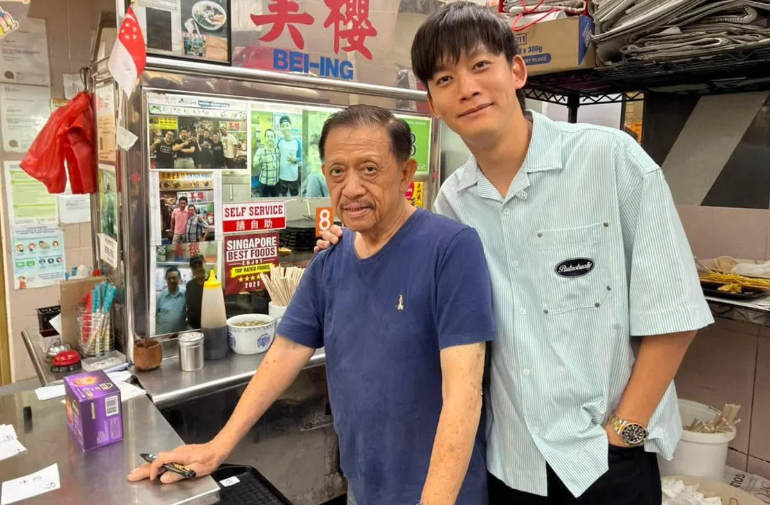
Singapore actor Noah Yap has firmly rejected allegations that his visit to an injured elderly hawker at Roxy Square constituted a self-serving publicity stunt designed to court media attention and public sympathy. The rebuke comes after online critics questioned his motives, with one netizen suggesting Yap had staged the encounter to "show concern and gather publicity" before other public figures could capitalize on the incident for their own benefit. Rather than dismissing the criticism in silence, Yap chose to engage directly with detractors, providing detailed context about his longstanding connection to the hawker and the genuine nature of his concern.
At the heart of Yap's defence lies a personal history extending over two decades. The actor emphasized that he has been a loyal customer of Bei-Ing Wanton Noodle since his primary school years, establishing a meaningful relationship with the stall owner Yeo that transcends the typical vendor-customer dynamic. This extended patronage suggests the bond runs deeper than casual transactions, with Yap noting that Yeo and his family have consistently inquired after him on each visit, treating him with the warmth typically reserved for younger family members. In Yap's characterization, Uncle Yeo has effectively witnessed his journey from childhood to adulthood, positioning the elderly hawker as a quasi-paternal figure rather than a mere service provider.
The underlying incident that prompted scrutiny of Yap's actions unfolded on August 15 when a viral video captured an altercation between the elderly hawker and a younger man at the coffee shop. According to accounts provided by Yeo and his family, the incident originated from a seemingly innocent gesture: as Yeo was walking past a table after closing his stall, he noticed a young girl and, finding her adorable, reached out to pat the child on the head. This spontaneous action, intended as a benign and affectionate gesture typical of older Asian vendors' interactions with children, escalated dramatically when the girl's father confronted him. CCTV footage subsequently shared online appeared to document the father grabbing Yeo forcefully and shoving him to the ground, an act of violence that prompted police intervention and triggered community outcry. The incident has become emblematic of broader tensions around public space etiquette and personal boundaries, with the elderly vendor becoming an unexpected symbol of vulnerability in modern Singapore's commercial districts.
Yap's decision to visit Yeo the day following the incident, on August 16, reflected what he characterized as a natural response rooted in genuine relationship and concern rather than opportunistic calculation. Upon arriving at the stall, Yap discovered the elderly hawker maintaining good spirits despite his ordeal, though Yeo initially resisted seeking medical treatment for injuries sustained during the scuffle. The actor's observations painted a portrait of a resilient elderly vendor attempting to minimize the severity of his physical condition, a tendency common among older Singaporeans who prioritize business continuity over personal recovery. Yap's decision to publicize his visit through social media was framed not as a bid for attention but as an act of awareness-raising about an incident that demanded broader public acknowledgment and discussion.
The actor's response to critics carried an undertone of exasperation, with Yap directly challenging the notion that he possessed sufficient free time to manufacture publicity stunts or engage in calculated image management. His pointed retort "Get a life la. I'm not as free as you think" reflected the frustration of someone whose genuine action of support was being reinterpreted through a cynical lens by online observers. This response speaks to the broader phenomenon of social media criticism that often assumes malicious intent behind public figures' actions, reducing complex human motivations to simple narratives of self-promotion. Yap's irritation underscores how public figures navigating social responsibility must simultaneously defend their authentic impulses against an increasingly skeptical online audience.
The social media post through which Yap articulated his defence also carried a substantive message about community values and social responsibility. He emphasized that "violence is never the answer" and called for greater collective kindness among Singaporeans, positioning the incident not merely as a personal grievance but as a symptom of deteriorating civility in public spaces. This framing elevates the conversation beyond questions of Yap's personal motives to encompass broader societal concerns about how conflicts are resolved and how vulnerable populations, particularly elderly service workers, are protected within Singapore's multicultural framework. By recontextualizing the incident within these larger themes, Yap attempted to redirect critical attention toward systemic issues rather than his own conduct.
The police confirmed that a report regarding the alleged assault was lodged and investigations remain ongoing, ensuring that the incident maintains formal attention within Singapore's law enforcement apparatus. This official investigation provides a counterbalance to social media speculation and innuendo, grounding the discussion in factual documentation and proper procedural channels. For viewers concerned with accountability and justice, the ongoing investigation offers reassurance that the incident will be addressed through appropriate legal mechanisms rather than resolved solely through public opinion and viral video discourse.
For Malaysian and Southeast Asian readers observing this episode, the situation illuminates several important dynamics within Singapore's public sphere and offers insights relevant across the region. First, it demonstrates how rapidly incidents can be weaponized in online spaces, with context often stripped away in favor of sensationalized narratives. Second, it highlights the vulnerability of elderly workers in informal sectors, a concern that resonates across Southeast Asia where many elderly vendors continue working without formal protections or social safety nets. Third, it reveals the precarious position of public figures attempting to balance genuine community engagement with intense scrutiny about motives and authenticity. These themes are not unique to Singapore but reflect regional patterns in urbanization, informal economy dynamics, and the transformative impact of social media on public discourse.

