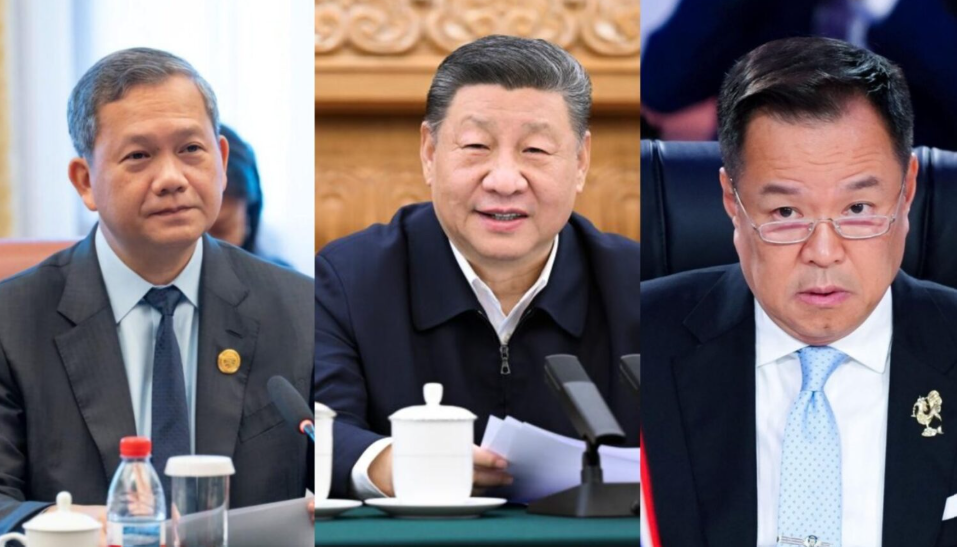
The prime ministers of Cambodia and Thailand are poised to converge in Shanghai on July 17 for the opening of the World AI Conference 2026, a gathering that on the surface reflects the two Southeast Asian neighbours' deepening tech ambitions but conceals far more consequential questions about whether the summit will catalyse genuine diplomatic movement on their intractable border crisis. Hun Manet and Anutin Chanvirakul have accepted invitations from Chinese President Xi Jinping to participate in the event, marking a carefully choreographed moment in which two regional powers with competing territorial claims will sit in the same room as their largest economic partner.
The composition of each delegation signals how seriously both capitals are treating the engagement. Hun Manet will arrive with foreign minister Prak Sokhonn, defence minister Tea Seiha, and Sun Chanthol, first vice-chairman of Cambodia's Council for the Development, suggesting that Phnom Penh intends this as a substantive working visit rather than mere ceremonial attendance. Thailand's delegation will similarly include foreign minister Sihasak Phuangketkeow, indicating that Bangkok too views the Shanghai trip through a diplomatic lens. Both leaders are scheduled for individual meetings with Xi and Chinese premier Li Qiang, presenting multiple opportunities for bilateral discussions.
Cambodia's foreign ministry framed the visit in expansive terms, emphasising the deepening of its "long-standing friendship" with China and the advancement of a "Comprehensive Strategic Partnership of Cooperation" alongside what it termed the "Diamond Cooperation Framework" and an "all-weather Cambodia-China Community with a Shared Future in the new era." These phrases, while laden with diplomatic formality, betray Cambodia's underlying strategy: to leverage its privileged relationship with Beijing as a counterweight to Thailand's territorial assertions. Thailand's official statement similarly characterised the visit as strengthening the bilateral "Comprehensive Strategic Cooperative Partnership," though with less rhetorical flourish.
The critical context lies in the silence that has pervaded Cambodia-Thailand relations since December, when the two premiers last engaged in substantive negotiations. Their most recent encounter occurred at the 3rd Asean Future Forum held in Hanoi in early June, an event that produced little more than the symbolic handshake for assembled photographers. The absence of genuine dialogue over seven months reflects the depth of mistrust between Phnom Penh and Bangkok, particularly regarding Thailand's continued occupation of Cambodian territory and the plight of approximately 20,000 Cambodian civilians unable to return to their homes.
Analysts increasingly view China as the only power capable of mediating this festering dispute, given its status as a principal trading partner and major investor in both nations. Beijing's economic leverage—coupled with its broader strategic interest in maintaining regional stability—could theoretically motivate it to push both sides toward compromise. However, the efficacy of such pressure remains uncertain, particularly given the structural complexities of Thai governance that have thwarted previous settlement attempts.
Kin Phea, director of the International Relations Institute at the Royal Academy of Cambodia, articulated a sophisticated analysis of the obstacles impeding resolution. He argued that the fundamental problem extends beyond civilian governments' stated positions to encompass the military institutions that actually wield decision-making authority within Thai governance structures. The Thai armed forces, according to Phea's assessment, have consistently failed to implement agreements reached by civilian counterparts, instead permitting themselves freedom to encroach upon Cambodian sovereign territory through military actions undertaken without civilian constraint.
Phea called upon China to assume a more active arbitral role, specifically urging Beijing to compel both nations toward the negotiating table while emphasising adherence to international law and diplomatic solutions. His comments invoked the December 2025 Fuxian Consensus, a Chinese-brokered understanding that theoretically established a framework for peaceful resolution. Yet the consensus has proven largely ineffectual, with Thailand allegedly disregarding its commitments and maintaining military presence in disputed areas.
The prospect of meaningful breakthrough at the Shanghai conference appears constrained by the asymmetry in each nation's internal political dynamics. Cambodia's Hun Manet, having consolidated power as the country's prime minister, possesses the authority to negotiate binding agreements. By contrast, Thailand's fractured political landscape—characterised by military influence that persists despite nominal civilian government—creates structural impediments to implementation even if Anutin were to agree to significant concessions during Shanghai talks.
For Malaysia and the broader Southeast Asian region, the Cambodia-Thailand dispute carries implications extending well beyond bilateral relations. Prolonged instability along one of the region's terrestrial boundaries complicates Asean's collective security posture and raises questions about the bloc's capacity to resolve internal conflicts through established mechanisms. Malaysia, which has previously mediated regional disputes and maintains careful diplomatic balance with both Bangkok and Phnom Penh, has reason to monitor whether Shanghai produces substantive progress or merely generates further frustration within Asean's membership.
China's approach to the Shanghai summit will reveal much about Beijing's willingness to expend political capital on regional conflict resolution. If Xi and Li Qiang use their bilateral meetings to push substantively for border negotiations and Thai troop withdrawal, it would signal Chinese commitment to regional stability transcending mere economic interest. If instead the summit devolves into ceremonial exchanges and AI conference attendance, it will vindicate those who contend that great power engagement in Southeast Asian disputes operates primarily at the level of symbolic diplomacy rather than transformative pressure.
The December 2025 Fuxian Consensus, despite its limitations to date, established that China recognises the dispute as requiring resolution. Whether Shanghai represents genuine escalation of that commitment or simply another opportunity for photo-ops with carefully coordinated handshakes remains the fundamental question animating the upcoming conference. Phea's explicit call for China to "play a more active role as arbitrator" reflects the desperation within Cambodia's strategic community for external pressure that might overcome Thai military intransigence.
The Joint Boundary Commission, moribund in recent months, holds the institutional mechanism through which detailed border demarcation could theoretically proceed if political will materialised. Yet without Thai military compliance with civilian agreements and China's demonstrated willingness to enforce consequences for non-compliance, the JBC's resurrection appears unlikely. Shanghai therefore presents a critical juncture: an opportunity for Beijing to translate economic leverage into binding diplomatic outcomes, or another chapter in the pattern of promising summits followed by continued stalemate.

