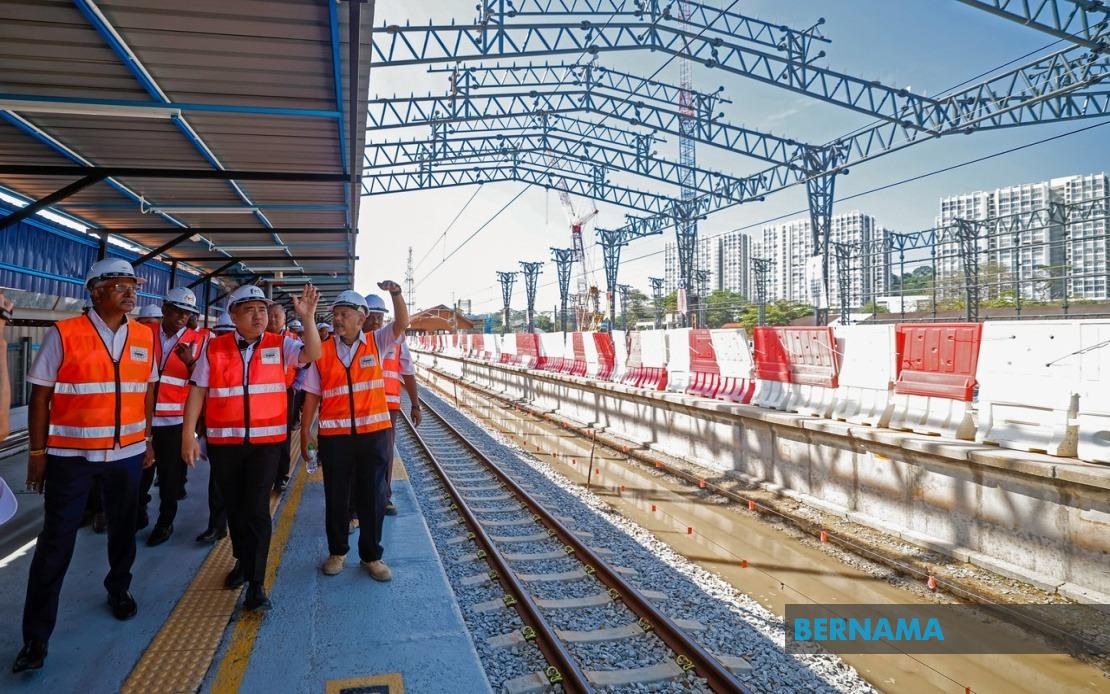
Seremban's long-anticipated new railway station has passed a crucial milestone in its development journey. Transport Minister Anthony Loke announced that the Seremban Sentral railway station project has achieved 35 per cent completion and remains on schedule to open its doors in March 2027, marking a significant infrastructure milestone for Negeri Sembilan and the broader Klang Valley region.
The RM100 million project represents an ambitious attempt to transform how residents and commuters in Seremban access rail services. What makes this development particularly noteworthy is its commitment to integrating heritage with modernity. The new station will merge seamlessly with the historic Seremban KTMB station, which has served the community for over a century. This approach preserves the architectural and cultural identity of the city while delivering contemporary transport infrastructure capable of meeting demands decades into the future.
According to Loke, who also serves as the Member of Parliament for Seremban, the project has successfully navigated its most labour-intensive phase. The completion of piling work and underground utility relocation represents a watershed moment that will allow construction tempo to accelerate significantly. These preliminary stages are notoriously time-consuming because they require precise engineering calculations, careful coordination with existing underground infrastructure including cables and electrical systems, and meticulous planning to avoid disruptions to surrounding areas. Now that these foundations are literally in place, teams can proceed with installing structural elements, roof systems, glass facades, and interior finishings at a faster pace.
The architectural vision for Seremban Sentral reflects current trends in Malaysian infrastructure development. The station incorporates a green building concept that emphasises environmental sustainability alongside cultural authenticity. Design elements inspired by Minangkabau architecture will give the station a distinctive regional character that connects travellers to the local heritage and identity of Negeri Sembilan. This aesthetic approach represents a departure from the generic glass-and-steel designs that have dominated transport infrastructure across Southeast Asia, offering instead a distinctly Malaysian expression of modern design.
Capacity considerations have been central to the planning process. The initial design allows the station to accommodate approximately 30,000 passengers daily upon opening, a figure the ministry considers appropriate for the projected demand during the first years of operation. However, the planners have engineered considerable flexibility into the project. The station will ultimately feature six platforms, though only three will be constructed initially. This phased approach means that as Seremban's population grows and economic activity expands, additional platforms can be added without requiring a complete redesign. The ministry projects the station could eventually handle up to 120,000 passengers daily, ensuring the infrastructure remains relevant for perhaps the next three to five decades.
The station's physical layout addresses practical traffic management challenges that plague many transport hubs. Two separate entrance points and drop-off areas have been strategically positioned, one fronting Jalan Tunku Antah and another at the rear of the facility. This dual-access design should significantly reduce vehicular congestion in surrounding streets during peak periods, a critical consideration in an urban environment where transport infrastructure often creates bottlenecks rather than alleviating them.
Beyond the new station building itself, the ministry has undertaken complementary work to address long-standing operational problems. The historic Seremban KTMB station underwent complete renovation work that finished in recent weeks, involving comprehensive upgrades to electrical and wiring systems to ensure the heritage structure remains safe and functional. More significantly, engineers have designed and begun constructing a new sewerage system specifically to combat flash flooding that previously disrupted services. Rather than allowing rainwater to flow through the station area as before, the new system directs water directly to Sungai Temiang, effectively eliminating the flood risk that historically trapped water on platforms and tracks during heavy downpours.
The Seremban Sentral project forms part of a broader regional connectivity initiative. The parallel Klang Valley Double Track Phase 2 upgrade project has reached 55.8 per cent completion, which will eventually enhance railway capacity across the metropolitan region. Temporary reductions in afternoon Komuter service frequency reflect the trade-off between maintaining current operations and accelerating construction work, a pragmatic decision that privileges long-term infrastructure benefits over short-term convenience.
Looking beyond the immediate station opening, the Transport Ministry envisions Seremban Sentral as a catalyst for broader urban development. The facility will serve as the anchor for a transit-oriented development project that will transform the surrounding area into a mixed-use urban precinct. This approach aligns with international best practices in urban planning, where high-quality public transport infrastructure becomes the organising principle for residential, commercial, and recreational development. For Seremban, the implications extend beyond mere transport convenience—the station promises to reshape the city's economic geography and quality of life.
The project's significance extends to Malaysian transport policy more broadly. Seremban Sentral demonstrates the government's commitment to modernising rail infrastructure outside Kuala Lumpur and the major urban centres of Klang Valley. By investing in secondary cities, the ministry aims to distribute economic opportunities more equitably across the nation and provide residents outside metropolitan areas with world-class public transport amenities. The green building standards and capacity for future expansion reflect contemporary thinking about sustainable, adaptable infrastructure rather than the fixed-capacity facilities that have often proven inadequate within a decade of opening.
For Malaysian commuters and business travellers, the March 2027 opening date marks a key date to anticipate. Upon completion, the station will likely encourage modal shift away from private vehicles toward rail travel, potentially easing traffic congestion on highways serving the Negeri Sembilan corridor. For property investors and developers in Seremban, the project signals an inflection point in the city's development trajectory. Transit-oriented development opportunities around the station are likely to attract significant investment, particularly once the facility begins operations and real-world passenger volumes become apparent.

