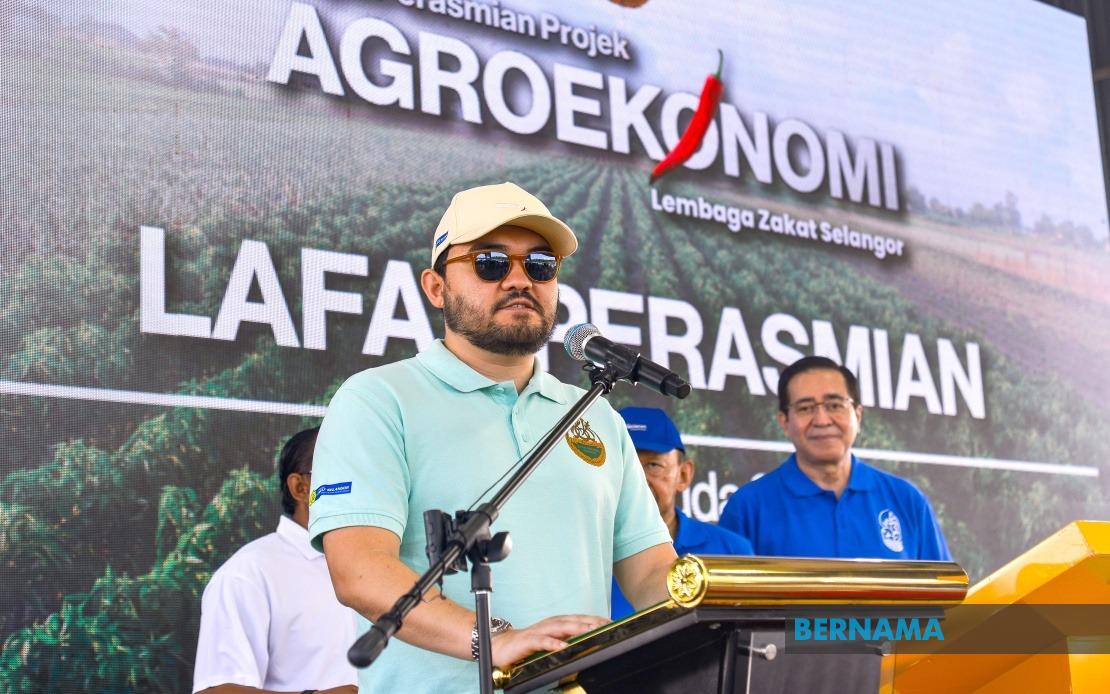
The Selangor Zakat Board has shifted its approach to supporting low-income Muslim communities by moving beyond temporary financial relief towards creating lasting economic opportunities rooted in agricultural production. On July 1, the board officially opened its Agroeconomic Project at Laman Agro Ehsan in Bukit Beruntung, a substantial initiative representing a fundamental reimagining of how zakat funds can be deployed for long-term community development rather than short-term assistance.
The project commands an investment of RM26 million across a 110-acre site, with 76 acres actively dedicated to agricultural operations. The initiative is built on a carefully structured model: 48 selected asnaf participants—individuals and families eligible to receive zakat support—will each cultivate a half-acre plot containing 2,000 chilli plant bags, collectively producing 96,000 plants per growing cycle. The Raja Muda of Selangor, Tengku Amir Shah Sultan Sharafuddin Idris Shah, performed the official launch, signalling high-level state support for this poverty-reduction strategy.
What distinguishes this project from conventional agricultural schemes is its comprehensive three-year support framework. Rather than simply providing land, the Selangor Zakat Board has embedded training, monitoring, and hands-on guidance into the programme design. Participants receive technical instruction covering crop management, disease prevention, pest control, and harvest optimisation. This pedagogical dimension addresses a critical gap in rural development—many communities possess land access but lack the knowledge systems necessary to maximise productivity and profitability.
The income projections offer meaningful incentive. Programme managers estimate that once production stabilises, participants could achieve monthly earnings reaching RM4,000 per plot. For context, this figure substantially exceeds many service-sector wages available to low-skilled workers in Selangor's peripheral areas, potentially enabling families to transition from welfare dependency to self-sufficiency. The chilli crop itself is strategically chosen—demand remains consistent across Malaysian households, restaurants, and food processors, reducing market volatility risks that affect more specialised agricultural products.
Beyond agricultural support, the project acknowledges that farming ventures require stable living conditions to succeed. Participants receive fully subsidised accommodation at Prima Beruntung housing, eliminating rental burdens during the critical three-year transition period. This holistic approach recognises that poverty alleviation demands addressing multiple simultaneous constraints—knowledge gaps, capital limitations, housing insecurity, and market access all intertwine to trap families in cycles of economic marginalisation.
The participant selection process demonstrates institutional rigour. Collaboration with the Kuala Langat Area Farmers' Organisation (PPKKL) embedded local agricultural expertise into recruitment, ensuring that candidates possessed at least baseline capacity and motivation to succeed in farming. This screening mechanism contrasts with universalistic grant schemes, which sometimes support unsuitable candidates and generate disappointing outcomes.
Participant testimonies underscore the transformative potential. Norfhadilah Mohd Shafiin, a 45-year-old mother of five, emphasised that the programme transcends financial provision by building confidence and agricultural competency. Similarly, Raimi Rusydi Rodi highlighted how the structured learning environment fostered peer collaboration while equipping him with practical skills. These accounts illustrate how well-designed development interventions address both material deprivation and psychological dimensions of poverty—the sense of incapacity and dependency that often accompanies economic marginalisation.
The financial architecture reveals sophisticated resource mobilisation. While the Selangor Zakat Board provides the foundational investment, strategic partnerships amplify the initiative's reach. The Pilgrims Fund Board, RHB Islamic Bank Berhad, and Cagamas Berhad contributed wakalah (agency-managed) funds totalling RM2.07 million, leveraging corporate social responsibility mandates and Islamic banking principles. This collaborative funding model demonstrates how public institutions can catalyse private-sector participation in poverty reduction through structured mechanisms that align business interests with social objectives.
For the broader Malaysian policy landscape, this project offers instructive lessons about evolution in zakat administration. Historically, zakat systems functioned primarily as consumption-focused transfers, providing immediate relief but rarely addressing underlying income-generation capacity. The Selangor initiative exemplifies a global trend toward productively-oriented social protection—programmes that combine immediate support with human capital accumulation and asset development. This approach aligns with sustainable development principles and recognises that poverty reduction demands supply-side interventions that enhance beneficiaries' productive capabilities.
The project also addresses regional economic disparities. Selangor contains significant populations living in peripheral settlements with limited employment prospects. Agricultural development projects like this can reverse urban-to-rural labour migration by creating viable income opportunities in suburban and semi-rural zones, potentially stabilising communities and reducing the pressure on sprawling informal urban settlements.
However, the initiative's success hinges on several critical factors beyond the three-year programme duration. Market linkages—ensuring reliable buyer relationships for the chilli output—remain essential for sustaining income levels after formal programme support concludes. The Selangor Zakat Board must develop exit strategies that transition participants toward independent market engagement and cooperative marketing arrangements.
Longer-term scalability presents another consideration. If outcomes match projections, demand for programme slots will likely exceed available capacity. The board's strategic challenge involves replicating this model across additional sites while maintaining quality of training and monitoring. Success here could position Selangor as a regional leader in asset-based poverty alleviation, potentially influencing zakat administration practices across other Malaysian states.
The Selangor Zakat Board's initiative demonstrates that sophisticated poverty reduction demands treating beneficiaries as productive agents rather than passive recipients. By combining capital access, technical knowledge, stable housing, and market-oriented production, the project constructs the conditions necessary for genuine livelihood transformation. As Malaysia progresses toward developed-nation status, initiatives like this prove increasingly essential for ensuring that economic growth benefits all segments of society rather than concentrating wealth among already-advantaged populations.

