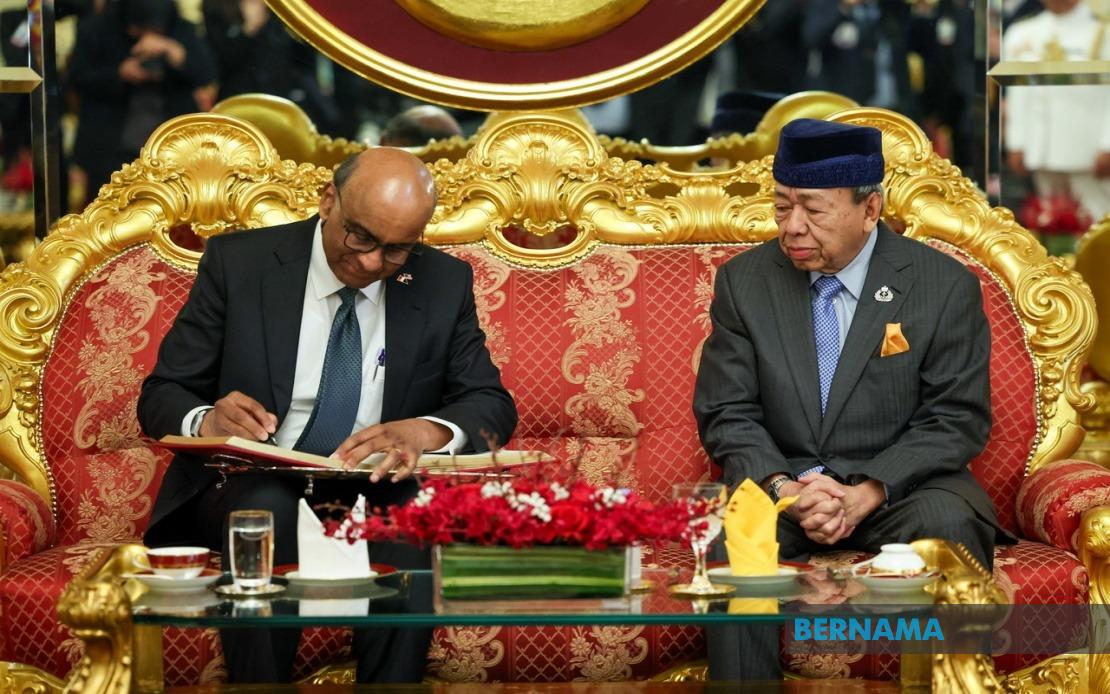
The Sultan of Selangor, Sultan Sharafuddin Idris Shah, received Singapore President Tharman Shanmugaratnam at Istana Alam Shah in Klang on July 14, marking a significant moment in Malaysia-Singapore bilateral relations during the president's official state visit to the country. The meeting, which lasted approximately 90 minutes, underscores the importance both nations place on maintaining high-level political engagement and strengthening their longstanding diplomatic connection in a region where such exchanges carry considerable weight.
President Tharman arrived at the palace at 11 am and was formally received by the Raja Muda of Selangor, Tengku Amir Shah, reflecting the ceremonial significance accorded to visiting heads of state. The audience concluded at 12.40 pm, providing a substantial window for substantive discussions on matters of mutual interest. Entrepreneur Development and Cooperatives Minister Steven Sim was present throughout the engagement, serving as the minister-in-attendance, a role that typically involves facilitating discussions and ensuring appropriate government representation during such high-level interactions.
The visit forms part of President Tharman's three-day state mission to Malaysia scheduled from July 13 to 15, undertaken at the formal invitation of His Majesty Sultan Ibrahim, King of Malaysia. This engagement represents a carefully choreographed diplomatic exchange that demonstrates the depth of relations between Kuala Lumpur and Singapore at the highest institutional levels. The presence of a sitting president for a multi-day visit signals the gravity with which Malaysia's leadership views its relationship with its prosperous southern neighbour.
According to Malaysia's Foreign Ministry, this state visit represents a reciprocal gesture following His Majesty Sultan Ibrahim's own state visit to Singapore on May 6 and 7, 2024. Such exchanges of high-level visits are fundamental to maintaining robust bilateral relations and allowing leaders to discuss pressing regional and bilateral issues in intimate settings. The reciprocal nature of these visits demonstrates a balanced approach to diplomacy, ensuring neither nation feels its gestures go unacknowledged at the highest levels of state protocol.
The economic relationship between Malaysia and Singapore remains extraordinarily significant for both parties. Singapore continues to function as Malaysia's second-largest trading partner globally, a position reflecting decades of integrated economic activity, supply chains, and cross-border investment flows. More particularly, within the ASEAN framework, Singapore stands as Malaysia's single largest trading partner among member states of the regional bloc. This economic interdependence makes political stability and warm diplomatic relations essential for both economies.
The role of Selangor in this diplomatic engagement carries additional weight given the state's economic prominence within Malaysia. As the nation's industrial and commercial powerhouse, Selangor hosts significant Singapore-based investments and serves as a crucial hub for regional business operations. The Sultan of Selangor's participation in receiving the Singapore president thus carries practical implications for the state's business community and signals government commitment to maintaining the regulatory and diplomatic environment necessary for continued bilateral trade and investment.
President Tharman's visit to Malaysia reflects Singapore's strategic interest in maintaining robust engagement with its largest neighbour and closest ASEAN partner. While Singapore and Malaysia occasionally experience friction over border issues, maritime boundaries, and resource management, high-level diplomatic visits serve as important mechanisms for dialogue and conflict resolution. These state visits demonstrate both nations' commitment to managing differences through established diplomatic channels rather than allowing disagreements to escalate.
For Malaysian readers and businesses, the significance of such visits extends beyond ceremonial considerations. The state visit provides an opportunity to reinforce bilateral agreements on trade facilitation, logistics coordination, and cross-border investments that directly impact Malaysian economic performance. The extended engagement at Istana Alam Shah, lasting 90 minutes, suggests substantive discussions likely occurred on economic cooperation, regional stability, and shared ASEAN interests during a period when both nations are navigating regional geopolitical complexities.
The timing of this exchange also reflects broader Southeast Asian dynamics. As tensions fluctuate in the South China Sea and regional powers vie for influence, the Malaysia-Singapore relationship remains a stabilizing force within ASEAN. Regular high-level visits and presidential audiences help cement this stability and demonstrate to other regional actors the strength of bilateral cooperation. The ceremonial aspects of the Istana Alam Shah meeting thus carry symbolic weight beyond the immediate bilateral context, signalling to the region that Malaysia and Singapore remain united on matters of shared concern.
Looking forward, the successful completion of this state visit and the positive reception extended to President Tharman by Selangor's Sultan suggest momentum will continue in the bilateral relationship. Both nations will likely continue leveraging these formal occasions to deepen economic ties, coordinate on ASEAN initiatives, and address any lingering bilateral issues through sustained dialogue. For Malaysian businesses operating in or trading with Singapore, such diplomatic warmth creates favourable conditions for continued commercial expansion and partnership opportunities across the causeway.

