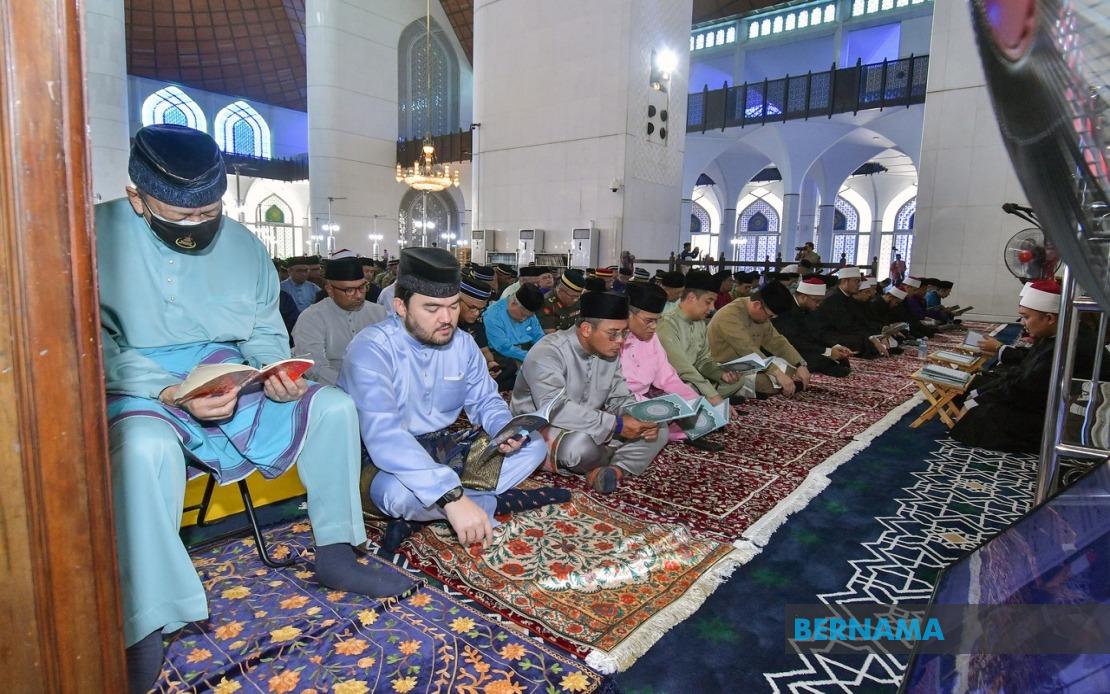
The Sultan of Selangor, Sultan Sharafuddin Idris Shah, participated in a Surah Yassin recitation and tahlil ceremony on Wednesday at one of the state's most prominent mosques, underscoring the role of Islamic observance in Malaysia's national commemorations. The event at Masjid Sultan Salahuddin Abdul Aziz Shah in Shah Alam drew around 1,000 participants, including members of the armed forces and police personnel stationed across Selangor, reflecting the integration of religious and civic duties that characterises Malaysia's approach to Independence Day preparations.
Accompanying the Sultan was Tengku Amir Shah Sultan Sharafuddin Idris Shah, the Raja Muda of Selangor, signalling the continuity of royal family involvement in state religious and national affairs. The presence of the heir apparent alongside the reigning Sultan demonstrates the traditional emphasis placed by the Selangor palace on ceremonial participation in significant national moments. Such joint appearances reinforce the symbolic authority of the monarchy in bridging religious and state functions, a constitutional arrangement that remains central to Malaysian governance.
State leadership was prominently represented through the attendance of Menteri Besar Datuk Seri Amirudin Shari, who received the Sultan upon his arrival at the mosque. This gesture reflects the conventional protocol governing interactions between the state's executive and the royal institution in Selangor, where the Sultan holds constitutional primacy in matters of Islam and Malay custom. The presence of Dr Mohammad Fahmi Ngah, chairman of the State Islamic Affairs and Innovation Culture Committee, underscored the government's institutional commitment to religious programming during the pre-Merdeka period.
Amongst the officials present were key figures from Selangor's Islamic administration, including Datuk Mohd Shahzihan Ahmad, director of the Selangor Islamic Religious Department (JAIS), and Datuk Salehuddin Saidin, chairman of the Selangor Islamic Religious Council (MAIS). The combined presence of these overlapping administrative bodies highlights how Islam's institutional framework in Malaysia operates through multiple coordinating agencies at the state level, each with distinct but complementary mandates. For Malaysian readers familiar with state governance structures, this layering of Islamic authorities reflects both the constitutional division of powers and the practical challenges of coordinating religious policy across different institutional levels.
Following the Yassin recitation, Sultan Sharafuddin performed Friday prayers and heard a sermon addressing themes directly relevant to Malaysia's National Day contemplations. The sermon, titled "Merdeka Daripada Belenggu Kerakusan" or "Freedom from the Shackles of Greed," delivered by the mosque's Grand Imam Muhammad Farhan Wijaya, contextualised national independence within an Islamic moral framework. This rhetorical approach connects Malaysia's historical struggle for sovereignty with contemporary concerns about ethical governance and equitable wealth distribution—issues that resonate particularly in a region where development and social cohesion remain competing priorities.
The timing of this religious observance carries significance beyond mere ceremonial scheduling. Positioned two days before Selangor's state-level National Day celebrations, the mosque gathering functions as a spiritual prelude to larger public festivities, establishing a pattern wherein Islamic devotion and national commemoration are presented as mutually reinforcing rather than competing commitments. This integration reflects Malaysia's constitutional framework, in which Islam holds a privileged position while the nation explicitly maintains secular governance principles—a balance that requires careful symbolic management during national holidays.
Selangor's National Day celebrations will unfold at Kajang Stadium on Sunday evening, commencing at 8 pm under the theme "Malaysia MADANI: Kesejahteraan Dinikmati," which translates as "Malaysia Flourishing: Enjoying Prosperity." This theme aligns with the federal government's broader "Malaysia MADANI" developmental narrative, emphasising equitable growth and shared well-being across diverse communities. The choice of this particular theme, juxtaposed with the mosque sermon's warnings against greed, suggests an intentional messaging strategy linking spiritual discipline to economic prosperity—a conceptual pairing that appeals to Malaysia's diverse electorate across religious and socioeconomic lines.
For Selangor specifically, these National Day preparations carry particular weight given the state's position as Malaysia's economic powerhouse and its heterogeneous demographic composition. The involvement of both the Sultan and the Menteri Besar in pre-Merdeka religious observances sends implicit signals about the state administration's commitment to maintaining religious credibility whilst pursuing secular development objectives. This balancing act becomes increasingly crucial in a political context where religious sentiment frequently intersects with electoral calculations and communal identity formation.
The participation of security forces personnel in the mosque gathering also warrants attention. The inclusion of armed forces and police members in religious observance during a pre-National Day event underscores how Malaysia's defence and security establishments maintain institutional connections to Islamic practice and royal authority. This integration, dating back to Malaysia's founding, reflects the historical understanding that national unity and Islamic observance are mutually supportive rather than antagonistic—a principle tested periodically by evolving social attitudes and demographic shifts across the region.
The institutional coordination evidenced in Wednesday's event—involving the palace, the state executive, Islamic affairs bureaucracies, and security establishments—illustrates the multifaceted infrastructure required to orchestrate National Day commemorations in contemporary Malaysia. Each participant brings distinct legitimacy sources: the Sultan derives authority from constitutional provisions and historical lineage, the Menteri Besar from democratic election, Islamic officials from doctrinal expertise, and security forces from their guardianship role. This pluralistic orchestration, whilst sometimes appearing unwieldy, has proven functionally effective in maintaining the symbolic coherence necessary for a multi-religious, multi-ethnic nation-state.
Looking ahead to Sunday's Kajang Stadium celebrations, Selangor's National Day programming demonstrates how Malaysian states adapt federal themes to local contexts. The "Malaysia MADANI" framework provides overarching coherence, yet individual states customise celebrations to reflect their specific demographic compositions and political circumstances. For Selangor, maintaining visible Islamic institutional participation whilst simultaneously projecting an inclusive, prosperity-focused vision requires delicate choreography—precisely the kind of balancing that the Sultan's pre-Merdeka mosque visit helps facilitate.

