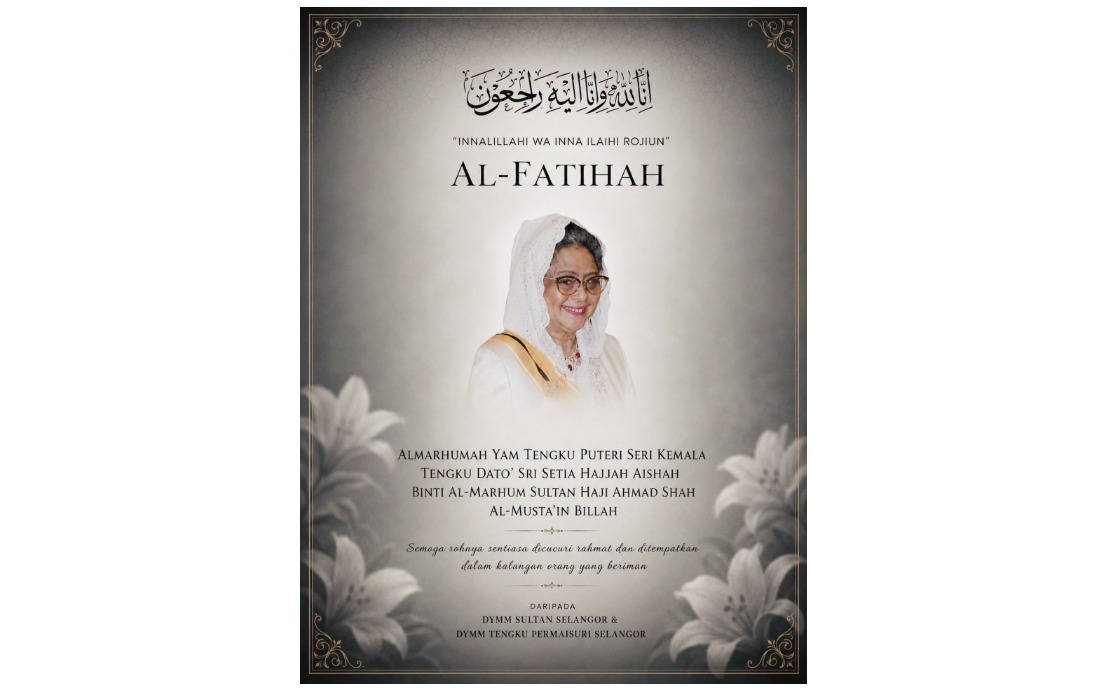
The royal households of Selangor have joined the nation in mourning the passing of Tengku Puteri Seri Kemala Tengku Datuk Seri Aishah, elder sister to the Sultan of Pahang, Al-Sultan Abdullah Ri'ayatuddin Al-Mustafa Billah Shah. Sultan Sharafuddin Idris Shah and Tengku Permaisuri Norashikin conveyed their formal expressions of grief through an official statement released by the Selangor Royal Office, reflecting the deep sense of loss felt across Malaysia's royal establishments during this solemn occasion.
Tengku Datuk Seri Aishah passed away on Tuesday evening at a private medical facility in Kuala Lumpur at 9.15 pm. Her death marks the loss of a member of Pahang's royal family whose lineage connects her directly to Sultan Ahmad Shah, the revered former Sultan of Pahang whose reign spanned several decades and left an indelible mark on the state's governance and development.
The formal condolences issued by the Selangor palace underscored the interconnected nature of Malaysia's royal families and the protocols of sympathy observed during times of bereavement. In their statement, Sultan Sharafuddin and Tengku Permaisuri Norashikin expressed their profound sadness while offering prayers for the departed soul, invoking divine mercy and peace for Tengku Datuk Seri Aishah. The palace released the customary Islamic supplication Al-Fatihah as a mark of respect and spiritual support for the bereaved family.
Preprations moved swiftly following the announcement of her passing, with arrangements made to transport her remains to the Pahang Royal Mausoleum located in Pekan. The scheduled interment would honour royal protocol and customary practices befitting a member of the sultanate's extended household. Her burial was to be conducted with full ceremonial honours, reflecting the dignified treatment accorded to senior royalty within the Pahang state.
The death of Tengku Datuk Seri Aishah represents a continuation of natural succession within Malaysia's royal households, a reality that periodically brings the nation's ruling families together in collective mourning. These moments of shared grief, expressed through formal channels and public statements, reinforce the bonds of kinship that unite the various sultanates across the peninsula and contribute to the broader sense of national identity and unity centred on the institution of the monarchy.
Intermarriage and family connections between different royal households have historically created a complex web of relationships that span centuries of Malaysian history. The Pahang sultanate, one of the oldest and most prominent royal families in the nation, maintains deep connections with other state households including Selangor, fostering mutual respect and cooperation at both ceremonial and administrative levels. When members of these families pass away, the formal expressions of condolence serve not merely as courtesies but as reaffirmations of these enduring bonds.
For the Pahang Sultan and his immediate family, the loss of an elder sibling carries particular significance within traditional Asian and Islamic contexts, where respect for senior family members remains a cornerstone of familial values. The passing of Tengku Datuk Seri Aishah would necessitate a period of formal mourning within the Pahang palace, during which state affairs would continue under established protocols while allowing space for the family to observe customary grieving practices.
The role of senior royalty such as Tengku Datuk Seri Aishah, while often conducted away from public prominence, remains important in supporting the current ruling Sultan and maintaining historical continuity within the sultanate. Elder family members frequently serve as advisors, custodians of royal tradition, and living links to previous generations of leadership, providing guidance grounded in decades of experience and institutional memory.
Royal deaths in Malaysia invariably prompt reflection on the institution's place within the nation's constitutional framework and cultural fabric. The monarchy continues to occupy a unique and revered position in Malaysian society, serving as a symbol of national unity and continuity across generational changes. The public expressions of sympathy from fellow royalty, such as those offered by the Selangor palace, reinforce this symbolic significance and demonstrate how the institution transcends individual sultanates to represent a broader Malaysian identity.
As condolences continue to pour in from various quarters of Malaysian society, the focus remains on ensuring that Tengku Datuk Seri Aishah receives the dignified farewell befitting her station and that the Pahang Sultan's family receives the support and privacy necessary during this period of grief. The protocols surrounding royal funerals and the careful observation of Islamic burial practices reflect Malaysia's commitment to upholding both its monarchical traditions and its religious foundations.

