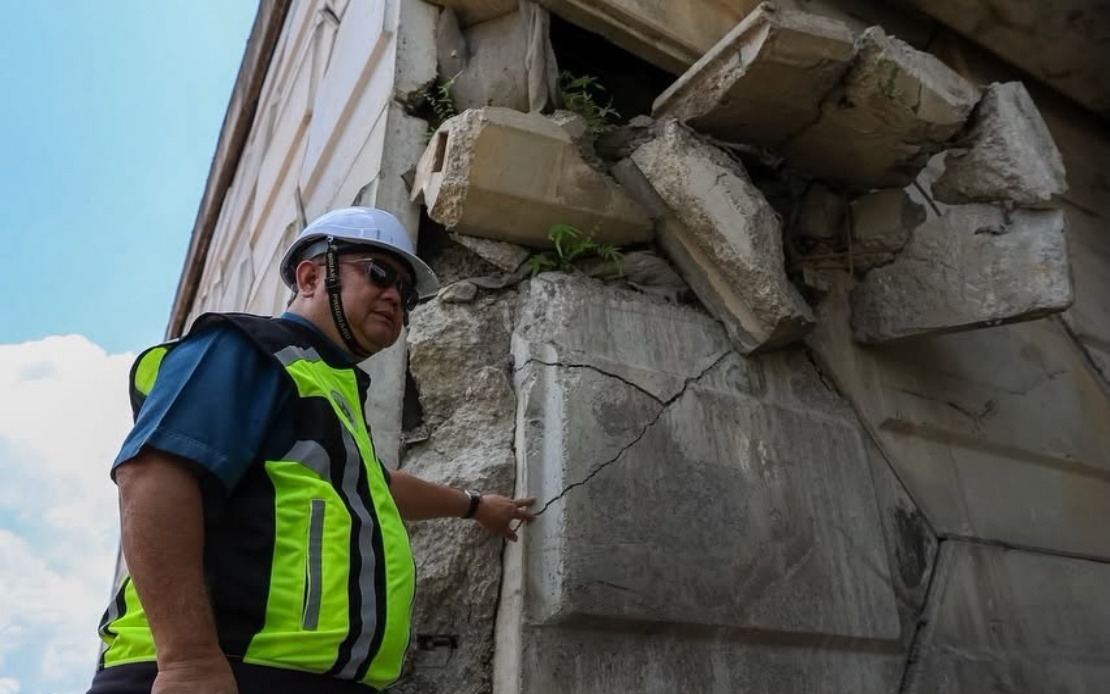
The Selangau-Mukah Interchange Flyover on the Pan Borneo Highway will gradually return to service only after structural repairs meet rigorous safety benchmarks, Works Minister Datuk Seri Alexander Nanta Linggi confirmed following an inspection of the damaged facility in Sibu on July 6. The undertaking represents an attempt to balance urgent commuter needs against uncompromising engineering standards for one of Sarawak's critical transport corridors.
The closure was implemented after a collision involving a palm oil tanker severely compromised the structural integrity of Ramp 1, creating a hazard that made continued operations untenable. On-site engineering assessments revealed that the impact had inflicted damage to a section of the retaining wall structure, necessitating controlled demolition and reconstruction work before vehicular movement could resume. This incident underscores the vulnerability of major highway infrastructure to sudden transport accidents, particularly given the volume of heavy industrial vehicles traversing Borneo's arterial routes.
Nanta articulated a three-pillar strategy to address the crisis. First among his priorities is maintaining absolute safety standards for all road users transiting the Pan Borneo Highway, which has become economically vital for resource-rich Sarawak. Second, the minister committed to strict oversight of the repair timeline to prevent project slippage and needless extension of the closure period. Third, he pledged transparent communication with the travelling public regarding available alternative routes, current restrictions, and progress updates on restoration efforts.
The flyover's extended closure is creating substantial disruption for residents and regular commuters on the Bintulu-Mukah-Sibu corridor, one of the most travelled routes in the region. The detours required to bypass the closure add considerable time and fuel costs to journeys for heavy commercial traffic, small business operators, and daily travellers. Mukah district, which serves as a significant palm oil processing hub and coastal settlement, faces particular economic strain from the interrupted passage.
Nanta acknowledged the mounting public anxiety surrounding the closure, noting that community concerns expressed through both conventional media and social media platforms warrant serious official attention. This recognition reflects shifting governance expectations in Malaysia, where government officials increasingly monitor digital discourse and integrate citizen feedback into decision-making frameworks. The minister's explicit commitment to consider public input signals a departure from traditional top-down infrastructure management toward more responsive communication models.
The phased reopening approach represents a measured response to the dual pressures facing transport authorities. Unaffected sections of the interchange will be progressively returned to traffic as engineering teams complete work on specific structural components, allowing partial relief of congestion before full restoration. This staged methodology minimises economic disruption while enabling continuous safety verification at each phase, rather than requiring an all-or-nothing reopening upon completion.
The collision itself raises questions about vehicle safety protocols and structural design resilience on major highways. The Pan Borneo Highway, a multi-billion-ringgit megaproject spanning Sarawak and Sabah, represents Malaysia's largest infrastructure initiative for decades. However, incidents such as the tanker strike demonstrate the ongoing need for reinforced barriers, improved heavy vehicle monitoring, and enhanced enforcement of transport regulations to protect critical infrastructure from preventable accidents.
Nanta's assurance of continued ministerial oversight provides some reassurance to stakeholders, though uncertainty remains regarding the precise reopening timeline. No specific date has been provided for either partial or full restoration of service. The repair work involves not merely mending the damaged retaining wall but undertaking comprehensive structural analysis to ensure the entire Ramp 1 configuration meets contemporary engineering specifications and safety margins.
For Malaysian and Southeast Asian readers, this situation exemplifies the infrastructure maintenance challenges confronting rapidly developing economies. Major highway systems, once constructed, require continuous vigilance against collision damage, environmental degradation, and age-related deterioration. The closure illustrates both the criticality of such infrastructure to regional economic flows and the vulnerability of even recently completed facilities to sudden disruption.
The incident also reflects broader patterns in Malaysian transport governance, where mega-infrastructure projects occasionally reveal gaps between initial design capacity, actual traffic loads, and contingency planning. Future highway development in the region would benefit from incorporating enhanced protective measures against heavy vehicle impacts, particularly in areas where industrial transport is concentrated.
Stakeholders ranging from palm oil exporters to small traders depend on the Pan Borneo Highway for competitiveness and market access. Each week of closure translates into lost productivity and increased logistics costs throughout Sarawak's supply chains. Nanta's commitment to balancing safety with timely restoration therefore carries implications extending well beyond the immediate inconvenience to individual commuters, affecting economic competitiveness across multiple sectors dependent on reliable transport infrastructure.
The minister's pledge to maintain transparency and community engagement throughout the repair process may set a precedent for future infrastructure crises in Malaysia. As development accelerates across Southeast Asia, establishing clear protocols for crisis communication and phased recovery could become increasingly important for maintaining public confidence in major transport systems and government capacity to manage complex engineering challenges effectively.

