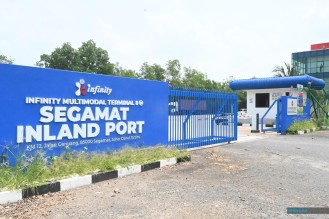
Segamat Inland Port (SIP) is setting its sights on processing more than 6,000 twenty-foot equivalent units (TEUs) of containers before the year concludes, capitalising on momentum since reopening its gates in late June after more than a decade of dormancy. The facility, situated in the heart of Johor's industrial heartland, represents a significant shift in Malaysia's logistics infrastructure strategy, moving away from road-dependent transport and towards rail-based solutions that promise safer and more efficient cargo movement across the region.
During its inaugural month of full operation through July, the inland port managed approximately 1,000 TEUs comprising both containerised and bulk cargo shipments. Samuel Ho, the facility's manager, attributed this steady launch to growing awareness among industrial operators in northern Johor, southern Pahang, southern Negeri Sembilan, and Melaka about the advantages of rail transport. The comprehensive catchment area underscores SIP's strategic positioning as a multistate logistics hub, serving manufacturing clusters and warehouse operators who previously relied exclusively on road transport to move goods to and from Malaysia's major container ports.
The reactivation of SIP forms part of the government's broader Road to Rail initiative, executed in partnership with state railway operator Keretapi Tanah Melayu Bhd. This policy shift reflects a deliberate pivot towards sustainable transport solutions and infrastructure optimisation. By encouraging shippers to shift freight from highways to rail corridors, authorities aim to improve network efficiency while addressing longstanding congestion challenges on major routes. For the Johor-Pahang-Negeri Sembilan region, this translates into competitive advantages for manufacturers and logistics firms seeking cost-effective alternatives to trucking for bulk cargo distribution.
Safety considerations underpinned the decision to resurrect SIP after its lengthy closure. Rail transport eliminates exposure to road accidents and traffic delays that plague long-haul truck operations, a reality that resonates strongly with shippers managing time-sensitive inventory. Moreover, the environmental and operational case is compelling: a single freight train journey replaces approximately eighty container trucks on the road, dramatically reducing diesel consumption and carbon emissions per tonne-kilometre. For Malaysian companies increasingly conscious of sustainability commitments and operational costs, this efficiency metric carries substantial financial and reputational weight.
Previously, SIP's potential remained underutilised because the railway line operated on a single track, forcing cargo trains to yield scheduling priority to passenger services. This operational constraint rendered freight rail uncompetitive against road haulage, which offered flexibility that industrial shippers demanded. The completion of the double-tracking project to Johor has fundamentally transformed this dynamic. The enhanced infrastructure now permits SIP to accommodate up to four cargo receiving and dispatching cycles weekly, compared with merely one trip per week under the old single-track regime. This four-fold increase in throughput capacity provides the operational reliability that modern supply chains require.
The expanded scheduling flexibility opens new commercial pathways for shippers across northern Johor and beyond. Major container ports including Port Klang, Port of Tanjung Pelepas, and Johor Port in Pasir Gudang can now efficiently feed cargo to SIP's inland distribution network. Manufacturers in districts such as Batu Pahat and Kluang gain access to premium port facilities without maintaining operations at congested coastal terminals. This geographic arbitrage enables businesses to locate factories and warehouses in lower-cost interior locations while maintaining expedited cargo connections to international shipping networks. Ho explicitly frames SIP as a catalyst for industrial investment and economic decentralisation within the Johor region.
The initial phase of SIP occupies 20.23 hectares adjacent to Segamat Railway Station and has already generated employment for over 200 local residents across security, logistics, and port operations roles. The facility's three-phase development roadmap suggests that employment generation will accelerate substantially as capacity expands. For communities in Segamat and surrounding areas, the port represents a tangible economic opportunity in a region traditionally dependent on agriculture and small-scale manufacturing. The jobs created span both unskilled and skilled positions, offering pathways for workforce development across multiple tiers.
Beyond commercial operations, SIP is positioning itself as a knowledge hub through collaboration with Universiti Tun Hussein Onn Malaysia (UTHM). The partnership encompasses fieldwork exposure for students and research initiatives that advance understanding of inland port operations and rail logistics. This academic engagement serves dual purposes: generating practical expertise for university programmes while providing the inland port with research support for optimisation initiatives. For Malaysia's logistics sector, such knowledge transfer relationships strengthen the professional foundations of the industry and create pathways for innovation in port and transport operations.
SIP originally commenced operations in 1997 but languished due to limited commercial traction during its initial decades of operation. Transport Minister Anthony Loke Siew Fook officially relaunched the facility on June 25, 2026, signalling political commitment to the inland port's strategic importance. Loke framed SIP as instrumental for strengthening national logistics networks and enhancing supply chain efficiency. Beyond economic metrics, he highlighted the facility's potential to absorb employment across security and logistics sectors while generating direct and indirect economic benefits throughout northern Johor.
The quantified impact projections are substantial. SIP's operations could eliminate approximately 18,000 lorry movements—encompassing both standard trucks and container trailers—from Malaysian roads each month once the facility reaches full capacity. This reduction translates into measurable improvements in highway safety, reduced congestion on critical corridors, and optimised utilisation of the national rail network. For a country managing rapid urbanisation and industrial growth, such infrastructure solutions address multiple policy objectives simultaneously: enhancing freight efficiency, improving road safety, reducing environmental impact, and decentralising economic activity away from congested coastal regions.
Looking forward, SIP's trajectory hinges on sustained growth in cargo throughput and continued expansion of the facility's physical and operational capacity. The target of 6,000 TEUs by year-end represents ambitious but achievable growth from the initial 1,000-TEU baseline. Success in meeting this milestone would validate the Road to Rail initiative's core premise and potentially inspire similar inland port developments throughout Malaysia's peninsula. For shippers, manufacturers, and logistics operators across the Johor-Pahang-Negeri Sembilan economic corridor, SIP's expanding capacity promises materialising competitive advantages that extend beyond cost reductions to encompass reliability, safety, and sustainability credentials that increasingly influence business location and partnership decisions.

