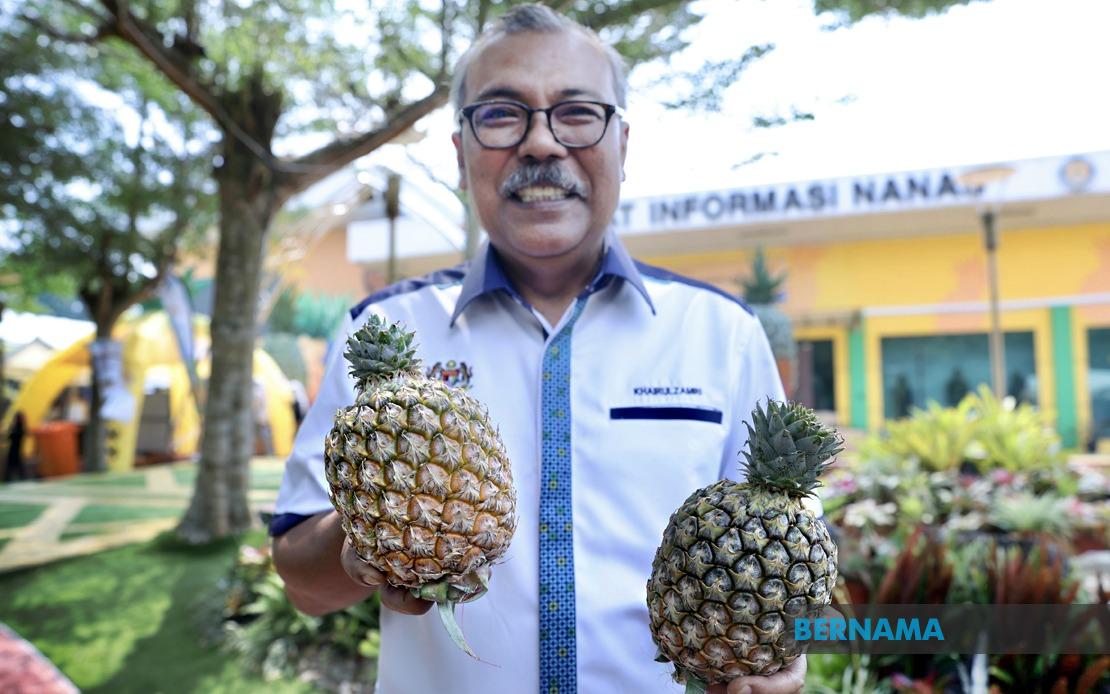
Malaysia's agricultural showcase is buzzing with excitement over a homegrown innovation that could reshape the nation's pineapple sector. The Sarawak Gold (SG1) pineapple variety is commanding centre stage at Laman Nanas during MAHA 2026, the sprawling agriculture exposition currently underway at the Malaysia Agriculture Expo Park (MAEPS) in Serdang, with seven tonnes of the golden fruit transported from Sarawak to give visitors an authentic taste of what industry officials are hailing as a game-changer.
According to Mohd Khairuzamri M. Salleh, director-general of the Malaysian Pineapple Industry Board (LPNM), the SG1 represents a significant leap forward in commercial pineapple cultivation. Originally discovered and developed in Miri, this premium variety combines several attributes that distinguish it from existing market leaders. The fruit delivers a sweetness profile comparable to MD2, currently the industry benchmark, while boasting an aesthetically striking rose-shaped crown that sets it apart visually on retail shelves and in export markets where presentation directly influences purchasing decisions.
The real competitive advantage of SG1, however, lies in its accelerated growth cycle. Where conventional MD2 pineapples require 14 months from planting to harvest, SG1 achieves maturity in just nine months—a reduction that translates into faster capital turnover for farmers and more frequent cropping opportunities annually. This efficiency gain holds particular significance for smallholder farmers across Malaysia who operate with limited land and capital, potentially allowing them to generate income at a faster pace and reinvest profits more readily into farm improvements.
Beyond the speed advantage, SG1 cultivation density opens new possibilities for agricultural productivity. The variety thrives when planted at remarkably high densities ranging between 25,000 and 30,000 plants per acre, substantially exceeding the spacing requirements of conventional varieties. This capacity to produce more fruit per unit of land without compromising quality offers Malaysian growers a pathway to increased yields without necessarily requiring significant land acquisition—a critical consideration in a nation where agricultural land remains constrained by competing development pressures and urbanisation.
The LPNM is now actively pursuing expansion of SG1 cultivation across Peninsular Malaysia, bringing this Sarawak innovation to farmers in the more densely populated regions where market proximity and infrastructure advantages could accelerate adoption. Distribution of SG1 seedlings to commercial growers throughout the peninsula is anticipated to commence during the coming year, effectively democratising access to this superior variety and potentially catalysing a productivity shift across the entire Malaysian pineapple sector.
On the international front, preliminary trial shipments from Sarawak to Singapore have already demonstrated commercial viability, suggesting that the variety possesses the requisite shelf life, transportability, and consumer appeal for cross-border trade. Looking ahead, the variety's inherent resilience positions it as a potential contender for penetrating demanding export markets including China and New Zealand, both of which represent substantial revenue opportunities for Malaysian agriculture but impose strict quality and consistency standards that Malaysian producers have historically found challenging to meet consistently.
This year's MAHA exhibition amplifies the pineapple sector's broader ambitions through its thematic focus on "Value Creation for Food Security," a framing that deliberately repositions pineapple farming beyond simple fresh fruit production. The industry narrative being promoted at the exposition—encapsulated as "one planting, three harvests"—reflects an integrated agricultural philosophy where the entire plant becomes economically valuable rather than treating only the fruit as marketable produce.
This diversification approach addresses a critical dimension of agricultural sustainability and farmer income stability. Pineapple crowns and leaves traditionally considered waste now enter value chains as ruminant feed, textile materials, and paper products, effectively tripling the revenue potential from a single cultivation cycle. Such circular agricultural models align with global sustainability imperatives while materially improving farmer profitability and reducing economic vulnerability to fruit market price fluctuations.
The MAHA 2026 exhibition itself underscores Malaysia's commitment to showcasing agricultural innovation to a broad audience. Running through September 6 at MAEPS, the exposition attracts approximately 2,000 exhibitors and is projected to welcome over four million visitors, making it a significant platform for disseminating information about agricultural advancement to consumers, retailers, institutional buyers, and fellow farmers. For the pineapple industry specifically, this visibility offers invaluable marketing exposure for both the commodity itself and the technological innovations driving sector modernisation.
The introduction of SG1 arrives at a propitious moment for Malaysian agriculture. Regional competition in pineapple production intensifies as neighbouring countries develop their own varieties and production capabilities. The rapid maturation cycle, high-density planting capacity, and export-ready quality characteristics of SG1 position Malaysia to compete more effectively in Southeast Asian and beyond regional markets. Additionally, the emphasis on value-added production from the entire plant acknowledges emerging consumer preferences for sustainability and waste reduction, creating differentiation advantages in premium markets increasingly willing to pay premiums for environmentally conscious agricultural products.
Looking forward, the successful commercialisation of SG1 could serve as a template for innovation in other Malaysian agricultural sectors, demonstrating how domestically developed varieties can leverage natural advantages, scientific expertise, and targeted marketing to achieve both productivity gains and market differentiation. For pineapple-growing communities in Sarawak and across Peninsular Malaysia, the variety represents tangible evidence that agricultural evolution remains possible, that farmer incomes can expand through innovation, and that Malaysia's natural agricultural heritage can be refined into globally competitive products.

