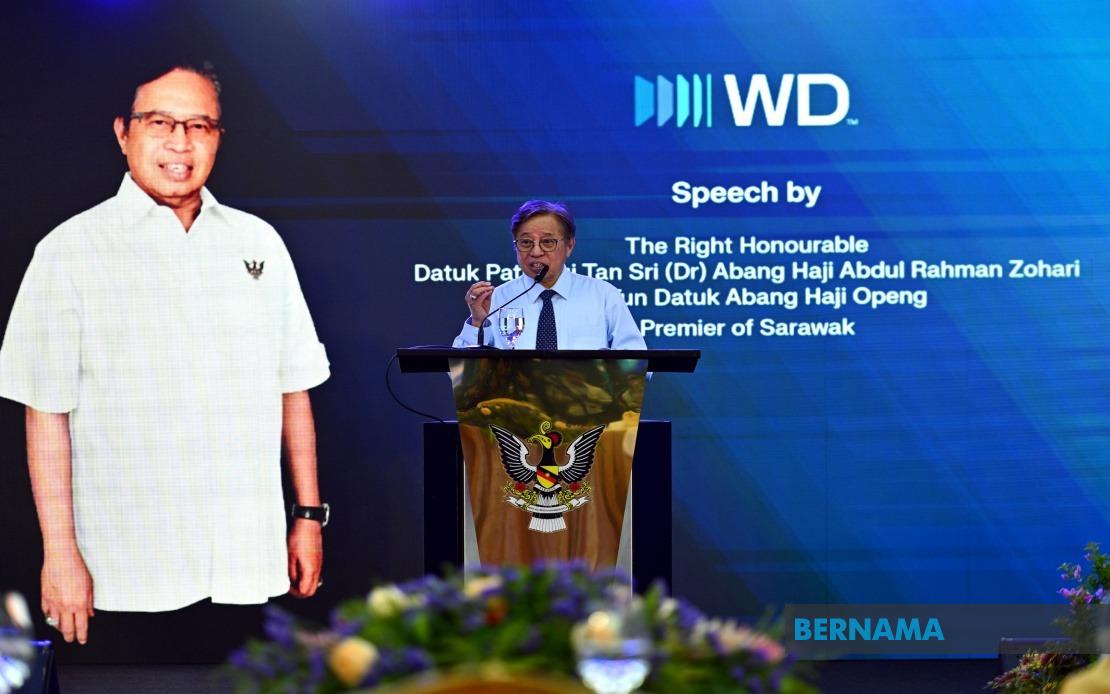
Sarawak's leadership has adopted a pragmatic stance on the prospect of enlarged federal transfers, acknowledging both its fiscal needs and Kuala Lumpur's constrained position. Premier Tan Sri Abang Johari Tun Openg told reporters in Kuching on July 2 that the state would embrace any uplift to its special grant under Article 112D of the Federal Constitution, though only if such an increase sits comfortably within the federal government's budgetary envelope. His measured response reflects the delicate balance required when negotiating financial arrangements between states and the centre in Malaysia's federal architecture, particularly as the nation manages competing demands on limited resources.
The premier's conditional acceptance underscores Sarawak's understanding that fiscal realities often constrain political ambitions. Rather than issuing demands or hardline rhetoric, Abang Johari acknowledged that if the Federal Government cannot afford an increase, Sarawak grasps the constraints at play. This pragmatic tone emerged during remarks made after his attendance at the New Horizon for Western Digital Sarawak programme, suggesting the state's leadership prioritises maintaining constructive relations with federal authorities over confrontational posturing on funding disputes.
While the special grant issue carries significance for Sarawak's revenue base, substantive negotiations remain in early stages. Abang Johari noted that detailed discussions have not yet materialised, though the topic surfaced in broad-brush terms during a recent encounter with Prime Minister Datuk Seri Anwar Ibrahim in Bintulu. This indicates that formal talks lie ahead, with neither side having tabled concrete proposals or figures. The framing as preliminary suggests months of dialogue may be required before any agreement crystallises.
At the federal level, Prime Minister Anwar has already signalled his administration's commitment to the negotiation process. During Question Time in the Dewan Rakyat on June 30, he reported that discussions concerning Sarawak's special grant were proceeding in tandem with broader efforts to honour the spirit of the Malaysia Agreement 1963. This public positioning demonstrates political will to engage Sarawak seriously, though it stops short of promising a definite outcome or timeline. The framing around MA63—the foundational agreement that brought Sarawak into the Malaysian federation—carries symbolic weight, tying the grant discussion to constitutional principles and historical commitments rather than treating it as a mere budgetary favour.
Beyond the immediate financial negotiation, Sarawak is positioning itself as an emerging technology and digital infrastructure hub. The premier highlighted the three-decade partnership between the state and Western Digital, emphasising its evolution toward manufacturing glass substrate-based data storage systems. This technology transition matters because such components underpin the explosive growth in data centres globally, a sector expected to consume vast amounts of electricity and water—resources Sarawak possesses in abundance.
The shift toward positioning data storage infrastructure as a cornerstone of Sarawak's future economic development reflects sophisticated long-term thinking. Rather than remaining dependent on extractive industries, the state's leadership recognises that artificial intelligence expansion will drive unprecedented demand for data storage capacity and processing power. Glass substrate technology, as Western Digital notes, enables significantly higher data density than conventional approaches, making it crucial to meeting the infrastructure demands of AI-driven global digital systems. This technological leap could reshape Sarawak's economic trajectory over the coming decade.
Sarawak's natural endowments—particularly abundant hydroelectric potential and access to freshwater—constitute competitive advantages in attracting capital-intensive technology investment. Data centres consume enormous quantities of electricity and cooling water, making locations with reliable renewable energy and water abundance increasingly attractive to multinational operators seeking to lower operational costs and environmental footprints. By leveraging these resources, Sarawak positions itself against other regional competitors for technology investment, potentially unlocking high-value manufacturing and employment opportunities beyond traditional resource extraction.
The premier's framing of data as a future asset more valuable than petroleum carries important implications for Southeast Asia and Malaysia alike. As global digital infrastructure investments multiply, regions that successfully host these industries will capture disproportionate economic value. Sarawak's early positioning, combined with its resource advantages and established relationships with global technology leaders like Western Digital, could establish it as a regional data infrastructure node—not merely a commodity supplier but a critical component of global digital architecture.
For Malaysian policymakers nationally, Sarawak's dual-track approach—simultaneously negotiating improved federal transfers while aggressively developing technology sectors—offers a template for balancing federalism with economic modernisation. The state refuses to position itself as perpetually disadvantaged within the federation, instead investing in sectors poised for growth and demonstrating economic dynamism that justifies federal confidence and investment. This self-directed development strategy, combined with constructive negotiation rather than confrontation, may ultimately secure larger federal allocations more effectively than adversarial posturing would allow.
The broader MA63 context surrounding these grant negotiations remains significant for understanding Sarawak's negotiating leverage. The agreement contains provisions regarding resource ownership and revenue sharing that, while implemented for six decades, continue to generate discussion about whether the spirit of the original compact has been fully honoured. By linking special grant discussions to MA63 reaffirmation, both Sarawak and the federal government signal that these conversations carry constitutional and historical weight beyond simple budgetary arithmetic. This framing suggests that resolving the grant question may also require federal acknowledgement of broader MA63 principles.
The timing of these discussions coincides with Malaysia's ongoing economic repositioning in a post-pandemic global environment characterised by technological acceleration and supply chain reshaping. For Sarawak specifically, the convergence of technology investment opportunities, renewable energy abundance, and federal engagement over constitutional fiscal arrangements creates a window in which the state can meaningfully reshape its economic foundation. The premiers measured optimism about grant increases, coupled with aggressive technology sector development, reflects confidence that Sarawak's future extends beyond oil revenues and into digitalised, high-value sectors where its geographic and resource advantages carry global significance.
Looking forward, the outcome of negotiations on Article 112D grant increases will signal whether federal authorities view Sarawak as a strategic economic partner worthy of enhanced investment or merely as a supplicant state dependent on discretionary handouts. Premier Abang Johari's diplomatic framing—welcoming increases while respecting federal constraints—has positioned Sarawak to accept either outcome without loss of face, while simultaneously developing economic alternatives that reduce dependence on federal transfers altogether. This balanced approach may ultimately prove more effective than aggressive demands in securing both immediate financial improvements and longer-term economic self-sufficiency.

