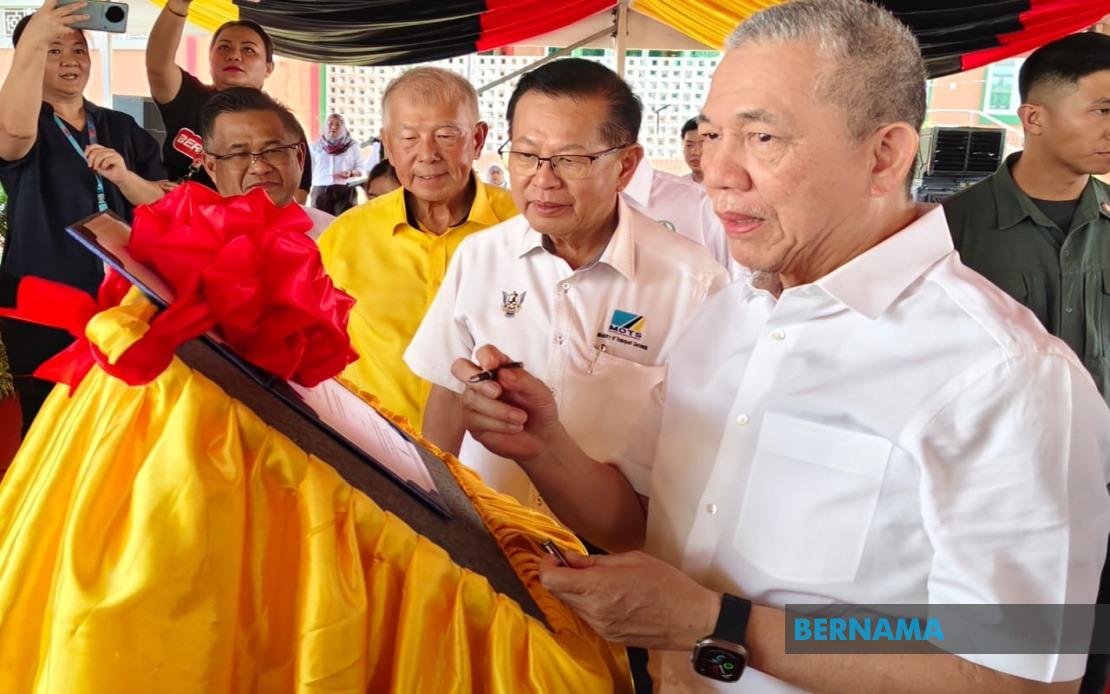
Sarawak is mobilising a significant portfolio of environmental infrastructure projects to address the state's persistent challenges with coastal and riverbank erosion as well as recurring flood events. Deputy Prime Minister Datuk Seri Fadillah Yusof announced approval for 52 initiatives under the Cakna MADANI Programme, collectively valued at RM9.46 million, reflecting the federal government's commitment to protecting vulnerable communities and infrastructure across the state this year.
The distribution of these projects reveals varying stages of implementation across Sarawak. Twelve have already reached completion, demonstrating tangible progress on the ground, while thirteen are currently under active construction. The remaining twenty-seven projects remain in pre-implementation phases, suggesting a significant pipeline of work that will extend government engagement in erosion and flood mitigation across multiple districts over the coming months. This tiered approach allows for sustained momentum in addressing environmental challenges while managing implementation capacity and resource allocation.
Fadillah, who concurrently serves as Energy Transition and Water Transformation Minister, inspected the Riverbank Stabilisation Project at the Tab Cinaq Cemetery in Miri District as a concrete example of these initiatives. The project, initiated in May with a budget of RM134,682, focuses on constructing a fifty-metre retaining wall designed to arrest riverbank erosion while simultaneously protecting the cemetery and surrounding infrastructure from further degradation. Expected completion in November demonstrates the government's ability to deliver smaller-scale interventions within defined timeframes, building local confidence in project execution.
The significance of such targeted projects becomes apparent when considering the broader vulnerability patterns across Sarawak's geography. Riverbank erosion poses particular threats to burial grounds, residential areas, and critical facilities in districts like Miri, where water courses flow through densely populated zones. The stabilisation approach adopted here—using engineered retaining structures rather than reliance on natural processes—reflects contemporary best practices in mitigating anthropogenic land-use changes and increased water flow intensities associated with altered rainfall patterns.
Beyond the immediate Cakna MADANI projects, the deputy prime minister outlined an expansive long-term strategic vision for flood and erosion management across Sarawak. Twenty-nine major mitigation initiatives, encompassing the Flood Mitigation Plan (RTB), High Priority Flood Mitigation (TBBT) projects, coastal erosion control measures, and river conservation works, have received approval with a combined estimated cost of RM3.834 billion. This represents a substantially larger commitment of resources and underscores the depth of government concern regarding water-related disasters in the state.
The composition of this wider portfolio illuminates important patterns in resource allocation and project continuity. Eighteen of the twenty-nine projects constitute continuation phases of existing schemes, collectively costing RM3.567 billion, indicating that the government is building upon established programmes with proven track records rather than constantly initiating new frameworks. Simultaneously, eleven projects represent novel initiatives budgeted at RM267 million, ensuring that emerging vulnerabilities and newly identified priority areas receive dedicated attention and fresh design solutions.
Among the continuation projects, the RTB Sungai Miri stands out as a substantial undertaking. With a total project cost of RM31 million and construction commencing in October 2023, this river mitigation scheme has achieved fifty-eight point eleven per cent physical progress as of Fadillah's visit. The scheduled completion date in November 2026 reflects realistic implementation timelines for complex engineering works that must navigate seasonal weather patterns, hydrological variations, and technical coordination requirements inherent in riverine infrastructure development.
For Malaysian and Southeast Asian observers, these initiatives carry broader significance beyond Sarawak's borders. The region experiences increasing rainfall variability and intensity attributed to climate change dynamics, creating mounting pressures on existing drainage and erosion control infrastructure. Sarawak's proactive approach to systematically mapping vulnerabilities and deploying tiered solutions—from small community-level projects to major basin-wide mitigation schemes—offers a replicable model for other Malaysian states and regional governments grappling with similar challenges.
The financial allocation of nearly RM3.9 billion represents a substantial commitment, particularly when distributed across a state with dispersed populations and complex geography. This investment strategy suggests federal recognition that environmental protection constitutes essential infrastructure requiring parity of funding with conventional development projects. For local communities repeatedly affected by seasonal flooding or gradual land loss, such investments translate into enhanced property security, reduced displacement risks, and improved economic stability.
The three Cakna MADANI projects specifically located in Miri indicate that smaller urban and semi-urban centres receive proportionate attention within the broader state portfolio. This geographic distribution helps prevent the concentration of resources in major urban areas while acknowledging that erosion and flood threats affect communities of all sizes. The inspection visit itself served a communicative function, allowing the deputy prime minister to publicly demonstrate government engagement with grassroots environmental challenges and signal commitment to constituencies that might otherwise feel overlooked in larger policy discussions.
Implementation success for these initiatives will depend substantially on coordination between state and federal agencies, community engagement in maintenance and monitoring, and adaptive management as climatic patterns evolve. The staggered completion timelines spanning from immediate completion through to 2026 require sustained political will and budget protection across electoral cycles and competing policy priorities. Early delivery of Cakna MADANI projects, with twelve already finished, establishes credibility for longer-term commitments and demonstrates government capacity to translate announced plans into tangible outcomes.
Looking forward, the scale of investment in Sarawak's erosion and flood management reflects broader regional recognition that water-related disasters impose escalating economic costs through infrastructure damage, livelihood disruption, and public health consequences. By systematically addressing both immediate vulnerabilities through Cakna MADANI initiatives and structural challenges through major mitigation projects, the government positions itself to reduce disaster risk accumulation and protect long-term development gains. For Sarawak's residents and investors, this comprehensive approach signals that environmental stability constitutes a core government service priority warranting sustained financial commitment and technical expertise.

