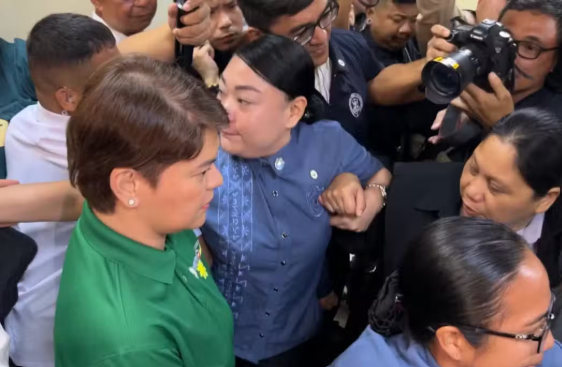
Vice President Sara Duterte of the Philippines has doubled down on her combative framing of her impeachment proceedings, telling reporters on Tuesday that she expects to be "bloodied but unbowed" as she navigates the high-stakes trial unfolding in the Senate. The statement, made as she arrived for a meeting with her legal team, invokes the defiant spirit of William Ernest Henley's celebrated poem "Invictus," a work centred on human resilience and the refusal to surrender to adversity—a rhetorical choice that underscores Duterte's determination to resist removal from office despite the gravity of the accusations arrayed against her.
The Vice President's latest remarks reiterate language she first employed in May 2025, when she openly declared a desire for the impeachment process to proceed, using the term "bloodbath" to describe the anticipated confrontation. However, this bellicose posture has drawn substantial criticism from political opponents and observers, who have noted an apparent contradiction between Duterte's expressed eagerness for the trial and her conspicuous absence from most impeachment hearings held in both 2025 and 2026. Her selective attendance has raised questions about the sincerity of her stated willingness to engage with the process and defend herself against the charges.
The impeachment framework Duterte confronts is comprehensive and multifaceted. The four articles of impeachment encompass allegations of financial impropriety spanning both executive branches under her purview. Article I addresses the alleged misappropriation of P612.5 million in confidential funds—P500 million traced to her Office of the Vice President and P112.5 million from the Department of Education. These funds, which operate with minimal public transparency and oversight, are traditionally used for sensitive operations, and their accounting has become a focal point of legislative scrutiny regarding potential abuse.
Article II ventures into personal financial conduct, alleging that Duterte has failed to accurately disclose her assets across Statements of Assets, Liabilities and Net Worth filed annually from 2022 through 2024. The article further accuses her of maintaining undisclosed business interests despite an obligation to divest from such holdings upon taking office. Such violations of disclosure requirements carry significant constitutional weight in the Philippines, as they undermine the transparency mechanisms designed to prevent conflicts of interest and financial corruption among high-ranking officials.
Article III targets Duterte's stewardship of the Department of Education, alleging involvement in bribery schemes and irregular procurement practices involving departmental officials. These accusations suggest a pattern of misconduct extending beyond her personal finances into institutional governance, potentially implicating broader systemic failures in how public education resources are allocated and monitored. The Department of Education oversees the nation's largest government budget after defence spending, making procurement integrity in this sector a matter of substantial public consequence.
Article IV represents the most serious and extraordinary charge: allegations that Duterte made assassination threats against President Ferdinand Marcos Jr., First Lady Liza Araneta-Marcos, and former House Speaker Martin Romualdez. If substantiated, such threats would constitute not merely impeachable conduct but potentially criminal behaviour of the highest order, transcending ordinary political dispute to enter the realm of threats against state security and the lives of government leaders. This article transforms the impeachment from a question of administrative misconduct into an issue of constitutional governance and the rule of law.
The procedural framework governing this trial imposes substantial hurdles for prosecutors seeking Duterte's removal. The Senate functions as the trial venue, with senator-judges required to deliver a conviction with a supermajority vote of at least two-thirds under the 1987 Philippine Constitution. This demanding threshold reflects the constitutional designers' intent to prevent impeachment from becoming a tool of simple partisan majorities, but it also means that Duterte's opponents must convert at least 16 of the 24 senators to secure removal—a politically formidable challenge that rewards legislative fragmentation and cross-party negotiation.
The anticipated 92-day duration of the trial projects completion into early 2027, extending well into the final years of the current administration's term. This extended timeline raises strategic considerations for all parties involved. For Duterte and her supporters, protracted proceedings may favour delay and the dissipation of political momentum against her. For impeachment advocates, the extended schedule risks allowing public attention to wane and legislative coalitions to fracture under pressure from competing priorities and electoral calculations.
The trial's progression occurs within a broader context of Philippine political turbulence and factional contestation at the highest levels of government. Duterte's relationship with President Marcos Jr. has visibly deteriorated, transforming from initial cooperation into open conflict—a dynamic that colours all subsequent institutional interactions and legislative votes. The impeachment itself represents an extraordinary escalation of executive-branch conflict, with the Vice President effectively under siege from both the legislative branch and the President's political apparatus.
For Malaysian observers, the unfolding proceedings merit careful attention as a case study in constitutional crisis and institutional stress. The trial will test whether Philippine democratic institutions can manage extraordinary political conflict through established legal procedures, or whether the system will fracture under pressure from competing power centres. The outcome will carry implications for perceptions of institutional stability across Southeast Asia and may influence regional assessments of the Philippines' political predictability and governance reliability.
Duterte's invocation of "Invictus" and her defiant rhetoric signal her intention to contest the charges vigorously and resist removal regardless of political pressure. Whether this posture translates into effective legal defence remains uncertain, but her willingness to frame the impeachment as a battle rather than a process suggests she intends to weaponise the trial politically, using it to consolidate her political base among supporters who view the proceedings as an unjust persecution rather than legitimate accountability.

