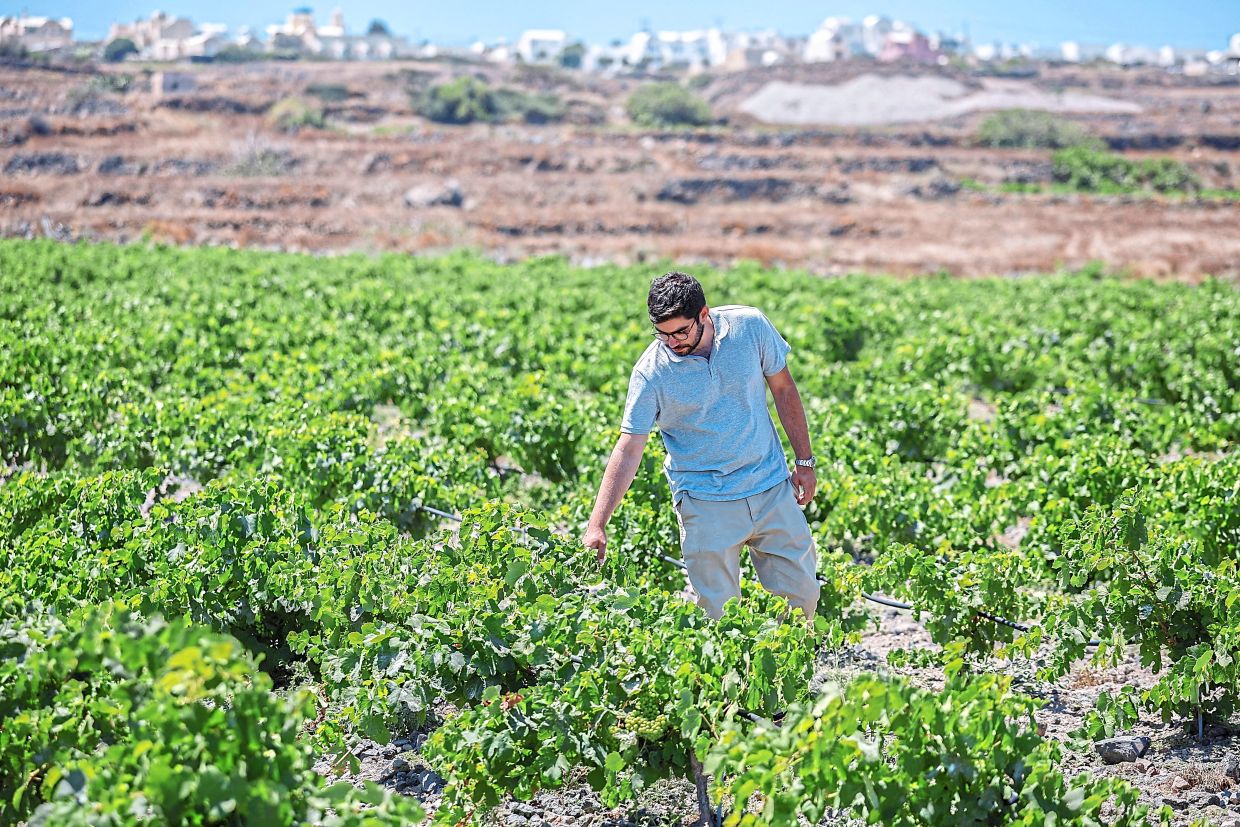
The vineyards of Santorini are in crisis. On the Greek island, a 90-year-old vine trained into a traditional basket shape—a "kouloura" designed to shield grapes from the punishing Mediterranean sun—has finally succumbed to relentless heat and drought. Its death is no isolated incident but rather a harbinger of systemic collapse facing one of Europe's most celebrated wine regions. The preceding three years, from 2023 to 2025, have brought abnormally low rainfall and searing temperatures that have upended the agricultural rhythms of centuries, driving grape prices sharply higher while wine production plummets and water anxiety spreads across the island.
Yiannis Boutaris, a sixth-generation winemaker who manages Domaine Sigalas—now part of the broader Kir-Yianni family of wineries—has watched these changes accelerate with mounting alarm. The combination of minimal precipitation and reduced cultivation over recent seasons has devastated older vineyard stock across Santorini, forcing growers to confront uncomfortable truths about their industry's future. Yet Boutaris remains determined to navigate this transition without abandoning the heritage that defines Santorini's identity. His philosophy centres on adaptation rather than retreat: preserving tradition while fundamentally restructuring how vineyards function in an increasingly hostile climate.
To test this approach, Boutaris has partnered with local authorities and scientific researchers on a pilot scheme that would recycle wastewater from residential buildings and hotels to irrigate vineyards. This methodology, already established in California's wine regions, represents a pragmatic solution to the island's dual crisis of water shortage and agricultural survival. Recycled wastewater offers several advantages over alternative supply mechanisms: it reduces dependency on expensive desalination plants, which consume enormous energy and impose heavy financial burdens on communities already strained by tourism infrastructure demands.
Beyond wastewater recycling, Boutaris is experimenting with restructuring vine layout to improve irrigation efficiency. Traditional Santorini vineyards scatter plants organically across terrain, but he is trialling a row-based arrangement that makes systematic water distribution far more manageable. Additionally, he is piloting atmospheric water harvesting technology that extracts moisture directly from air using specialised hydrogels, then releases it as usable water by applying solar-generated heat. These layered interventions reflect a recognition that survival requires not single solutions but rather integrated strategies drawing on both ancient wisdom and modern technology.
The water stress afflicting Santorini extends well beyond wine production, creating a broader competition for resources that intensifies during peak tourism months. When warm weather brings millions of visitors to islands like Santorini, a three-way contest erupts among farmers needing irrigation water, hotel operators filling swimming pools and guest facilities, and other domestic consumers. This demand surge, colliding with depleted aquifers and limited rainfall, forces difficult allocation decisions that pit economic interests against agricultural sustainability. The pressure is particularly acute on Santorini, where tourism and agriculture form dual pillars of the island economy and population survival.
Comparisons to other Greek regions underscore Santorini's particular vulnerability. In northern Greece, where cooler climates and higher precipitation create less stressful growing conditions, grape prices remain modest at approximately €0.80 per kilogram—equivalent to roughly RM3.70—reflecting abundant supply and easier cultivation. Santorini's relative scarcity and premium reputation have driven prices upward, but this advantage becomes precarious if environmental degradation compromises production capacity entirely. The economic model that has sustained island viticulture for millennia depends on continuation of viable growing conditions.
According to Stefanos Koundouras, a viticulture professor at Aristotle University in Thessaloniki, Santorini experienced its most severe climate stress in 2023 and 2024, with temperatures reaching their highest levels in six decades. This record-breaking heat has already begun affecting wine character and quality—the distinctive properties that command premium international prices and define Santorini's brand. Koundouras warns that if current warming and drying trends persist, the wine sector could face systemic unsustainability across all of Europe, particularly throughout Mediterranean regions where temperature and rainfall are shifting toward conditions incompatible with traditional viticulture.
Yiannis Papaeconomou, another island winemaker with relatively young vines barely six years old, is likewise embracing adaptive strategies. He intends to connect his vineyard to the wastewater recycling initiative but has simultaneously implemented complementary techniques. Subsurface drip irrigation delivers water directly to soil beneath plant canopies, minimizing evaporation losses that occur when water is applied from above during intense heat. He has also restructured vine trellising—the framework supporting plant growth—to enable more efficient water distribution and uptake. These interventions represent small adjustments individually but collectively constitute the incremental evolution required for vineyard survival.
The Greek wine industry's predicament carries implications extending far beyond island economies or tourism aesthetics. Wine production serves as an early-warning indicator for broader agricultural vulnerability across Europe. If Mediterranean viticulture—an industry with institutional knowledge spanning centuries and resources for innovation—struggles against climate pressures, other sectors relying on rainfall reliability and temperature stability face equivalent or greater jeopardy. Santorini's experiments with wastewater recycling and atmospheric water capture offer potential models that crop producers across semi-arid regions might eventually adopt, though scaling such technologies and securing necessary capital investments remain formidable challenges.
The fundamental challenge confronting Santorini's winemakers is philosophical as much as technical. How do you preserve cultural heritage and agricultural identity when the physical environment upon which they depend becomes increasingly hostile? Boutaris and his peers are not simply installing new irrigation equipment; they are fundamentally reimagining what Santorini viticulture means in a climate-transformed world. Success requires neither nostalgic attachment to impossible past conditions nor wholesale abandonment of traditional practices, but rather creative integration of heritage wisdom with contemporary innovation—a delicate balancing act that will determine whether future generations can continue producing wine on this iconic Greek island.

