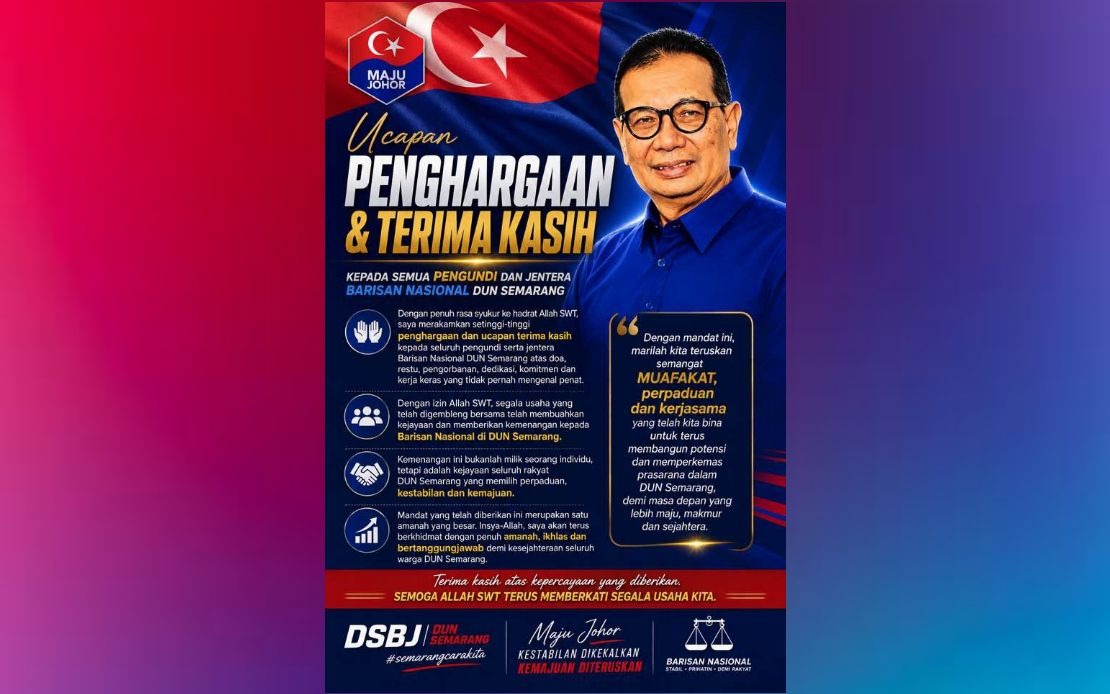
Datuk Samsolbari Jamali has etched his name into Johor's political annals by securing the Semarang state seat for an unprecedented sixth consecutive term in the 16th Johor state election held on July 12. The victory represents a remarkable achievement in longevity and electoral support, underscoring the deep-rooted confidence that constituents have maintained in the Barisan Nasional candidate across multiple election cycles spanning two decades.
The 65-year-old UMNO stalwart from Ayer Hitam division captured 17,374 votes, crushing his opponents with a commanding majority of 14,679 votes. His performance substantially surpassed his previous electoral performances, demonstrating a consolidation of support that suggests growing acceptance of his leadership in the constituency. The Pakatan Harapan-Amanah candidate Ramli Abd Hamid finished a distant second with merely 2,205 votes, while Perikatan Nasional-Bersatu's Muhammad Syafiq Abdul Aziz received 2,695 votes, indicating that opposition forces made minimal inroads into Semarang's traditional support base.
When Samsolbari's current victory is placed alongside his 2022 result, the improvement becomes striking. In the previous state election, he won by a majority of 5,846 votes—substantial by most standards but overshadowed by his latest performance. The 2018 general election saw him secure the seat with a majority of 5,842 votes. This progression suggests that either his personal political brand has strengthened considerably, or that the broader Johor electorate has shifted decisively toward BN in the intervening period, or both factors are at play.
Samsolbari's political journey spans more than thirty years of dedicated service to the Johor state administration and legislature. His representation of Semarang began in 2004, meaning he has now contested the seat seven times across four distinct election cycles—2004, 2008, 2013, 2018, 2022, and the recent 2024 poll. He has never experienced electoral defeat in his home constituency, a record that places him among Johor's most durable political figures. This consistency is particularly noteworthy in an era when voter sentiment frequently shifts and long-serving politicians often face demographic and attitudinal changes that chip away at their support.
Beyond his electoral victories, Samsolbari has accumulated significant administrative credentials. He served as chairman of the State Agriculture, Agro-based Industry and Rural Development Committee, positioning him at the center of Johor's efforts to develop its rural economy and agricultural sector—sectors that remain vital for many Semarang constituents. His leadership of the Malaysian Pineapple Industry Board (LPNM) further demonstrates his specialization in agricultural policy, a critical portfolio in a state where rural livelihoods remain economically significant. Following BN's 2022 victory, he was elevated to Deputy Speaker of the Johor State Assembly, a recognition of his parliamentary experience and legislative acumen.
In his immediate response to victory, Samsolbari characterized his win not as a personal achievement but as a collective mandate from the people of Semarang. He emphasized that voters had chosen unity, stability, and progress—language that speaks to the broader aspirations of constituents beyond narrower partisan concerns. His stated commitment to consensus-building and cooperative governance suggests an approach focused on constituency development and infrastructure improvements rather than divisive politics. This messaging aligns with the moderate positioning that has evidently resonated with Semarang voters across multiple election cycles.
Samsolbari's triumph formed part of a comprehensive Barisan Nasional victory across Johor that reordered the state's political landscape. BN won 48 of the 56 state seats contested, translating into a robust two-thirds majority in the State Legislative Assembly. This represents a significant improvement on the 2022 election, when BN secured 40 seats—an eight-seat gain that demonstrates the coalition's capacity to expand its mandate and consolidate power in one of Malaysia's most politically significant states. The 2024 outcome suggests that Johor voters had developed greater confidence in BN's governance or alternatively, had shifted away from both Pakatan Harapan and Perikatan Nasional as credible alternatives.
The broader election featured 172 candidates competing across 56 seats, drawn from diverse political parties reflecting Malaysia's fragmented opposition landscape. BN and PH each fielded 56 candidates, while Perikatan Nasional presented 33 candidates. Smaller parties and coalitions—Bersama (15 candidates), MUDA (four), and independent candidates (six)—supplemented the field, alongside single candidates from Parti Sosialis Malaysia and Parti ASLI. This distribution highlights how BN and the major opposition blocs dominate Johor's electoral terrain, while splinter parties and independent voices occupy marginal positions.
For Malaysian political observers, Samsolbari's achievement carries implications beyond Semarang's boundaries. In an era when political volatility has characterized Malaysian electoral behavior since 2018, his sustained electoral dominance suggests that certain political brands can achieve durable regional bases of support. His administrative focus on agriculture and rural development appears to have produced tangible constituent benefits or at least the perception thereof. As Malaysian politics continues to experience realignment and recalibration, Samsolbari's steady hand in his constituency demonstrates that traditional BN approaches—combining grassroots organization, administrative competence in relevant sectors, and moderate political messaging—retain electoral viability when executed consistently over extended periods.
The Johor result more broadly reinforces BN's reconstitution as Malaysia's dominant coalition, reversing the fragmentation it experienced after 2018. For Samsolbari specifically, his sixth consecutive victory positions him as a potential elder statesman within Johor's political hierarchy, potentially influencing future legislative direction and resource allocation toward Semarang. His continued service, now with renewed constituent backing and enhanced majority support, suggests that Semarang voters remain convinced that his representation serves their interests better than available alternatives, a judgment they have rendered six times consecutively.

