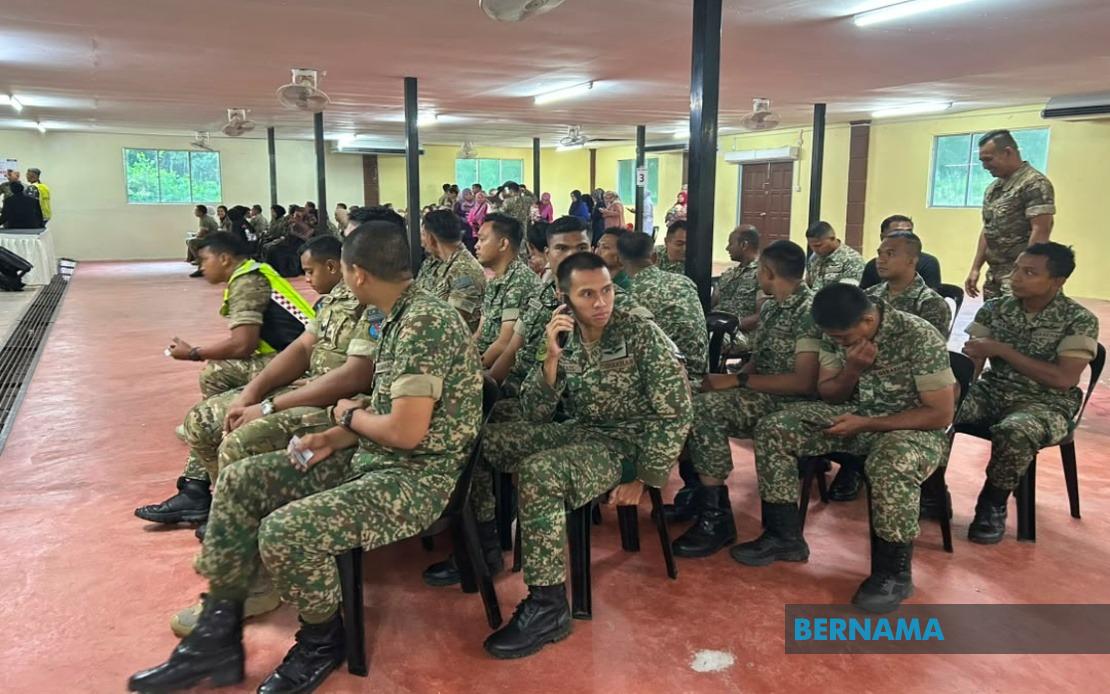
Malaysia's Home Minister Datuk Seri Saifuddin Nasution Ismail and Defence Minister Datuk Seri Mohamed Khaled Nordin have made simultaneous public appeals to early voters participating in the 16th Johor State Election, emphasising the importance of exercising voting rights with both responsibility and democratic integrity. The two cabinet members issued their messages through separate Facebook posts as nearly 25,000 security personnel and their spouses cast ballots in advance of the main polling day scheduled for Saturday.
The early voting process, which commenced on Saturday at 64 designated centres across Johor, encompasses two distinct groups within the security establishment. A total of 12,041 members of the Malaysian Armed Forces and their spouses represent one segment, while 12,710 personnel from the Royal Malaysia Police and their spouses form the second cohort. These two groups, totalling 24,751 eligible voters, were accorded early voting privileges due to their operational commitments and the nature of their roles in maintaining national security during the election period.
Saifuddin Nasution, who simultaneously holds the position of Pakatan Harapan secretary-general, framed his message around the broader democratic framework. His appeal transcended mere procedural compliance, instead casting the voting act as a fundamental expression of civic duty that must be undertaken in full awareness of democratic principles. He specifically wished all early voters a seamless voting experience whilst emphasising that the exercise of voting rights must be coupled with corresponding responsibility and adherence to democratic norms.
The Defence Minister's contribution to the public messaging campaign focused on a development-oriented perspective. Mohamed Khaled urged early voters to recognise their participation as instrumental in ensuring Johor's continued trajectory toward progress. This framing connects individual voting actions to broader state-level outcomes, positioning the election as a referendum on development continuity rather than merely a personnel selection exercise.
Menteri Besar Datuk Onn Hafiz Ghazi, representing the Barisan Nasional perspective, advanced a distinct appeal centred on institutional stability and governance continuity. His message entreated early voters to place confidence in BN candidates as vehicles for maintaining an agenda encompassing stability, development initiatives, and welfare provisions for the public. This represents the incumbent coalition's campaign strategy, which emphasises proven governance records rather than programmatic innovation.
The voting infrastructure mobilised for early balloting reflected the scale of this participation exercise. Across the 64 early voting centres that opened at 8 am, voting proceeded throughout the day, with facilities closing in staggered intervals between noon and 6 pm depending on local voter registration numbers and centre location. This phased closure approach aimed to manage crowd flow and ensure orderly administration across diverse geographical settings within Johor.
The broader electoral contest encompasses 56 state seats, with both major coalition blocs—Pakatan Harapan and Barisan Nasional—fielding candidates in all constituencies. The total candidate pool reached 172 aspirants across these two groupings, indicating competitive contests throughout the state. The early voting phase therefore represented merely the opening chapter of what promises to be a keenly contested electoral exercise.
For Malaysians observing Johor's political dynamics, this election carries significance extending beyond state-level governance. Johor remains economically vital to the federation and holds considerable symbolic weight within peninsular politics. The performance of major coalitions in this contest provides early indicators of shifting voter sentiment ahead of potential future federal electoral contests. The emphasis by multiple political leaders on responsible, peaceful and orderly conduct suggests awareness that electoral integrity and democratic propriety remain central concerns for institutional legitimacy.
The mobilisation of cabinet-level ministers to publicly encourage early voter participation underscores the seriousness with which the federal government approaches participation in democratic processes. Rather than leaving early voting to routine administrative processes, senior leadership intervention ensures high-profile emphasis on civic engagement and democratic values. This approach serves multiple functions: it reinforces the legitimacy of the electoral exercise itself, it acknowledges the special status of security personnel as stakeholders in national governance, and it projects images of governmental commitment to inclusive democratic participation.
The specific emphasis by all three leaders on peaceful, orderly and smooth conduct suggests underlying concerns about potential disorder or irregularities. By framing these procedural qualities as explicit goals worthy of public prayer and hope, leaders implicitly acknowledge that electoral processes can encounter difficulties. This proactive messaging aims to establish normative expectations for conduct amongst both voters and election administration officials, potentially serving preventive functions against misconduct.
The Malaysian electoral context has witnessed growing public attention to process integrity and voter confidence in recent years. The Johor exercise provides a testing ground for demonstrating that security establishment participation occurs within transparent, accessible frameworks where serving personnel can exercise votes without compromising their operational effectiveness. The successful completion of this early voting phase thus carries implications for how security personnel engagement in future electoral exercises might be structured and perceived by the broader electorate.

