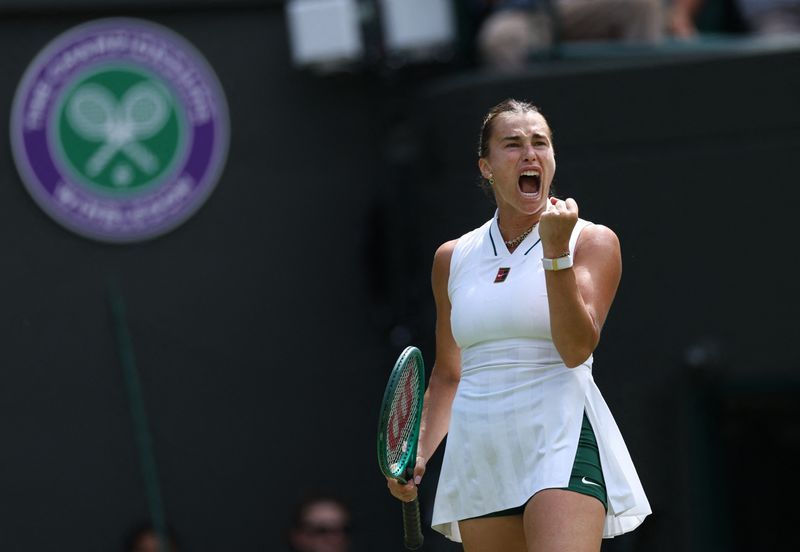
Aryna Sabalenka's tempestuous relationship with Wimbledon's grass courts once again took centre stage on Wednesday as the world number one scraped past American McCartney Kessler 6-1 7-6(9) in a second-round encounter at the All England Club. The Belarusian's discomfort on the slippery surface was evident throughout the match, yet her championship pedigree and mental fortitude ultimately proved decisive in a contest that stretched beyond an hour and a half.
Sabalenka's opening set performance provided little hint of the drama to follow. She dispatched Kessler with commanding efficiency, dominating play and converting her opportunities with the kind of aggressive baseline striking that has made her one of tennis's most formidable competitors. The American's resistance crumbled in the first set, offering little resistance to the top seed's relentless assault. For the watching crowd, it appeared a straightforward victory was in the offing.
The narrative shifted dramatically in the second set when Kessler unleashed a remarkable surge. Building momentum point by point, the young American clawed her way to a 5-2 advantage, suddenly presenting herself as a genuine threat to upset one of the tournament's favourites. At this juncture, Sabalenka's frustration with the surface became increasingly visible. She repeatedly struck her left thigh in anger, her repeated miscues and the difficulty she experienced adjusting to grass court conditions evident in her body language and emotional responses.
Kessler's breakthrough performance reached its zenith when the American secured two set points while serving at 5-3, placing herself on the verge of forcing the contest into a deciding third set. That would have represented a remarkable achievement for the 24-year-old from Michigan, who had already attracted attention by becoming the only player to progress to the second round without conceding a single game in her opening match. The tiebreak, when it eventually arrived, maintained the tension with Kessler once again holding two set points as she moved to 5-3 in the deciding mini-match.
Yet at each critical juncture, Sabalenka's superior weaponry and vast Grand Slam experience asserted itself. The top seed's heavier groundstrokes proved the decisive factor, generating pace and depth that Kessler struggled to match when the pressure mounted. Rather than capitulating as her ranking might have suggested, Sabalenka dug deep into her reserves of determination, raising her level precisely when the match threatened to slip away. Her superior court positioning and understanding of grass court tactics, developed through numerous previous campaigns, ultimately proved the differentiator.
The crucial moment arrived when Sabalenka converted her third match point after precisely 99 minutes of play, securing passage to the third round and maintaining her pursuit of a maiden Grand Slam title on a surface other than hard courts. This objective has become increasingly important to Sabalenka's legacy, as three of her four Grand Slam victories have come at the Australian Open. Her triumph over Kessler represents meaningful progress towards diversifying her major championship resume and establishing herself as a complete player across all surfaces.
For Sabalenka, the victory carried particular satisfaction given the adversity she overcame. Rather than imposing her will from start to finish as the world number one might typically do, she was forced to adapt, persist, and ultimately rely on the combination of shot-making quality and mental resilience that separates genuine champions from merely talented competitors. Her immediate opponent will be Latvia's Jelena Ostapenko in the next round, another player who has demonstrated the capacity to trouble the very best on grass.
In her post-match reflection, a visibly relieved Sabalenka acknowledged the examination she had endured. She praised Kessler's aggressive approach and execution under pressure, recognising that her opponent had pushed her to the limit across the second set. The top seed's willingness to credit her opponent's performance, even while celebrating her own escape, reflected the respect due to Kessler's showing. The American's fearless tennis and refusal to capitulate despite holding multiple opportunities to advance deserves recognition for having stretched the world's leading player to such a degree.
For Southeast Asian tennis followers watching Wimbledon's development, Sabalenka's struggles on grass offer a broader perspective on the sport's complexity. The All England Club's surface requires fundamentally different tactical approaches than the hard courts that dominate the professional calendar in Asia and Australia. Sabalenka's difficulty in this setting, despite her overall excellence, underscores how Grand Slam tournaments on varied surfaces create unpredictable challenges that transcend simple rankings and playing power.
The match also highlighted Kessler's emergence as a player capable of troubling established elites. While her breakthrough second-round appearance ended in defeat, she demonstrated the competitive qualities and aggressive instincts necessary to compete at tennis's highest levels. For American tennis enthusiasts, her performance suggested developing talent that may produce deeper runs in future major championships.

