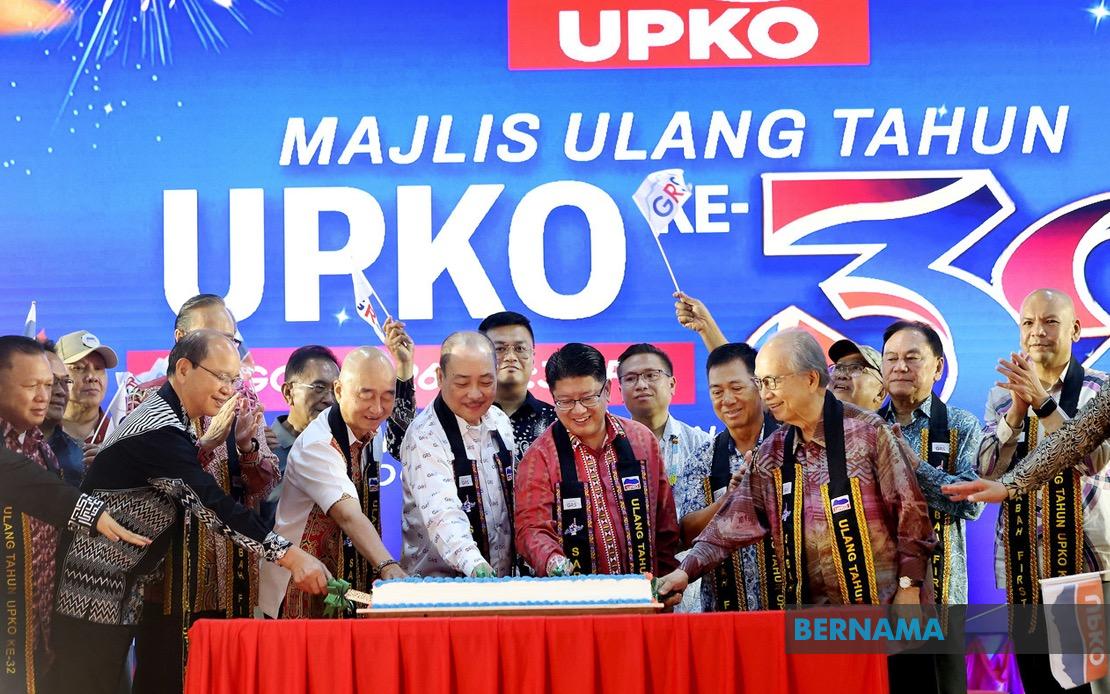
Sabah's ability to pursue meaningful development and economic growth hinges on maintaining political stability, according to Chief Minister Datuk Seri Hajiji Noor. The leader of Gabungan Rakyat Sabah (GRS) made the case during remarks at the United Progressive Kinabalu Organisation's 32nd anniversary celebration in Kota Kinabalu, underscoring how regional governments must establish a secure political foundation before ambitious projects can succeed.
Hajiji stressed that the coalition's internal cohesion directly affects the state's capacity to attract investment, implement long-term initiatives and deliver tangible benefits to residents. Without consensus among governing partners, bureaucratic delays and political infighting can derail major undertakings such as port development, transport infrastructure and industrial zones—projects that Sabah, as a vast eastern Malaysian state, depends upon to reduce its economic distance from peninsular centres.
The Chief Minister acknowledged that GRS comprises parties with distinct organisational histories and ideological origins, yet he framed this diversity as a strength rather than a liability. He appealed to component party leaders to transcend factional interests and operate within a unified framework centred on Sabahan welfare. This approach reflects a pragmatic recognition that Sabah's fractious political landscape—historically marked by shifting coalitions—requires deliberate efforts to prevent destabilisation through defections or internal revolts.
Central to Hajiji's message was the recent integration of UPKO, which joined GRS in June as its sixth component party. UPKO's incorporation expands the coalition to encompass Parti Gagasan Rakyat Sabah, Parti Bersatu Sabah, the Liberal Democratic Party, Parti Harapan Rakyat Sabah and Parti Cinta Sabah. This expansion signals an attempt to broaden the coalition's base and reinforce its majority in the state assembly, thereby reducing vulnerability to defections that could trigger a political crisis and ministerial reshuffle.
UPKO's involvement carries particular weight given that its president, Datuk Ewon Benedick, holds the position of Sabah Deputy Chief Minister III and oversees the Industrial Development, Entrepreneurship and Transportation portfolio. By granting UPKO a deputy chief minister role alongside substantial ministerial responsibilities, the coalition leadership has created incentives for sustained party commitment. Such power-sharing arrangements are essential in Malaysian coalition politics, where the distribution of Cabinet posts directly influences party loyalty and prevents partners from abandoning the arrangement for opposition inducements.
Hajiji articulated his vision through four interlocking themes: Sabah First, Sabah United, Sabah Forward and Sabah Prosper. These slogans encapsulate a development-focused ideology that subordinates partisan competition to collective state interest. The messaging aims to reframe coalitional governance as fundamentally about delivering public goods—infrastructure, jobs, education—rather than elite power struggle. For voters, this framing justifies accepting political compromises and coalition arrangements that might otherwise appear unprincipled.
The timing of these remarks reflects Sabah's ongoing navigation of delicate political equilibrium. The state has experienced multiple changes of government over the past decade, including the 2020 collapse of the Warisan-PKR administration and the subsequent rise of GRS. Each transition has brought uncertainty to business investment, civil service morale and long-term planning. Investors particularly require predictability; they are reluctant to commit capital to regions where election cycles or internal party conflicts generate abrupt policy reversals or leadership changes that threaten contract continuity.
Sabah's development challenges are substantial and enduring. The state confronts the challenge of diversifying its economy beyond palm oil and timber, establishing port and logistics hubs to compete with Peninsular Malaysia and the region, and improving connectivity to unlock interior agricultural and mineral potential. Infrastructure projects spanning years require administrations that can maintain focus and budgetary allocation across electoral cycles. Political instability undermines this capability, as incoming governments often redirect resources toward political bases or symbolic projects rather than continuing predecessors' initiatives.
The coalition model that Hajiji champions carries both strengths and inherent fragilities. Multiple parties sharing power can broaden representation and accommodation of diverse constituencies, yet coalition partners often have conflicting priorities. Disputes over budget allocation, Cabinet positions or policy direction can fracture alliances. Malaysian history demonstrates that coalitions without strong institutional anchors or shared ideological commitments frequently dissolve when one partner perceives better prospects elsewhere. The GRS model attempts to create such anchors through ministerial assignments, symbolic rhetoric around Sabahan identity and periodic reinforcement of common cause.
For Malaysian observers beyond Sabah, the Chief Minister's emphasis on political stability carries broader implications. As federal politics has grown more fractious—with shifting coalitions and defection politics increasingly visible—state governments have become laboratories for coalition management. Sabah's approach, emphasising development delivery and territorial unity over partisan advantage, may offer lessons for other regions navigating similar instability. Conversely, if GRS proves unable to maintain cohesion despite Hajiji's exhortations, it would demonstrate the difficulty of sustaining coalitions without deeper structural or ideological foundations.
The challenge ahead for GRS lies in translating rhetoric into sustained action. Coalition unity rhetoric is common across Malaysian politics; what matters is whether genuine cooperation materialises in resource allocation, policy implementation and internal conflict resolution. UPKO's recent accession will be tested when ministerial disputes arise or when federal politics creates incentives for state-level partners to shift alliances. Hajiji's message to party members—that shared commitment to Sabah's welfare supersedes factional interest—represents the ideological glue required to hold GRS intact through inevitable pressures toward disintegration.

