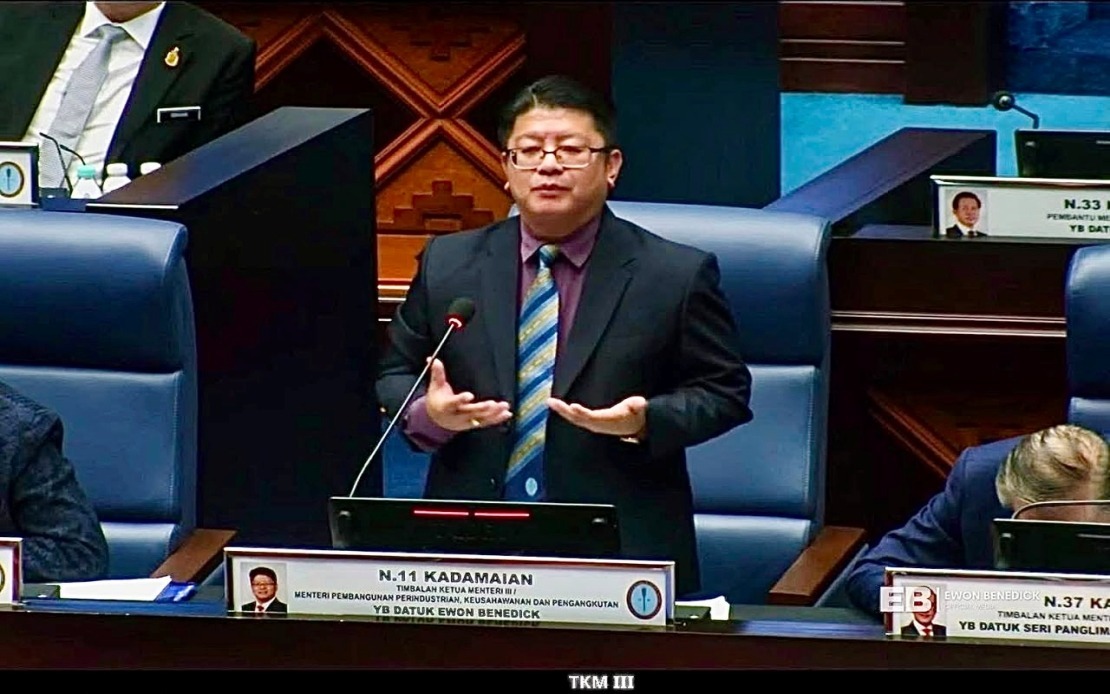
The Sabah state government has made substantial progress in addressing the persistent problem of abandoned containers clogging Sepanggar Port, leveraging a combination of regulatory measures and aggressive pricing to free up critical port space. Deputy Chief Minister III Datuk Ewon Benedick revealed to the state assembly that the controversial new port charges have proven effective, resulting in the removal of 103 containers that had languished at the facility for longer than 21 days, with some remaining idle for more than a year. The intervention marks a turning point for what had become an increasingly acute operational headache, threatening the port's ability to handle legitimate cargo and limiting its competitive advantage in the region.
The underlying challenge stemmed from a combination of weak incentives and structural market failures. Under the previous fee structure, storage charges were pitched so low that container owners found it economically rational to leave their boxes sitting at Sepanggar Port rather than paying for dedicated warehouse space at external logistics facilities. This perverse incentive effectively transformed the public port into a free or cheap parking lot, consuming valuable berths and container handling areas that could have been deployed for active cargo operations. Ewon, who also serves as Sabah Minister of Industrial Development, Entrepreneurship and Transport, acknowledged that the old pricing regime had inadvertently encouraged hoarding by making port storage more attractive than commercial alternatives.
The new pricing mechanism operates on two complementary principles designed to discourage extended idle storage. First, substantially higher per-day or monthly charges now apply to containers remaining at the port beyond a grace period, creating a financial penalty that motivates prompt removal or relocation. Second, port management has established a hard boundary at 21 days, after which containers may be disposed of according to established protocols. The combination proved remarkably effective in changing behaviour once announced. As word spread that abandoned containers would face disposal, owners rapidly mobilised to retrieve their property, effectively clearing the backlog within a short timeframe and liberating port infrastructure for productive use.
The legislative framework underpinning these operational changes received formal approval when the state assembly passed the Sabah Ports (Privatisation) (Amendment) Bill 2026. This legislative adjustment was driven partly by bureaucratic restructuring within the Sabah administration. Port responsibilities have been transferred from the Ministry of Works and Utilities to the Ministry of Industrial Development, Entrepreneurship and Transport, necessitating corresponding amendments to ensure statutory clarity about which minister holds authority over port-related matters. The amendment also harmonises terminology between the Sabah Ports (Privatisation) Enactment 1998 and the Sabah Ports Authority Enactment 1981, eliminating potential legal ambiguities that could have complicated future enforcement.
However, the government's assertive approach has generated pushback from the commercial community that depends on Sepanggar Port. Port user associations have formally appealed for a review of the new charges, arguing that the fee structure places unfair burdens on legitimate operators and that the increases may be disproportionate to the problem being solved. Rather than dismissing these concerns, Ewon signalled a willingness to engage in ongoing dialogue to strike a more sustainable balance. The ministry has incorporated representatives from port user associations, shipowners' associations, and shipping associations into a government task force, creating a structured mechanism for monthly consultation. This inclusive approach aims to identify pricing mechanisms that discourage hoarding without imposing unjust hardship on maritime commerce stakeholders.
For Malaysian and Southeast Asian business observers, the Sepanggar Port case illustrates a broader principle in infrastructure management: pricing is not merely an accounting tool but a powerful policy instrument capable of reshaping behaviour and allocating scarce resources efficiently. Ports across the region frequently struggle with similar congestion dynamics, where underpriced services create moral hazard and inefficiency. Sabah's experience suggests that transparent communication about new rules, combined with visible enforcement, can rapidly correct market distortions. The rapid container removals once disposal consequences were announced demonstrates that most actors respond predictably to incentives when those incentives are credible and clearly communicated.
The timing of these changes also reflects broader port development strategies across Borneo and the wider region. Sepanggar Port serves as a crucial logistics hub for Sabah's maritime trade, connecting to regional shipping networks and serving as a gateway for resource exports and manufactured goods. By improving operational efficiency and reducing congestion, the port becomes more competitive relative to alternative Southeast Asian ports, potentially attracting additional cargo traffic and enhancing Sabah's position in regional supply chains. Container terminals at modern ports are essentially real estate with finite capacity, and optimising their utilisation directly translates to increased revenue and throughput.
Beyond port management, the assembly also advanced other legislative reforms affecting Sabah's governance framework. The Sabah Native Affairs Council (Amendment) Bill 2026, championed by Local Government and Housing Minister Datuk Dr Mohd Arifin Mohd Arif, expands the council's mandate to encompass customary education and native customary law preservation. This reflects efforts to formalise and systematise indigenous governance structures that have historically operated on customary rather than statutory foundations. The amendment also creates a new Native Affairs Officer position, drawn from qualified state civil servants, to receive complaints and manage proceedings involving customary offences within native courts.
Complementing this was passage of the District Chief, Native Chief and Headman Bill 2026, establishing a comprehensive legal framework for these local leadership positions. The legislation specifies appointment procedures, allowances, performance standards, and grounds for revocation, bringing previously informal or partially regulated roles under systematic statutory control. Appointments proceed through the District Officer to the responsible minister, while revocation may occur for incapacity, bankruptcy, criminal conviction, customary law violations, misconduct, or failure to maintain local residence. These reforms represent an attempt to professionalise indigenous governance while respecting customary traditions and cultural autonomy.
The convergence of these legislative initiatives reveals a Sabah government engaged in multifaceted administrative modernisation. Port efficiency improvements address practical commercial challenges affecting investors and traders, while native affairs reforms strengthen governance structures affecting rural and indigenous communities. The sustained engagement with stakeholder associations on port charges reflects recognition that top-down policy implementation often fails without buy-in from affected constituencies. As Sabah continues navigating the complex balance between economic development and cultural preservation, these legislative measures signal a commitment to systematic, consultative governance that acknowledges both commercial realities and community concerns.

