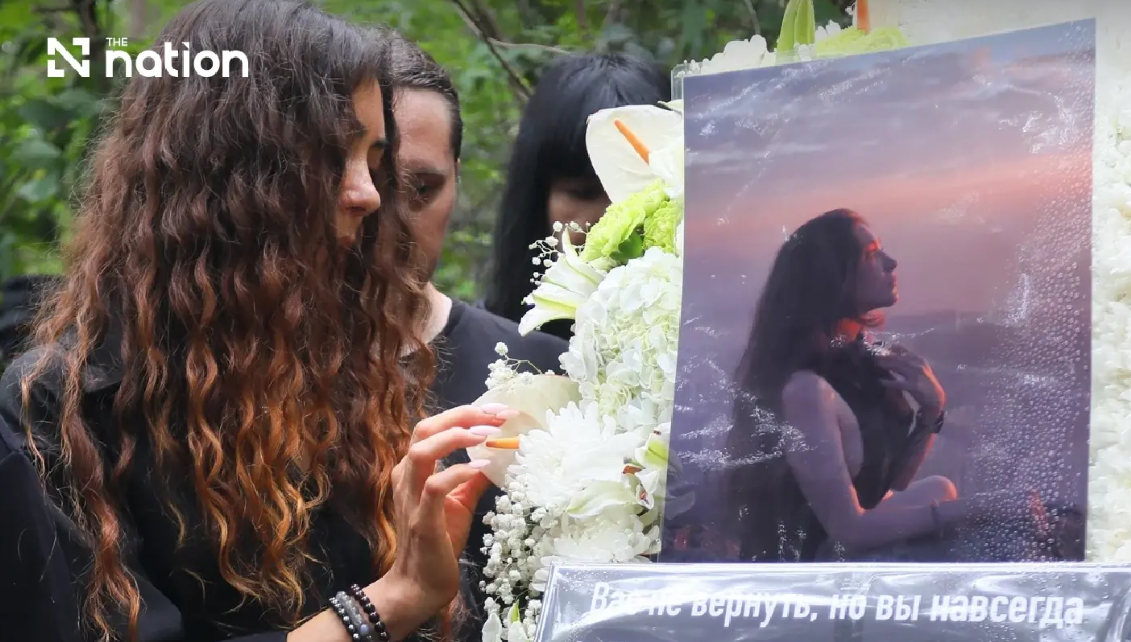
Sharina Nazimova gathered with mourners in Thailand's Chon Buri province on Thursday for a solemn Buddhist rite honouring her deceased children, Russian nationals Diana and Roman, alongside three members of a local Thai family believed to have fallen victim to the same perpetrators. The ceremony at the Huai Yai subdistrict site where the siblings were discovered drew Thai and international attendees, alongside provincial officials, law enforcement personnel and civil servants who came to pay their final respects.
The memorial service reflected the deep cultural and spiritual bonds that had formed between the Russian family and their adopted Thai community. Buddhist monks conducted traditional chanting and performed merit-dedication rituals for all five deceased, while those assembled observed moments of silence and joined their hands in solemn prayer. The gathering represented not merely a family's personal loss but a broader moment of collective mourning that transcended national and linguistic boundaries, underscoring how tragedy can unite disparate communities in shared grief.
Floral tributes formed a poignant centrepiece of the observance, with mourners placing white carnations, lilies and roses at the memorial site. The choice of white flowers carries particular significance in Thai Buddhist tradition, symbolising purity, respect and the peaceful transition of the deceased. Beyond conventional floral arrangements, the family positioned Diana's favourite coffee at the memorial—a deeply personal gesture that humanised the victims and anchored abstract loss in concrete, everyday memory. This intimate detail visibly moved attendees, demonstrating how small acts of remembrance can communicate the depth of familial bonds in ways that transcend formal ceremony.
Nazimova's emotional participation in the proceedings reflected the profound toll the tragedy had exacted on her family. Having raised both children as a single parent, she stood at the forefront of the service, visibly grieving whilst simultaneously extending gratitude to those who had supported her through the ordeal. Her tears were not private grief but shared mourning, witnessed and honoured by the assembled community. Relatives, friends and strangers alike offered comfort, transforming the memorial into an occasion where collective compassion provided solace to a mother confronting unimaginable loss.
In her remarks, Nazimova specifically acknowledged the multifaceted support systems that had sustained her family. She recognised not only government agencies and police but also Thai volunteers and the broader Thai public whose expressions of sympathy and practical assistance had provided crucial emotional scaffolding during this harrowing period. Such public recognition underscores how criminal investigations and their aftermath depend not solely on institutional responses but equally on community solidarity and human decency. For international families navigating tragedy in foreign jurisdictions, such support mechanisms prove invaluable in managing both grief and the administrative complexities that accompany loss.
The religious dimension of the memorial ceremony reflected the family's deep connection to Buddhist practice. Despite their Russian heritage and foreign status, Nazimova and her children had embraced Buddhism, embedding themselves within Thai spiritual traditions. This interfaith dimension of the tragedy carries particular resonance in contemporary Southeast Asia, where increasing migration and cultural exchange create complex emotional landscapes where loss becomes a shared human experience rather than an exclusively national concern. The merit-dedication rituals performed by monks thus honoured not only the deceased but also the bridges they had built between cultures.
Investigators identified Thana Kerdthong, aged 43, and Thongchai Srinil, 39, as principal suspects in the murders. Apprehended on July 31 in Sa Kaeo province following an intensive manhunt, the two men allegedly confronted Diana and Roman on a roadside, falsely presented themselves as law enforcement officers and subsequently forcibly transported them to a wooded location. Police characterised theft of the siblings' motorcycle as the apparent motivating factor, suggesting a tragic escalation from robbery into homicide. The suspects' subsequent discovery of burial sites during police-directed searches revealed not only the Russians' remains but also the bodies of a Thai family of three found in adjacent graves, expanding the scope of the alleged criminal conspiracy.
Police investigation into the suspects' contradictory statements revealed significant discrepancies in their accounts of events. Authorities indicated that preliminary testimony from both men remained unverified against forensic evidence and other investigative materials, suggesting that the evidentiary foundation for prosecution continues to develop. This investigative phase carries particular importance for justice outcomes, as the gap between initial confessions and corroborating evidence can substantially influence court proceedings and ultimate accountability. For the bereaved families, this extended investigative period prolongs uncertainty during an already devastating period.
The expansion of the investigation to encompass the Thai family's murders demonstrates how initial criminal incidents can uncover patterns of violence extending beyond primary victims. The simultaneous discovery of two grave sites suggests potential systemic criminal behaviour rather than isolated violence, raising questions about whether investigative protocols adequately identified and responded to preliminary warning indicators. For Southeast Asian nations managing increasing transnational crime and complex investigative scenarios, such cases illuminate the necessity for robust inter-agency coordination and comprehensive forensic capabilities.
The international dimensions of this tragedy carry broader implications for Thailand's tourism and personal security reputation. Foreign nationals, particularly those from Russia and other distant regions, choose Thailand as both temporary destination and increasingly as long-term residence. Violent crimes affecting international visitors inevitably generate anxieties about personal safety and government capacity to protect non-Thai citizens. The visible mobilisation of Thai authorities, the apparent thoroughness of investigative response and the public expressions of official sympathy all constitute attempts to reassure international communities that Thailand takes such incidents with utmost seriousness.
Attendees at the memorial ceremony articulated hopes that judicial proceedings would proceed with rigorous determination against those ultimately found culpable. This sentiment reflects recognition that formal justice processes, whilst essential, require sustained public attention and institutional commitment to prevent closure without accountability. For families confronting loss in jurisdictions where legal systems may differ substantially from their nations of origin, confidence in judicial integrity becomes paramount. The community's collective witnessing of the memorial ceremony thus served simultaneously as acknowledgment of loss and subtle reinforcement of expectations that justice institutions would deliver appropriate consequences.
The resolution of this tragedy through both emotional and judicial closure remains ongoing. Whilst the memorial ceremony provided formal opportunity for spiritual and communal observance, the investigation's continuation and eventual prosecution will determine whether institutional systems successfully transform grief into justice. For Nazimova and the Thai families affected, the weeks and months ahead will test whether the compassion demonstrated at Chon Buri extends through courtroom proceedings to ultimate accountability. The case ultimately exemplifies how personal tragedies become windows onto broader questions concerning security, justice and international community in contemporary Thailand.

