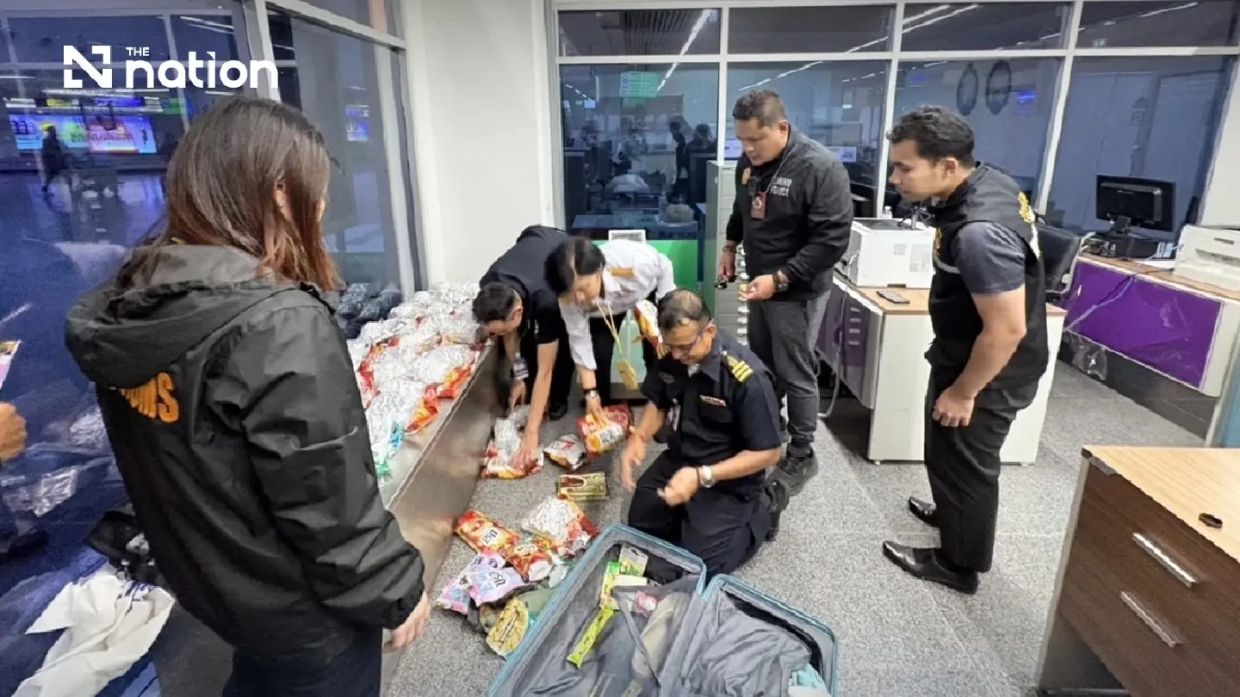
A 30-year-old Russian national faces charges after Thai authorities uncovered a significant drug smuggling attempt at Phuket International Airport on Wednesday, July 8. Customs officers discovered approximately 17.6 kilogrammes of cannabis products meticulously packed across two blue suitcases during a routine inspection of outgoing passengers at the airport's international departure terminal in Mai Khao subdistrict, Thalang district.
The cache seized from Sergei Chalabari comprised two distinct forms of the controlled substance. Officers identified 35 vacuum-sealed packages of cannabis flowers weighing 11.4 kilogrammes in total, supplemented by a further 12 packs of cannabis resin totalling 6.2 kilogrammes. This substantial quantity suggests an operation involving distribution or resale rather than personal use, raising questions about the broader supply networks operating in Southeast Asia's tourism hubs.
Customs officer Rawin Kanokakorn led the inspection team that examined the two blue BP WORLD wheeled suitcases, which together weighed eight kilogrammes. The meticulous concealment strategy—using vacuum-sealing techniques to mask the contraband—indicates a degree of preparation aimed at evading detection. However, routine customs procedures proved effective in identifying the illicit cargo before it could leave Thai territory.
During preliminary questioning conducted at the airport, Chalabari admitted ownership of both the suitcases and their contents, a confession that significantly strengthened the case against him. Such cooperation, whether voluntary or strategic, streamlined the procedural aspects of the detention and subsequent transfer to law enforcement authorities for formal investigation and prosecution.
Thai officials immediately invoked charges of attempting to export contraband goods outside official customs channels—a serious violation of the kingdom's narcotics laws. The smuggling charge carries substantial penalties, as Thailand maintains stringent anti-drug legislation with significant prison sentences and fines for those convicted of trafficking or attempting to transport controlled substances across international borders.
The investigation has been transferred to Sakhu Police Station, where detectives will pursue further legal proceedings against the Russian suspect. The confiscated suitcases themselves have been designated as evidence in the case, with the seized cannabis placed under secure custody pending potential destruction following court proceedings. This operation reflects Thailand's continued efforts to intercept drug trafficking at its major transportation hubs.
The arrest underscores the persistent challenges facing Phuket International Airport and other Southeast Asian gateways in combating narcotics smuggling. Phuket, as a major international tourist destination, experiences significant passenger volumes daily, creating both vulnerabilities and opportunities for law enforcement to detect illicit activities. The sophisticated concealment methods employed suggest that smugglers continue to develop strategies to circumvent detection, though authorities appear increasingly adept at identifying such attempts.
The coordination between multiple agencies—including Phuket Airport Customs House leadership under Nucha Jeeradit, various customs divisions, and Sakhu Police Station under Pol Col Salan Sankhisasasanakun—demonstrates Thailand's institutional capacity to respond to trafficking incidents. The involvement of investigation specialists and customs control divisions suggests a professional, structured approach to narcotics interdiction at international borders.
For Malaysian observers, the Phuket case carries particular relevance. Thailand and Malaysia share similar geographic positions within Southeast Asia's drug trafficking corridors, with both nations serving as transit points for narcotics moving toward international markets. The quantities seized at Phuket—sufficient to supply significant retail distribution networks—reflect supply patterns that directly concern Malaysian law enforcement agencies.
The incident also highlights the transnational character of modern drug trafficking, whereby foreign nationals are arrested in third countries attempting to export contraband internationally. This pattern suggests sophisticated smuggling organisations that recruit couriers from multiple nationalities and coordinate movements across diverse jurisdictions. Malaysian customs and immigration authorities maintain heightened awareness of such operations, particularly given Malaysia's role as a major air hub connecting South Asia, Southeast Asia, and beyond.
Thai authorities' success in apprehending Chalabari before his departure demonstrates the importance of maintaining robust border security protocols at international airports. Routine inspections, combined with trained officers capable of identifying sophisticated concealment methods, remain essential components of any nation's counter-narcotics strategy. For Malaysian officials, the Phuket seizure provides valuable intelligence about trafficking methodologies and the types of cargo movements that warrant closer scrutiny.

