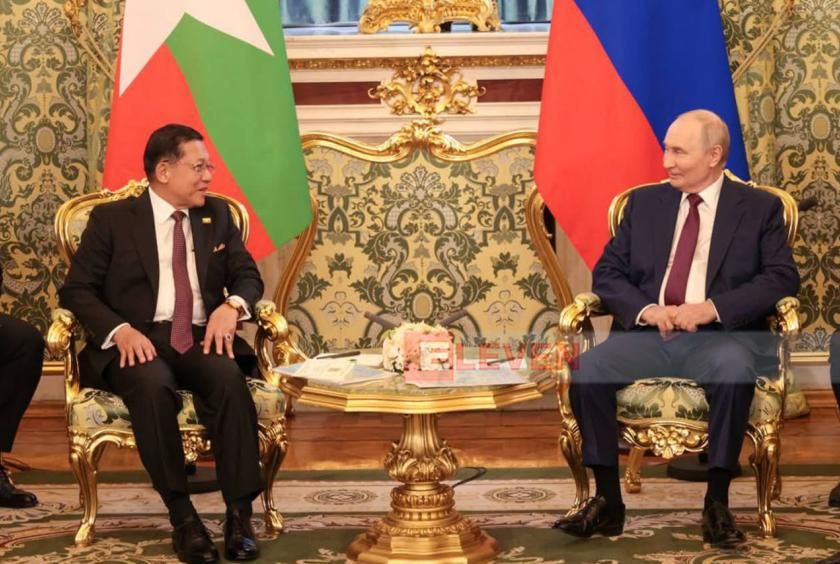
Russia has signalled its commitment to deepening energy partnerships with Myanmar, with President Vladimir Putin announcing at a joint media appearance in Yangon that Moscow is prepared to explore offshore oil and gas resources alongside President U Min Aung Hlaing. The two leaders, meeting on August 18, positioned energy cooperation as a cornerstone of broader bilateral relations rooted in historical ties stretching back to the Soviet era. The announcement underscores Russia's strategic pivot toward Southeast Asia as Western sanctions limit alternative avenues for economic engagement, while Myanmar, facing international isolation, finds Moscow a willing partner for resource development and infrastructure investment.
Putin framed the partnership within the context of decades-long Russia-Myanmar relations, highlighting Soviet-era assistance in social, economic, and defence sectors during the 1950s and 1960s. Hospitals and universities constructed during that period remain operational and valuable to Myanmar's development today, he noted, creating a historical narrative that legitimizes contemporary cooperation. This invocation of shared history serves a dual purpose: it appeals to Myanmar's institutional memory of Cold War-era partnerships while positioning Russia as a historically committed ally, a distinction that carries weight in Southeast Asian geopolitics where nations value long-term diplomatic relationships.
The energy sector emerged as the primary focus of new collaborative efforts. Beyond conventional oil and gas exploration, Putin specifically highlighted liquefied natural gas (LNG) as a growth area, suggesting that Russian exports could supply Myanmar's domestic energy needs while positioning the country as a potential re-export hub for regional markets. This proposal addresses Myanmar's chronic energy deficiency—a persistent constraint on economic development—while simultaneously creating commercial opportunities that could benefit both nations. For Myanmar's military-led government, energy security represents a critical governance challenge, making such partnerships instrumental to maintaining stability and supporting industrial expansion.
Infrastructure projects already underway demonstrate the breadth of Russian involvement in Myanmar's economy. Coal-fired power plants and oil refineries are operational or under construction, while Putin identified several emerging ventures: a steel manufacturing facility, fertilizer production plant, and a strategically significant deep-sea port in southern Myanmar. These industrial installations reflect Russia's interest in expanding Myanmar's manufacturing capacity and export potential, which could enhance the country's regional trade position. The deep-sea port project carries particular geopolitical weight, offering Russia potential maritime access while providing Myanmar with critical logistics infrastructure for regional commerce.
Nuclear energy represents another dimension of technological cooperation. Russia and Myanmar signed an agreement last year to construct a nuclear power plant, which Putin characterized as a flagship project for both nations. This commitment reflects Myanmar's long-term energy planning and Russia's technological capabilities in nuclear engineering. For the broader Southeast Asian region, Myanmar's nuclear development raises questions about regulatory frameworks, safety standards, and proliferation concerns—issues that neighbouring countries monitor closely given geographical proximity and shared water resources.
Beyond traditional energy and infrastructure, the partnership extends into high-technology sectors that reflect evolving global competition. Russian companies have proposed initiatives spanning digital infrastructure, cybersecurity, and advanced industrial applications. These proposals position Russia as a technological partner capable of supporting Myanmar's digital transformation, an area where Western companies have been constrained by sanctions regimes and geopolitical tensions. Cybersecurity cooperation, in particular, holds significance for a military government managing internal security challenges and international scrutiny of its governance practices.
Space cooperation represents an emerging frontier in bilateral relations. Putin noted that Russia and Myanmar signed a space agreement in 2025 and are actively implementing collaborative projects, though specific details remain undisclosed. This venture, while symbolically minor compared to energy partnerships, demonstrates the ambition and scope of cooperation, positioning Myanmar as a participant in Russia's space initiatives at a time when Moscow faces isolation from Western aerospace programmes.
Cultural and educational exchanges form the human dimension of state partnership. Russia has established cultural and religious centres in Altai, Kaluga, and Moscow, with approval granted for an Orthodox Christian church in Yangon, reflecting efforts to embed Russian cultural presence within Myanmar. Language instruction in Russian at Yangon and Mandalay universities, plus the military academy, cultivates future generations of Russian-speaking professionals and policymakers. Currently, 400 Myanmar students pursue studies at Russian universities, with an historical cohort of 17,000 graduates, creating a diaspora of Russia-educated elites whose networks and perspectives influence Myanmar's development trajectory.
Military-technical cooperation underscores the security dimensions of partnership. Putin emphasized frequent joint military exercises conducted in Myanmar's waters, complemented by regular visits from Russian naval vessels. These activities establish Russian naval presence in the Andaman Sea and Bay of Bengal, regions where geopolitical competition among major powers intensifies. For Myanmar, such cooperation addresses defence modernization while signalling alignment with Russia in an era of great-power competition.
The twelve memorandums of understanding signed during President U Min Aung Hlaing's visit formalize these commitments across multiple sectors, though the public record provides limited detail on specific terms, timelines, and financial commitments. The breadth of agreements—spanning energy, infrastructure, technology, culture, and military cooperation—reflects comprehensive strategic alignment. For Myanmar, diversification of international partnerships reduces dependency on any single power while enabling technology transfer and resource development. For Russia, Myanmar represents a foothold in Southeast Asia and access to maritime routes, markets, and natural resources.
Regionally, Russian-Myanmar deepening partnerships have implications for Southeast Asian stability and alignment patterns. As ASEAN nations navigate great-power competition between Western democracies and authoritarian powers, Myanmar's choices influence regional geopolitical balance. Russia's expansion in Myanmar potentially complicates ASEAN's efforts to maintain strategic autonomy and neutrality, particularly given Myanmar's current international isolation following the 2021 military coup. Neighbouring countries including Thailand, Bangladesh, and India monitor these developments closely, assessing implications for regional security architecture and energy competition.
Putin's emphasis on mutual respect, fairness, and non-interference in internal affairs reflects both nations' shared positions on sovereignty and governance. Both governments reject external pressure on human rights and political systems, creating common cause despite disparate strategic interests. This ideological alignment, combined with practical economic benefits, strengthens partnership resilience against international criticism. For Myanmar's junta, Russia's support provides diplomatic cover and concrete development assistance, while for Moscow, Myanmar offers a willing Southeast Asian partner navigating isolation from Western powers.

