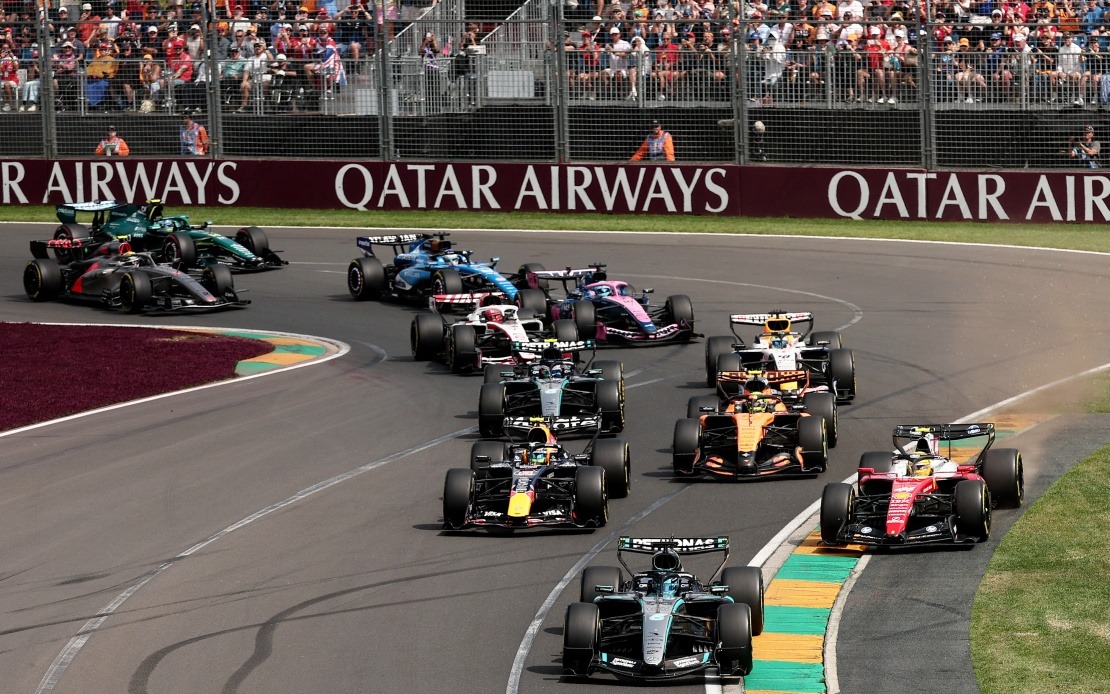
George Russell's championship hopes suffered another significant setback at Spa-Francorchamps on Sunday when mechanical gremlins and a collision with teammate Lewis Hamilton forced him out of the Belgian Grand Prix. The incident prompted an outburst over team radio that revealed the depth of the British driver's frustration with a season plagued by reliability issues. Russell's already challenging campaign has now tilted decisively against him, with the 26-year-old trailing the impressive Kimi Antonelli by 50 points after just ten rounds.
The collision that ended Russell's race was itself a consequence of earlier misfortune. A first-lap engine problem had left him exposed to the pursuing field, and the subsequent contact with Hamilton—his own teammate—compounded what had already been a disappointing weekend for the three-time Grand Prix winner. In unbroadcast radio transmissions, Russell could be heard expressing his exasperation in forceful terms, questioning what had gone wrong with the state of battery charge management on the straights and labelling the situation "unacceptable."
Russell's troubles at the Belgian circuit had begun much earlier, during qualifying, when he found himself half a second adrift of Antonelli on the grid. The initial diagnosis from Mercedes suggested the deficit might stem from Russell's driving technique, a suggestion that only deepened the mystery when engineers subsequently ruled out any such explanation. The true culprit appeared to be a deployment riddle within the power unit itself—a problem complex enough to evade quick resolution even after the qualifying session had concluded.
For Malaysian and Southeast Asian motorsports enthusiasts, this battle between Mercedes teammates offers a fascinating contrast in form. The teenage Antonelli, despite his relative inexperience at Grand Prix level, has demonstrated remarkable consistency and performance, securing six victories from the ten races contested. By contrast, Russell has found himself perpetually battling mechanical gremlins that have undermined what would otherwise be a serious championship contention. The gap between the two drivers speaks not only to individual capability but also to the cruel role that mechanical reliability plays in modern Formula One.
Russell expressed guarded optimism that Mercedes could identify and rectify the deployment issue before the Hungarian Grand Prix, the final round before the summer break. However, his comments to the media revealed a driver emotionally worn down by a relentless sequence of technical failures. He acknowledged feeling "numb to disappointment," a candid admission from a competitor accustomed to performing at the highest levels of motorsport. The psychological toll of repeated mechanical retirements and malfunctions cannot be underestimated in a sport where mental fortitude often determines the difference between champions and also-rans.
Mercedes team principal Toto Wolff responded with measured calm to Russell's outburst, seeking to contextualize the driver's emotional state whilst defending both the team and its commitment to resolving the issues. Wolff acknowledged that frustration was entirely natural when circumstances conspire against a driver, but he positioned Russell's struggles within a broader framework of professional resilience. The team principal emphasized that elite Formula One drivers regularly experience difficult periods and that the pathway forward lay in rebuilding morale and confidence rather than dwelling on setbacks.
Wolff's technical explanation revealed the extraordinary complexity inherent in modern Formula One power units. The interplay between energy harvesting and deployment strategies, compounded by driver inputs and circuit characteristics, creates a multifaceted engineering challenge that even the world's most advanced teams occasionally struggle to master. In Russell's case, Wolff identified a specific power unit issue that had restricted the energy available for deployment into turn 18, effectively costing the driver approximately half of his qualifying deficit to Antonelli, perhaps even more.
The timing of identifying this problem at Spa, rather than at a subsequent circuit, represented a silver lining for Mercedes. The high-speed nature of the Belgian Grand Prix, with its demanding energy demands, made the issue particularly visible. A circuit like Budapest, where energy management is less critical, might have obscured the problem entirely, leaving Russell struggling without clear diagnosis heading into the summer break. Nevertheless, as Wolff himself acknowledged, understanding the root cause offers little consolation to Russell when the damage to his championship aspirations has already been inflicted.
For regional Formula One followers, this situation underscores the competitive parity that has emerged within the Mercedes team this season. Rather than enjoying the dominance that characterized earlier campaigns, Mercedes has found itself fielding two drivers with vastly different fortunes—one flourishing and accumulating victories, the other hobbled by technical misfortune. This dynamic raises questions about resource allocation, strategic prioritization, and whether mechanical issues might be distributed more equitably across the two cars.
Russell's championship mathematics have become increasingly desperate. With Antonelli commanding a 50-point advantage and multiple rounds remaining before the season concludes, Russell faces a climb that would require sustained perfection alongside championship-rival retirements. The British driver's emotional volatility, evident in his radio outbursts, represents a pressure valve that many elite athletes employ when facing seemingly insurmountable obstacles. Whether Mercedes can resolve the underlying technical issues in time for Budapest will likely determine whether Russell's season shows signs of recovery or continues its downward trajectory.
The broader implications extend beyond Russell's individual campaign. Mercedes' reliability struggles this season contrast sharply with their recent reputation for engineering excellence and mechanical dependability. If these issues persist into the Hungarian Grand Prix and beyond, they threaten to undermine the team's constructors' championship ambitions and raise questions about their ability to compete with other front-running teams that appear to have solved similar reliability puzzles. The stakes, therefore, extend well beyond one frustrated driver's championship hopes.

