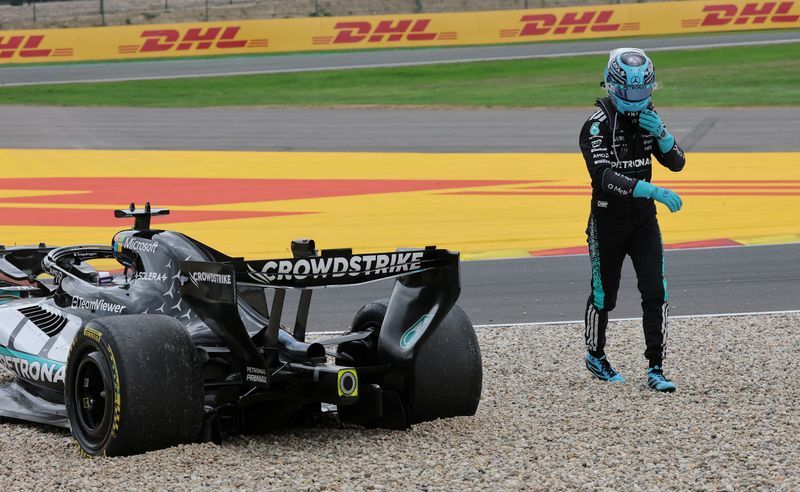
George Russell's pursuit of title contention at the Belgian Grand Prix ended almost as soon as it began, with the Mercedes driver crashing into Lewis Hamilton's Ferrari on the first lap at Spa-Francorchamps on Sunday. The collision sent Russell's vehicle spinning into the gravel trap, forcing him to retire from the race entirely whilst his former teammate Hamilton continued, though not without penalty. The incident left Russell visibly frustrated, describing himself as emotionally "numb to the disappointment" after another costly race failure that has left his championship aspirations in serious jeopardy.
Russell's afternoon unravelled rapidly despite beginning from a promising grid position of third place. His hopes took an immediate downward turn as he lost several positions whilst navigating the opening corners, dropping back to sixth as the field sorted itself through the first sequence of turns. What followed was Russell's aggressive attempt to recover lost ground, pushing forward to challenge Hamilton in a move that proved disastrous for both drivers. The contact between the two Mercedes stable-mates triggered the safety car and prompted an investigation from the stewards, who ultimately assigned Hamilton a five-second penalty for his role in causing the collision. However, the penalty provided little consolation to Russell, who had already exited the race.
The technical explanations provided by Russell after the race paint a picture of mechanical failure rather than pure driver error. He articulated that whilst his opening lap was executed well, positioning himself closely behind Red Bull's Max Verstappen, his car's electrical systems began failing almost immediately. The battery refused to recharge as planned at the first turn, forcing Russell to exit the corner with only 35 per cent of his electrical power reserve intact. This fundamental deficit cascaded into additional problems, with the turbo system failing to respond appropriately and leaving him bereft of the performance boost that competitors would normally expect at that stage of the race. By the time Russell reached Eau Rouge, arguably one of the most technically demanding sections of the circuit, he was operating on zero battery power, a situation he rightly characterised as genuinely dangerous given the high speeds and demanding nature of that particular corner.
The consequences of this technical failure proved immediate and severe. Russell found himself overwhelmed by three competitors simultaneously, unable to defend his position or maintain competitive pace due to the power deficit. Rather than direct criticism of his competitor or the racing circumstances, Russell's primary frustration targeted his own team's machinery and the circumstances that placed him in such a compromised position. He emphasised that the subsequent incident with Hamilton, whilst regrettable, stemmed directly from his inability to manage the expected performance from his vehicle. This distinction matters considerably, as Russell appeared concerned that observers might misinterpret the collision as a product of aggressive or reckless driving, when in reality it resulted from a cascading series of mechanical failures that left him desperately short of power at a critical moment.
Russell's assessment of the Hamilton incident itself demonstrated a measured perspective despite the competitive consequences. Whilst acknowledging that Hamilton bore greater responsibility for the contact, Russell stopped short of suggesting his former teammate had acted recklessly or with deliberate intent. The two drivers, who spent three seasons together at Mercedes before Hamilton's recent departure for Ferrari, maintain a professional relationship that the collision did not fundamentally alter. Russell's anger, he explained, was directed primarily inward at his own team's failure to diagnose and rectify the battery management and turbo charging issues that became apparent during qualifying on Saturday. That these problems persisted into race day without satisfactory resolution represented a significant operational oversight.
This latest mechanical retirement extends an increasingly problematic trend for Russell throughout the current season. The British driver has now recorded three races without scoring championship points, whilst his championship rival Kimi Antonelli has suffered only two blank results despite commanding the title standings with a 25-point advantage over Russell with nine of twenty-two races completed. Antonelli's consistency and performance have been considerably more reliable, particularly evident in his pole position start for this Belgian Grand Prix and his six race victories thus far. The contrast in reliability and execution between the two drivers has become a defining characteristic of the season's battle for the championship.
Russell's reflection on his emotional state reveals the psychological toll that repeated mechanical failures and collisions exact upon drivers competing at the highest level. When such setbacks occur with increasing frequency, the initial devastation gradually transforms into a form of emotional numbness, a coping mechanism that allows competitors to process disappointment without allowing it to become entirely consuming. Russell's comment that "when it happens so often you just get used to it" suggests a driver adapting to recurring adversity, though such adaptation can only be temporary before questions arise about whether his team possesses the technical capability to mount a genuine championship challenge.
For Mercedes as a constructor, the battery and turbo charging failures that affected Russell's Belgian Grand Prix run represent concerning reliability issues at a critical juncture in the season. With the championship deficit growing and the second half of the season approaching, the team faces mounting pressure to identify and eliminate such technical failures whilst simultaneously improving overall performance to match competitors like Red Bull and Ferrari. The fact that these problems emerged during qualifying and persisted into the race suggests either inadequate diagnostic protocols during preparation or inability to implement adequate solutions despite advance warning.
The broader implications for Russell's title hopes are increasingly difficult to ignore. With nine races completed and Antonelli establishing a commanding lead, Russell cannot afford further mechanical retirements or collisions that cost him significant points. The technical failures revealed at Spa represent precisely the kind of unforced errors that determine championships in the modern Formula One era, where the difference between winning and losing often comes down to equipment reliability as much as driver skill. Russell's frustration, though expressed with restraint, masks the growing realisation that his path to the championship has become substantially more complicated through no fault of his own.

