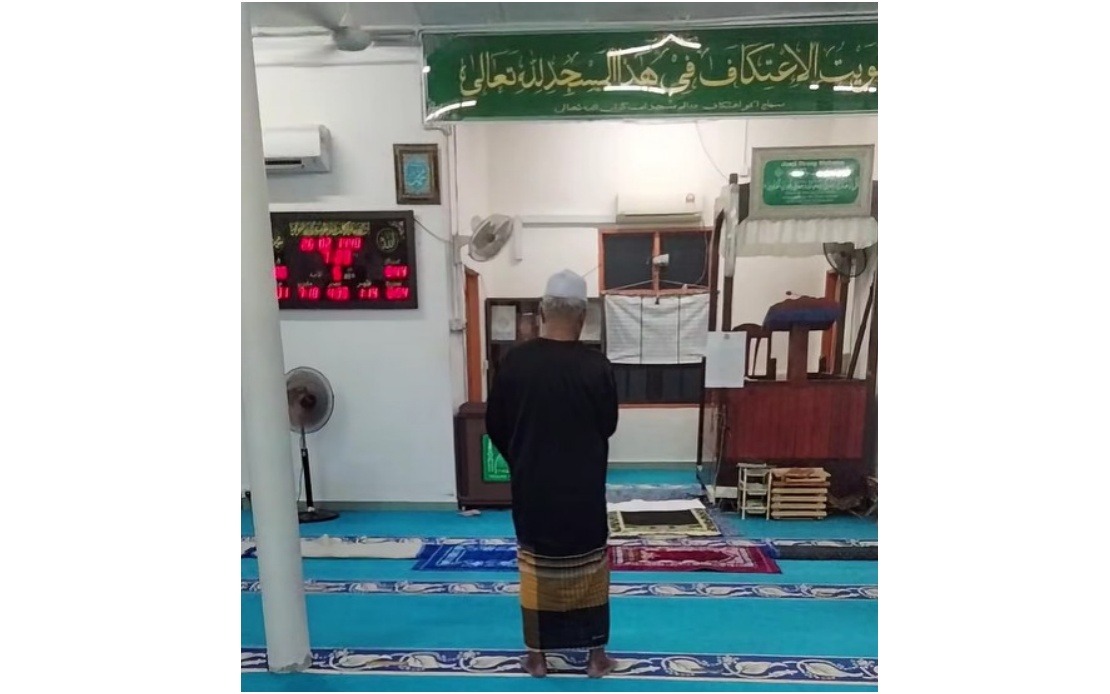
A 15-second video that circulated recently on social media has drawn unexpected attention to a small mosque in Mersing, prompting local officials to clarify the circumstances behind what appeared to be a single-person congregation. The footage, which made its way across Facebook and WhatsApp, showed one man performing prayers while simultaneously serving as imam and bilal—roles that typically require separate individuals—raising concerns among viewers about the religious institution's viability and management practices.
Mersing MP Muhammad Islahuddin Abas, who is also a village resident, explained that the viral clip does not accurately represent the actual state of Masjid Tanjung Resang. Speaking to reporters at the mosque, he acknowledged that the premise of the video, while technically capturing a real moment, failed to account for broader demographic realities affecting the area. The root cause, he stressed, lies not with institutional shortcomings but rather with demographic shifts that have reshaped rural communities throughout Malaysia's eastern seaboard.
The MP outlined how migration patterns have hollowed out many small villages in Johor's interior. While the settlement around Tanjung Resang retains a considerable number of residential structures, the actual resident population has dwindled substantially as people have sought employment opportunities in urban centres or relocated permanently to other regions. This phenomenon, replicated across Malaysia's rural landscape, creates a paradox where physical infrastructure remains intact even as the human communities they once served have dispersed. Despite this demographic challenge, Muhammad Islahuddin emphasised that the mosque continues to maintain an active programme of religious and educational activities.
The MP revealed that he himself was taken aback upon receiving a screenshot of the viral content through WhatsApp, forwarded to him by an acquaintance in Kuala Lumpur. The circulation pattern itself underscores how quickly information—sometimes lacking crucial context—spreads through Malaysian social networks, particularly when it touches on religious institutions. However, Muhammad Islahuddin adopted a pragmatic view of the controversy, suggesting that the unexpected exposure carries certain advantages for the mosque and the locality it serves.
Despite the embarrassment of being featured in viral content, Muhammad Islahuddin identified an unexpected silver lining in the episode. The very publicity that sparked concern has inadvertently raised awareness about the mosque's existence among people far beyond Mersing's boundaries. He highlighted that the mosque's position off the main thoroughfare has historically limited its visibility, with many even within the district remaining unaware of its location. By reaching audiences across Peninsular Malaysia through social media, the viral video has accomplished what conventional promotion strategies might have struggled to achieve.
Beyond its primary religious function, the MP emphasised that Masjid Tanjung Resang serves as an important community facility with broader appeal and utility. The mosque welcomes visitors of all faiths and has established itself as a convenient stopping point for hikers and outdoor enthusiasts attempting Gunung Arong, the prominent peak in the area. The facility has been equipped with amenities specifically designed to accommodate these visitors, positioning the mosque as an integral part of the local tourism and recreation infrastructure. This multi-functional approach reflects how rural religious institutions in Malaysia increasingly operate as hubs serving diverse community needs beyond conventional congregational prayer.
Abdul Syamil Abdul Fadzil, the mosque's chairman, separately confirmed that the viral video has prompted official scrutiny of the institution. A representative from the Johor Islamic Religious Affairs Department (JAINJ) reached out to him following the circulation of the footage, triggering a formal explanation of the mosque's actual operational situation. Abdul Syamil clarified that the individual visible in the video was not the imam but rather the mosque's noja, or assistant, who was captured performing a voluntary prayer rather than leading the formal congregation.
The chairman's account provided additional context that the edited footage fundamentally misrepresented the mosque's circumstances and activity level. He asserted that the viral clip captured an anomalous moment rather than the routine operational pattern. Masjid Tanjung Resang, according to Abdul Syamil, maintains a regular calendar of religious programmes and activities that continue without interruption. The clarification from both the chairman and the MP suggests that while the congregation may indeed be small due to demographic realities, the institution itself remains functionally active and committed to its role within the community.
The incident highlights a broader tension within rural Malaysia, where demographic decline has created sustainability challenges for village institutions while the physical infrastructure often remains deceptively substantial. Mosques, suraus, and other community facilities built to serve larger historical populations now operate with reduced congregations, a reality that extends across multiple states and affects not just religious institutions but also schools, clinics, and local government services. For rural leaders like Muhammad Islahuddin, the challenge involves maintaining institutional viability and community cohesion despite population pressures that are largely beyond local control.
The response from official quarters, particularly JAINJ's engagement with the mosque, indicates that state religious authorities recognise these demographic realities and are responsive to concerns about rural mosque management. Rather than viewing the situation as a failure of institutional oversight, the department appears to have approached the matter with understanding of the contextual constraints. This measured response contrasts with the sensationalism that sometimes characterises online discussion of such issues, suggesting that authorities operate with a more nuanced understanding of rural challenges.
For Mersing residents and the broader Malaysian public, the episode serves as a reminder that viral social media content, while attention-grabbing, often lacks the contextual depth necessary for fair assessment of local situations. The mosque that appeared to function with a single congregant in a 15-second video is, in reality, an active community institution navigating the very real challenges of rural Malaysia in the contemporary era. The unexpected publicity may ultimately prove beneficial, introducing the mosque to a wider audience and potentially attracting visitors and supporters who would otherwise never encounter it.

