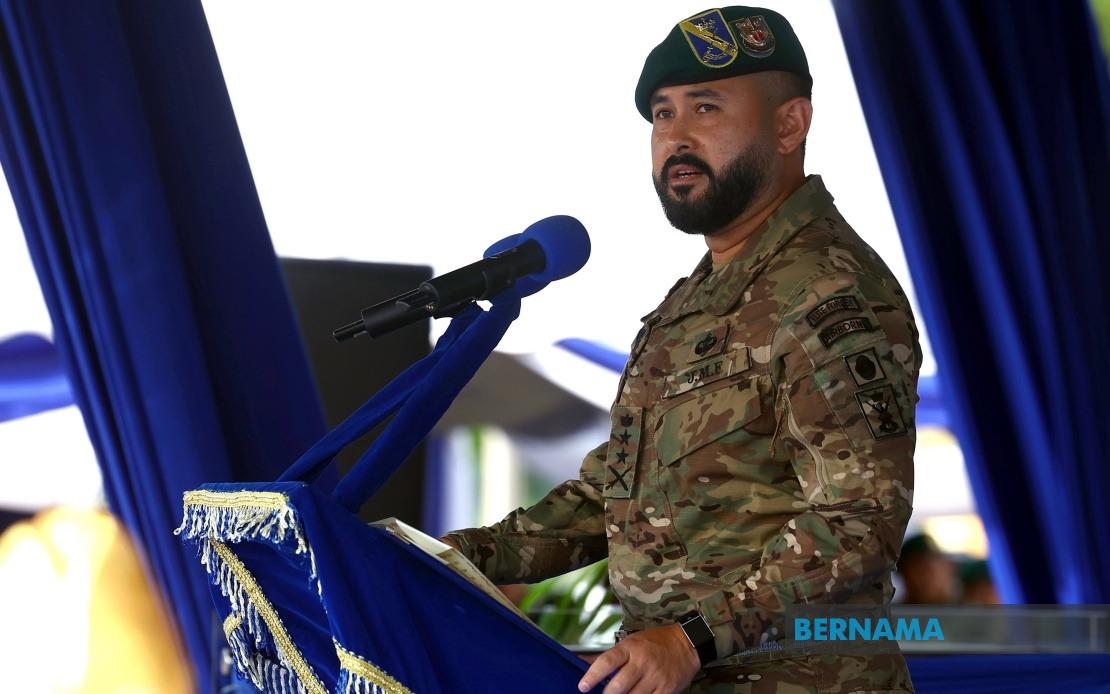
Tunku Mahkota Ismail, the Regent of Johor, has issued a stern warning that decisions endorsed by His Majesty Sultan Ibrahim, King of Malaysia, regarding the development of the Regimen Gerak Khas (RGK)—Malaysia's premier commando unit—must remain inviolable and cannot be altered to serve the interests of particular individuals or factions. Speaking at a ceremony marking the 61st anniversary of the RGK in Mersing on August 20, His Royal Highness emphasized that the special forces unit's strategic trajectory, once sanctioned at the highest level of the nation's leadership, deserves unwavering commitment from all institutional stakeholders.
The gravity of the Regent's intervention extends beyond a simple administrative reminder. His Royal Highness underscored that every proposal and initiative involving the RGK requires explicit consent from the King in his capacity as Colonel Commandant of the unit, and must be executed with absolute fidelity to the principles of national security and sovereignty. This framing positions the King's approval as sacrosanct, establishing a clear constitutional hierarchy that should govern decision-making within the defence establishment. The Regent's use of a traditional Malay adage—"harapkan pagar, pagar makan padi" (trusting the protector only for them to turn and destroy)—conveyed his concern that custodians of the RGK's development might betray their stewardship by accommodating improper pressures.
Beyond the realm of strategic planning, Tunku Ismail directed pointed criticism at the management structures within the Ministry of Defence and the broader Malaysian Armed Forces. He indicated awareness of specific personnel decisions, particularly regarding the appointment of the Ministry's secretary-general, and signalled his intention to address what he characterized as a systemic "cancer" within the military establishment. This language suggests deep institutional frustrations regarding governance, accountability, and the infiltration of parochial interests into defence matters—concerns that resonate across Southeast Asia, where civil-military relations and merit-based advancement remain contentious issues.
The Regent articulated a comprehensive vision for the RGK's modernization that encompasses far more than incremental improvements. He stressed that Malaysia's top defence leadership bears an institutional obligation to sustain the unit's capabilities across multiple dimensions: advanced equipment, sophisticated weaponry, enhanced mobility, cutting-edge technology, robust support systems, and operational assets. This multifaceted approach reflects an understanding that contemporary security challenges demand integrated responses rather than piecemeal upgrades.
The regional security environment provides crucial context for His Royal Highness's concerns. The Indo-Pacific geopolitical landscape has grown markedly more unstable, with intensifying great-power competition and persistent tensions in the South China Sea creating unprecedented challenges for middle-power nations like Malaysia. The Regent's observation that security has become "far more complex and unpredictable" acknowledges these shifting dynamics and justifies the elevated demands he places on the RGK as the nation's rapid-response capability. For Malaysian readers and regional observers, this framing positions force modernization not as military aggrandizement but as prudent adaptation to evolving threats.
Critically, the Regent rejected any suggestion that Malaysia can maintain security through complacency or reliance on outdated capabilities. He called for sustained, serious attention to the RGK's resource requirements, ensuring alignment between the unit's needs and its current and foreseeable operational demands. This argument carries implications beyond Malaysia, offering a counterweight to budgetary constraints that afflict many Southeast Asian defence ministries and demonstrating how strategic imperatives can justify sustained investment in specialized forces.
Tunku Ismail further insisted that procurement and capability development processes must be guided by objective criteria: demonstrated capability, quality assurance, operational effectiveness, and value-for-money considerations. All initiatives outlined under the 13th Malaysia Plan affecting the RGK warrant priority status, with special attention to technological innovation, fiscal efficiency, operational appropriateness, and long-term strategic requirements. This emphasis on transparent, merit-based procurement represents a veiled critique of practices—potentially involving patronage, inflated pricing, or unsuitable equipment—that have historically compromised defence effectiveness across the region.
Personnel management emerged as an equally significant concern for His Royal Highness. He insisted that career advancement, welfare provisions, and opportunity allocation must be administered transparently and according to merit, with complete exclusion of nepotism, favoritism, or personal advantage. The Regent warned that allowing vested interests to influence personnel decisions, tolerating systemic failures, or permitting non-transparent management would inevitably undermine the organization's operational readiness and institutional integrity. This reasoning reflects a sophisticated understanding of how organizational culture and human-resource practices directly influence military effectiveness.
The final dimension of the Regent's message addressed the personnel themselves. He called upon all RGK members to maintain exceptional standards across multiple domains: technical competence, physical conditioning, psychological resilience, personal integrity, and absolute loyalty to the Crown and nation. These expectations align with the principles articulated in the Commando Soldier's Oath, binding the unit's personnel to demanding standards. The Regent characterized the RGK as the "tip of the spear" in confronting security threats, a metaphor emphasizing both the unit's elite status and its critical role in national defence.
For Malaysian stakeholders and regional observers, the Regent's intervention carries profound implications. It signals that serious institutional actors within Malaysia's establishment remain committed to professional military values and are willing to challenge governance deficiencies when they detect them. The address demonstrates that questions of defence efficacy, personnel integrity, and strategic planning have not been surrendered to technocratic obscurity but retain prominence in elite deliberations. His Royal Highness's emphasis on maintaining the RGK's operational edge while ensuring merit-based governance reflects a vision in which security capability and institutional integrity are inseparable objectives.
The broader significance extends to Malaysia's regional standing. A professionally managed, well-resourced, and strategically focused special forces unit enhances the nation's capacity to respond to security emergencies, from terrorism to maritime threats. By insisting on merit-based advancement, transparent procurement, and adherence to the King's strategic vision, the Regent has articulated a framework within which the RGK can fulfill its destiny as a world-class rapid-response capability. For a nation navigating increasingly complex regional security dynamics, such institutional clarity proves invaluable.

