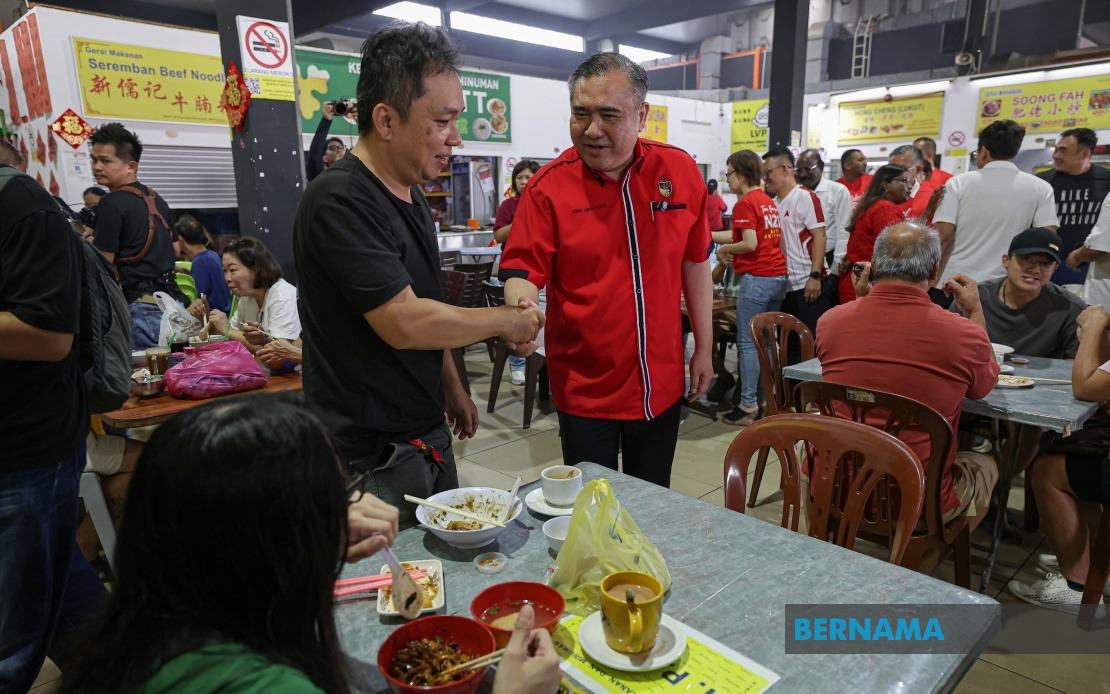
Transport Minister Anthony Loke has laid down firm directives requiring all campaign participants in the ongoing 16th Negeri Sembilan state election to adhere strictly to traffic regulations and road safety protocols. Speaking in Seremban following a walkabout with Pakatan Harapan candidates, Loke emphasised that compliance with traffic laws represents a fundamental expectation that supersedes electoral competition, underscoring that winning an election cannot justify endangering lives or violating established safety standards.
The DAP secretary-general's intervention signals a broader concern about the safety practices commonly observed during Malaysian electoral campaigns, when the pressure to mobilise supporters and conduct intensive ground operations can lead candidates and their teams to disregard traffic regulations. By making road safety compliance a priority rather than an afterthought, Loke is attempting to reshape campaign culture in a way that could have implications beyond Negeri Sembilan, potentially influencing how other states approach electoral conduct in forthcoming campaigns.
Loke has taken personal responsibility for enforcing these standards within his own party apparatus, instructing all DAP campaign teams to wear safety helmets without exception when operating motorcycles throughout the campaign period. During the nomination day proceedings, when his convoy travelled from Pekan Titi to Kuala Klawang, he made the helmet requirement an absolute prerequisite for participation, establishing a clear precedent that non-compliance would result in exclusion from official campaign operations. This hands-on approach demonstrates that the directive comes not as mere bureaucratic guidance but as a condition that reflects his personal commitment to accident prevention.
Beyond helmet usage, Loke has specifically flagged another dangerous practice that emerges during campaign activities: supporters and campaigners riding on the tailgates of moving four-wheel-drive vehicles. He characterised this behaviour as reckless and inappropriate, calling for all parties and campaign leaders to abandon such methods regardless of their effectiveness in transporting personnel or creating visual spectacle during convoy movements. The warning suggests that even seemingly minor practices, when multiplied across numerous campaign events and hundreds of participants, can accumulate into genuine public safety risks.
The minister's emphasis on leading by example carries particular weight in the Malaysian political context, where candidate behaviour often sets the tone for grassroots supporter conduct. By demonstrating personal adherence to traffic regulations through his own convoy protocols and public messaging, Loke is attempting to establish social norms that extend beyond his own party to influence the broader campaign environment. This approach acknowledges that unilateral compliance by one coalition carries limited impact if opposing candidates ignore similar safeguards, thereby creating a situation where safety-conscious campaigners become disadvantaged competitors.
The Negeri Sembilan state assembly was dissolved on June 5, triggering the election timeline that culminates in polling day on August 1. Early voting has been scheduled for July 28, accommodating military personnel and their spouses alongside police officers among the 889,490 registered voters eligible to participate. The substantial voter base includes 867,151 ordinary voters, 16,884 military early voters, and 5,455 police early voters, suggesting that campaign activities will be intense across the state during the weeks leading to the poll.
For Malaysian observers, Loke's intervention reflects a growing recognition that electoral periods present recurring challenges to public order and safety. The combination of increased vehicular movement, concentrated gatherings, sleep-deprived campaign teams, and competitive pressure creates environments where accidents become statistically more likely. By making road safety a specific electoral issue rather than leaving it to passive enforcement by traffic authorities, Loke is reframing campaign management as a shared responsibility that transcends party politics.
The Pakatan Harapan candidates present during the Seremban walkabout—Ho Weng Wah in Temiang, Lee Kai Yet in Mambau, Siau Meow Kong in Rahang, Nicole Tan in Bukit Kepayang, S. Mugunthan in Seremban Jaya, and Chew Seh Yong in Lobak—represent constituencies across diverse demographic and geographic terrain within the state. Each will conduct their own campaign operations, and Loke's directives establish baseline safety expectations applicable to all their activities.
The practical enforcement of these directives remains an open question, particularly regarding how effectively party discipline can prevent lower-level operatives and enthusiastic supporters from bypassing the safety requirements. In previous electoral cycles, campaign intensity occasionally overwhelmed formal safety protocols, suggesting that sustained messaging and regular reminders may be necessary throughout the campaign period to maintain compliance. Additionally, the degree to which Loke's standards are reciprocated by candidates from opposition coalitions will influence whether the campaign environment achieves the accident-free status he advocates or instead develops into a competition where some candidates maintain higher safety standards than others.
The broader implication of Loke's stance extends to a principle increasingly relevant in Malaysian politics: the notion that democratic competition operates within boundaries established by the state, and that electoral success cannot justify violating fundamental public order requirements. This framing potentially influences how subsequent campaigns in other states approach safety and regulatory compliance, particularly if the Negeri Sembilan campaign successfully demonstrates that robust safety protocols can operate alongside intensive political competition without diminishing electoral engagement or candidate competitiveness.

