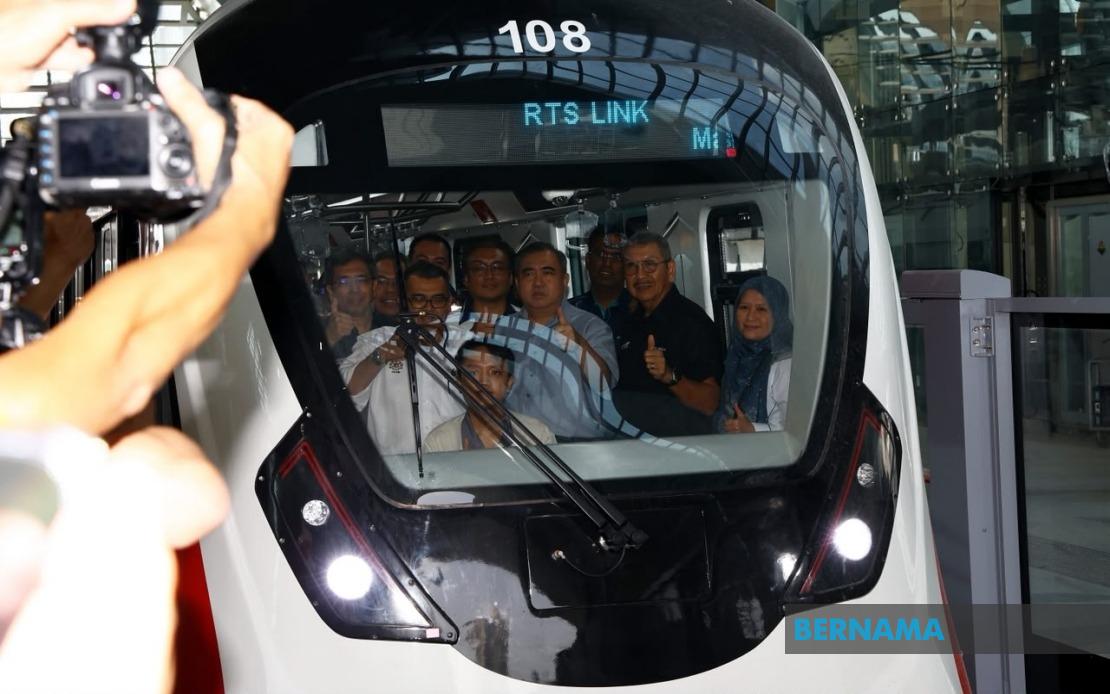
The Malaysian government has greenlit a RM60 million bridge project designed to directly connect the Bukit Chagar RTS Link Station with the KTMB Komuter rail service, eliminating the need for passengers to make circuitous journeys through the existing JB Sentral interchange. Transport Minister Anthony Loke announced the decision following an inspection of the Bukit Chagar site, emphasizing that the initiative represents a significant step toward seamless public transport integration in the Johor Bahru metropolitan area.
The bridge construction itself forms part of a broader infrastructure strategy to maximise the effectiveness of the Rapid Transit System Link when it commences operations on January 1 next year. By establishing direct pedestrian access between the Komuter platform and the RTS station, planners expect to streamline passenger flow and reduce friction points that typically discourage commuters from switching between transit modes. The project reflects growing recognition that successful rapid transit schemes depend not merely on individual transport lines, but on the quality of connections binding them together into a coherent network.
Under current arrangements, Komuter passengers wishing to access the RTS Link must navigate their way through JB Sentral, adding both time and inconvenience to their journey. This structural inefficiency has long been identified as a weakness in Johor Bahru's transport infrastructure, particularly given the projected demand surge once the cross-border link opens. The RM60 million investment addresses this shortfall directly, though the twelve-month implementation timeline means the bridge will likely debut several months after the RTS Link itself becomes operational. This phased approach, while not ideal, still positions the connector as ready by the first quarter of 2025.
Loke indicated that the Ministry of Economy has already approved the project, with the Ministry of Transport assuming execution responsibilities. The relatively substantial budget reflects not only the engineering requirements of spanning the gap between two distinct rail facilities operating at different technical specifications, but also the need to accommodate what officials expect will be significant passenger volumes once the RTS Link opens to traffic. Early projections suggest the system could handle up to 10,000 passengers per hour in each direction, a figure that underscores the infrastructure investment now underway.
The bridge project sits within a wider ecosystem of integration measures being implemented across the Bukit Chagar precinct. Officials are simultaneously developing the Bukit Chagar RTS Link Station as a genuine multimodal transport hub, incorporating connections not only with Komuter but also with JB Sentral, e-hailing services, and conventional bus networks. This comprehensive approach seeks to position the station as a genuine gateway to Johor Bahru rather than merely a border crossing point, potentially catalysing development in surrounding areas and reshaping commuting patterns across the region.
Crucial to this vision is an expansion of bus services coordinated with the RTS Link launch. The government is advancing the Stage Bus Service Transformation 2.0 programme, which envisions introducing at least 200 additional buses providing connections from residential zones across Johor Bahru to Bukit Chagar. These services will feed passengers into the RTS network rather than concentrating them at a single bottleneck, distributing demand across the transport system more effectively. The operator agreement is currently in final stages, with the Finance Ministry expected to deliver formal approval imminently.
The timing of these various initiatives reflects careful coordination between multiple agencies and stakeholder organisations. Officials have deliberately scheduled the bus fleet expansion to coincide with the RTS Link opening, a decision that demonstrates recognition of how demand management in transport systems depends on properly sequenced infrastructure delivery. Launching the rapid transit service without concurrent enhancement of connecting feeder services would risk overwhelming the initial system and damaging public confidence, while conversely deploying additional buses prematurely would squander resources on vehicles running half-empty.
The RTS Link itself represents a landmark development for Malaysia's transport architecture. As the country's first automated people mover serving an international border, it embodies technical sophistication and bilateral cooperation between Malaysian and Singaporean authorities. The physical infrastructure at Bukit Chagar, including the building structure and the Customs, Immigration and Quarantine complex, has reached completion stage. However, the system currently remains in testing and commissioning phase, with engineers conducting integration testing and multiple trial runs to verify proper functioning across all operational systems before public service commences.
For Malaysian readers, the RTS Link opening holds implications extending beyond Johor Bahru itself. As Southeast Asia's regional economies continue integrating through various mechanisms, efficient cross-border mobility increasingly matters to business competitiveness and personal opportunity. The success or failure of projects like the RTS Link will influence how governments across the region approach transport challenges in subsequent years. A well-executed launch, supported by thoughtfully designed feeder infrastructure like the Komuter bridge, can help establish best practices that other metropolitan areas may subsequently adopt.
The RM60 million bridge investment also warrants attention as a policy signal regarding transport prioritisation. Rather than permitting siloed development where different agencies operate separate transit networks with minimal coordination, the government has chosen to invest substantially in physical connectors binding systems together. This represents a departure from earlier infrastructure patterns in Malaysia, where jurisdictional boundaries sometimes took precedence over passenger convenience. Whether this integrationist approach becomes standard practice for future projects may depend significantly on how effectively the Bukit Chagar bridge functions once operational.

