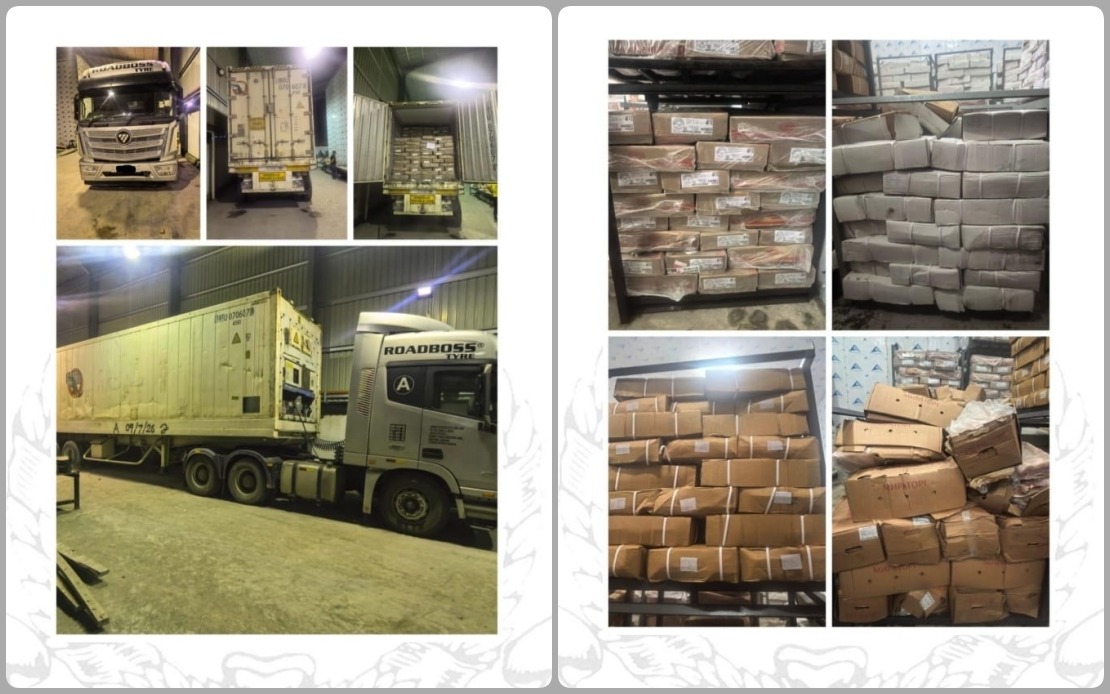
Authorities in Sarawak have made a significant seizure in the ongoing battle against illicit food imports, capturing RM6.19 million worth of frozen pork products at a warehouse in Miri. The operation, designated Op Taring Chiller, resulted in the arrest of a 26-year-old local resident during a raid conducted at 8 pm on the evening of July 9. The seizure represents a substantial disruption to what investigators believe was an illegal import network operating without the necessary permits or documentation required under Malaysian food safety regulations.
According to Datuk Seri Mohd Yusri Hassan Basri, director of the Internal Security and Public Order Department, the raid forms part of a sustained police initiative to combat the trafficking of frozen food products of uncertain halal status and other contraband items. The operation underscores growing concerns among Malaysian food safety authorities about the proliferation of undocumented imports, particularly those entering through less-regulated border points in East Malaysia. Such enforcement actions reflect heightened vigilance in protecting consumer interests and maintaining the integrity of halal food supply chains, matters of considerable importance given Malaysia's large Muslim population and stringent halal certification requirements.
The scale of the confiscated inventory illustrates the sophistication of the suspected smuggling operation. Officers discovered approximately 30,000 kilogrammes of cooked frozen pork large intestines, alongside 18,000 kilogrammes of pork loin arranged across 15 pallets. Additional stocks included 750 kilogrammes of pork in another pallet, multiple pallets of bone-in pork bellies with rind still attached, and quantities of frozen pork shoulder. The diversity and volume of products seized suggest a well-organised distribution network rather than opportunistic smuggling, pointing to a commercial enterprise deliberately circumventing import controls and food safety protocols.
The investigation fell under the jurisdiction of the Wildlife Crime Bureau and Special Investigation Intelligence division, which collaborated with Miri district police and the Sarawak Veterinary Services Department. This multi-agency approach reflects the complexity of tackling transnational smuggling networks, which often intersect with broader organised crime activities. For Malaysia's law enforcement apparatus, such collaborative operations have become standard practice when pursuing significant contraband seizures, combining intelligence capabilities with on-ground operational expertise.
Legal proceedings against the detainee are being pursued under Sections 9(1) and 9(3) of the Veterinary Public Health Ordinance 1999, a regulatory framework designed to safeguard public health through stringent food import and storage standards. Beyond criminal prosecution, authorities have issued a RM25,000 compound notice, a financial penalty that serves as both punishment and deterrent against future violations. The application of compound notices represents an efficient enforcement mechanism, allowing authorities to secure immediate compliance whilst pursuing separate criminal investigations.
This singular operation is emblematic of a broader enforcement surge against illicit food trafficking. Between January 1 and July 10, the Wildlife Crime Bureau and Special Investigation Intelligence division executed 201 raids nationwide, resulting in 375 arrests across various smuggling categories. These operations have proven remarkably productive, generating total seizures valued at approximately RM264.86 million. The scale of these figures illustrates the magnitude of the smuggling problem confronting Malaysian authorities and the hidden economic activity flowing through underground import channels.
The range of contraband intercepted extends well beyond pork products. Enforcement operations have targeted non-duty-paid goods, diverted subsidised commodities, additional frozen food shipments, wildlife smuggling networks, and electronic waste trafficking. This breadth reflects how smuggling operations in Southeast Asia frequently operate along diversified product lines, adapting to market demand and enforcement pressure. Criminal syndicates often leverage the same supply chains and corruption networks to move multiple illicit commodities simultaneously, making coordinated law enforcement responses essential.
The Miri seizure carries particular regional significance given Sarawak's geographical position. As a state sharing lengthy borders with Indonesia and its status as a major port of entry, Sarawak has become a critical frontier in Malaysia's anti-smuggling efforts. Illicit goods flowing through Sarawak often move toward peninsular Malaysia, where larger consumer markets and distribution networks exist. Disrupting smuggling at the point of entry, as occurred in this operation, prevents contraband from permeating deeper into Malaysia's economic system.
For Malaysian food safety regulators, the continuing emergence of undocumented pork products raises questions about enforcement adequacy at maritime and land borders. The sophistication evident in this operation—including the storage capacity and inventory management reflected in the seizure—suggests operators possess detailed knowledge of enforcement vulnerabilities. Authorities must therefore continuously evolve detection methodologies, intelligence gathering techniques, and inter-agency coordination to maintain enforcement effectiveness against increasingly adaptive smuggling networks.
The Royal Malaysia Police has committed to intensifying intelligence operations, surveillance activities, and integrated enforcement campaigns targeting smuggling and organised crime. Such statements, whilst routine in official communications, reflect genuine operational priorities within law enforcement hierarchies. Combating food smuggling serves multiple strategic objectives: protecting public health, maintaining customs revenue, preserving legitimate trade, and disrupting organised crime financing mechanisms that often fund broader criminal enterprises including drug trafficking and human smuggling.
For consumers and legitimate food importers, these enforcement actions provide reassurance that authorities actively monitor supply chains and investigate suspicious commercial activity. The seizure demonstrates that notwithstanding smuggling's persistence, detection and interdiction mechanisms do function. Nonetheless, the scale of ongoing smuggling indicates that competition between enforcement capacity and criminal ingenuity remains finely balanced, requiring sustained resource commitment and continuous operational innovation to tip decisively in favour of regulatory compliance and public protection.

