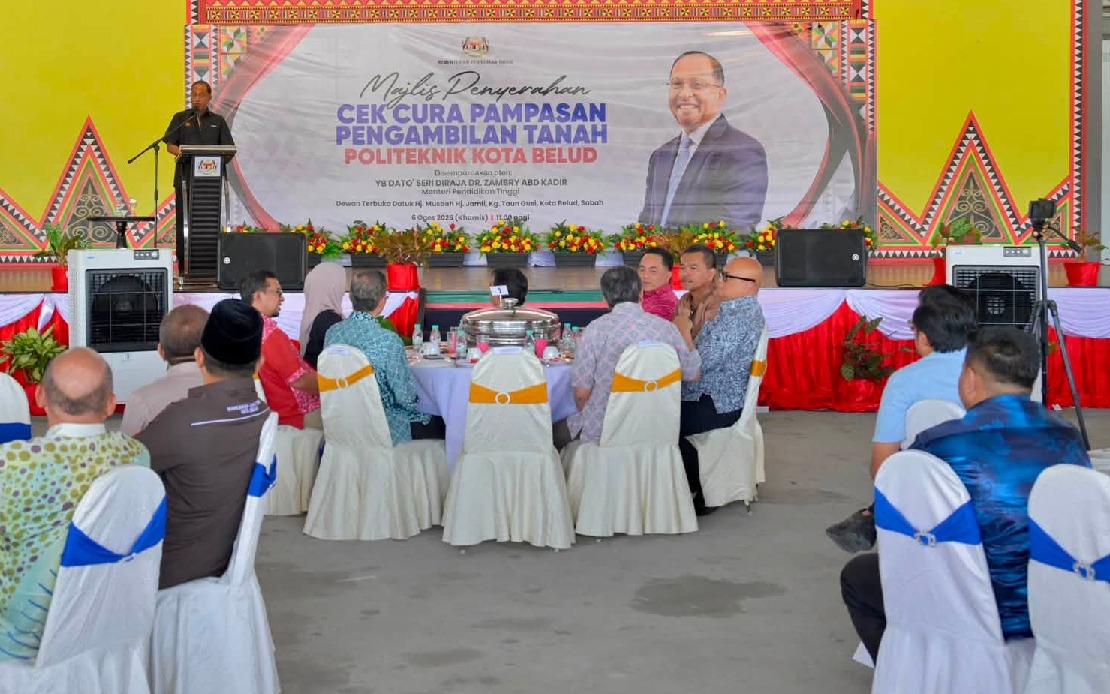
The RM250 million Politeknik Kota Belud has moved into active construction phases following the formal compensation of landowners, marking a significant milestone for higher education development in Sabah. Higher Education Minister Datuk Seri Zambry Abd Kadir presided over the mock cheque presentation ceremony in Kota Belud on August 6, signalling the official commencement of work on the facility. The polytechnic is anticipated to accept its first cohort of students sometime around 2030, representing a multi-year investment in technical workforce development for East Malaysia.
The completion of land acquisition represents the conclusion of preliminary groundwork that began in 2017 when the project was initially proposed by then Kota Belud Member of Parliament Datuk Seri Abdul Rahman Dahlan. The journey from concept to implementation phase underscores the lengthy planning cycles often required for major infrastructure projects in Malaysia, particularly those involving multiple landowners and compensation negotiations. Zambry explained that with land acquisition finalised, the initiative would progress into detailed design and planning stages, with the expectation that comprehensive development would commence under the Third Rolling Plan (RP3) in the forthcoming year as part of the broader 13th Malaysia Plan framework.
The polytechnic's curriculum design reflects contemporary economic imperatives facing Sabah and the broader Southeast Asian region. Rather than defaulting to traditional vocational training approaches, the institution will prioritise programmes addressing critical skill gaps in sectors that are reshaping employment landscapes. Green energy technologies represent a strategic focus aligned with global decarbonisation commitments and Malaysia's own renewable energy targets. Artificial intelligence and computer science offerings address the digital transformation challenges confronting both public and private sectors across the nation.
Agriculture-focused programmes incorporating smart technology represent another distinctive element of the polytechnic's planned offerings. Sabah's substantial agricultural heritage and forestry sectors stand to benefit from graduates equipped with digital tools for crop management, precision farming, and supply chain optimisation. By embedding technological competencies into agricultural training, the polytechnic positions itself as a bridge between traditional rural industries and modern agritech innovation, a particularly relevant development for a state where agricultural employment remains significant.
Enrolment projections demonstrate an intentional phasing approach to institutional growth. The initial intake is expected to accommodate approximately 500 students, reflecting a measured launch strategy that allows for refinement of operations and faculty development before scaling. Zambry outlined plans for eventual expansion to between 1,000 and 1,500 students, suggesting a medium-term vision of becoming a substantial regional technical education hub. This graduated growth model permits the institution to establish quality benchmarks and operational systems without the strain of immediate full-scale operations.
For Malaysia's polytechnic sector, this Sabah expansion addresses documented regional disparities in technical education infrastructure. East Malaysia has historically experienced lower per capita access to polytechnic facilities compared to peninsular states, creating barriers for rural and semi-urban students seeking affordable technical qualifications. The Kota Belud institution directly addresses this equity gap, potentially reducing internal migration pressures by enabling local skill acquisition and workforce development.
The facility's location in Kota Belud carries strategic implications beyond immediate enrolment figures. The district's position within Sabah's geography positions graduates to serve industries across the state's northern and central regions. Clustering advanced technical training near population centres outside Kota Kinabalu and Kuching promotes more distributed economic development, potentially strengthening secondary urban economies and reducing over-concentration of higher education opportunities in state capitals.
From a broader Southeast Asian perspective, Malaysia's sustained investment in polytechnic expansion reflects regional competition for technical talent amid rapid industrialisation and technology adoption. Thailand, Indonesia, and Vietnam have similarly prioritised vocational education expansion. By embedding contemporary technologies into polytechnic curricula, Malaysia aims to maintain competitive advantage in attracting investment-grade workforce capabilities and positioning graduates for integration into regional value chains.
The RM250 million investment figure warrants contextualisation within Malaysia's education spending patterns. While substantial, the per-student infrastructure cost demonstrates governmental commitment to quality facilities that support hands-on technical learning requiring laboratories, specialised equipment, and modern teaching infrastructure. This investment density reflects acknowledgment that quality polytechnic education requires appropriate physical assets and technological resources.
Implementation timelines extending to 2030 represent realistic assessment of construction complexities, regulatory approvals, and curriculum development cycles. However, they also highlight the extended timeframes characterising major public infrastructure projects in Malaysia. Stakeholders in Sabah will monitor progress during the Third Rolling Plan period to assess whether implementation maintains schedule integrity or encounters delays common to Malaysian development initiatives.
For students and families in Sabah considering technical education pathways, the Kota Belud polytechnic will eventually provide locally accessible opportunities previously requiring relocation or substantial investment in out-of-state education. This democratisation of access to modern technical training carries profound implications for social mobility and regional economic diversification across East Malaysia.

