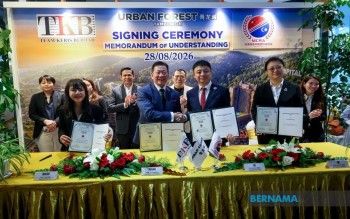
Team Keris Bhd's ambitious urban forest project in Tambun, Ipoh, represents a significant pivot in how Perak positions itself within Southeast Asia's competitive tourism marketplace. The RM1 billion development, scheduled for completion within three years, signals the state's determination to move beyond its current domestic-focused tourism model and establish itself as a credible international destination. This transformation reflects broader regional trends where established tourist hotspots like Kuala Lumpur and Penang have become saturated, making secondary cities increasingly attractive to global travellers seeking authentic experiences away from mainstream circuits.
The 84-acre project has been deliberately structured as an integrated ecosystem rather than isolated commercial development, a strategic approach that acknowledges how modern tourism operates. Team Keris Bhd has partnered with RJJ Hotels Sdn Bhd and the Malaysian Chinese Restaurant Association (MCRA) to weave together hospitality, food and beverage, retail, and commercial functions into a cohesive offering. This interconnected design ensures that international visitors arriving in Ipoh will find comprehensive facilities and experiences without the logistical friction that currently discourages longer stays. The complementary nature of the development matters considerably—without world-class accommodation, restaurants would struggle to attract international diners; without compelling dining and retail options, hotels would be unable to justify premium pricing.
Perak's tourism committee chairman Loh Sze Yee articulated an explicit vision of upscaling the state's international profile. His emphasis on adaptation to international standards addresses a persistent challenge facing Malaysian regional destinations: the gap between domestic expectations and global tourism norms. By intentionally designing the urban forest to international specifications from the outset, planners avoid the costly retrofitting that often plagues regional developments. The strategic advantage of situating this project adjacent to existing attractions like Lost World of Tambun cannot be overstated—it leverages existing visitor flows while expanding reasons for extended stays rather than brief pit stops.
The food and beverage strategy demonstrates sophisticated thinking about cultural representation and market positioning. The deliberate allocation of 40 percent of F&B operators to MCRA-affiliated restaurants and 60 percent to other Malaysian operators creates a curated narrative about Malaysia's culinary diversity. This represents a marked departure from the homogenisation that often characterises international tourism destinations, where global chain restaurants inevitably dominate. By maintaining this balance, Perak positions itself as authentically Malaysian while maintaining professional service standards that international visitors expect. The inclusion of Muslim-friendly offerings, including halal dim sum innovations developed by MCRA, signals sophisticated inclusivity that appeals to growing Muslim tourist demographics from Southeast Asia, the Middle East, and beyond.
The halal dimension carries particular strategic weight for Perak's regional competitiveness. Malaysia's established halal certification framework provides a tangible advantage unavailable to many regional competitors. As Gao Houyun, MCRA president, noted, this certification opens pathways for Perak-developed food brands to scale across Southeast Asian markets. This represents a potential economic multiplier effect extending well beyond the immediate urban forest development—successful restaurant concepts and ingredient suppliers could generate significant export revenue and employment across the broader state economy. The vision of sauces, spices, and specialty food manufacturers establishing operations in Perak reframes the development as an economic catalyst with supply-chain implications.
RJJ Hotels' integration through Jin Jiang Hotels provides the critical global distribution infrastructure necessary for transforming ambitions into reality. Jin Jiang's network spanning over 50 countries and 40 hotel brands fundamentally changes Ipoh's accessibility to international markets. Rather than relying on individual hotel marketing efforts, the urban forest gains access to sophisticated travel agent networks, package deal systems, and established customer relationships. Yap Lip Seng's emphasis on eliminating logistical barriers—the "I fly to KL, how do I get to Ipoh?" problem—highlights how many secondary Asian destinations fail despite quality offerings, simply because they require additional planning friction. By packaging complete experiences including flights, accommodation, dining, and activities into seamless packages, RJJ effectively removes decision-making barriers for potential visitors.
The extended stay concept shifts Ipoh's economic model fundamentally. Domestic tourism typically generates shorter, lower-value visits concentrated around specific attractions. International visitors booking through global platforms, conversely, tend to allocate multi-night stays and higher per-diem spending across accommodation, multiple dining experiences, and retail purchases. The urban forest's integrated design specifically encourages such spending patterns—visitors unable to access diverse experiences across multiple venues have limited reasons to remain. By concentrating high-quality options within a walkable development, the project maximises visitor spending concentration while enhancing the overall experience quality.
Workforce development emerges as a critical but underappreciated dimension of this initiative. Gao Houyun's mention of training and skills development for local operators and workers addresses a genuine constraint limiting Perak's tourism competitiveness. International-standard hospitality and F&B operations require specific competencies—from housekeeping standards to menu engineering to customer service protocols—that regional workforces often lack. By embedding training systems into the development's operational structure, the project creates human capital improvements extending beyond the immediate urban forest. Workers trained to international standards become mobile assets, elevating service quality across Perak's broader hospitality sector.
The development's timing reflects broader Southeast Asian tourism dynamics. Post-pandemic recovery has reshaped travel patterns, with increasingly sophisticated travellers seeking authentic regional experiences rather than resort enclave experiences. Perak's cultural heritage, natural attractions, and culinary traditions represent genuine differentiation from more developed tourism destinations. The urban forest essentially provides the infrastructure that allows travellers to access Perak's authentic offerings without accepting sub-standard service. This positioning—authenticity plus professionalism—represents precisely the market gap that secondary Asian destinations should occupy.
Competitive implications for neighbouring states warrant consideration. Penang and Selangor have become increasingly commodified and crowded, with tourism infrastructure straining under visitor volumes. Ipoh's development arrives at a moment when discerning travellers actively seek alternatives to overcrowded established destinations. By offering comparable amenities to major centres within a smaller, more manageable setting, the urban forest potentially captures market share from regional competitors. The Malaysian Chinese Restaurant Association's involvement proves particularly strategic, as Chinese cuisine represents a globally resonant culinary identity that transcends regional boundaries.
The project's success ultimately depends on flawless execution across multiple interconnected domains. Architectural quality, operational standards, marketing sophistication, and staff professionalism must all align perfectly. Any significant failure in any dimension—poor hotel service, mediocre dining, inadequate transport coordination—would undermine the entire integrated positioning. This represents both higher risk and higher potential reward compared to isolated developments. The three-year timeline is aggressive but achievable, particularly given the experienced developer roster involved. The memoranda of agreement and understanding represent binding commitments that transform abstract vision into contractual obligation.
For Malaysian economic planners, the urban forest model offers replicable lessons about positioning secondary cities within global tourism markets. Rather than attempting to compete directly with established megacities, strategic development around authentic cultural assets and integrated experiences can create sustainable competitive advantages. Perak's initiative suggests that the future of regional tourism lies not in larger casino resorts or theme parks, but in sophisticated curation of place-specific offerings delivered to international standards. If successful, the Ipoh urban forest will demonstrate that Malaysian regional destinations can access premium global tourism markets without compromising authenticity or local economic benefit.

